Category:
EducationPrimary Dzongkha Teacher Crisis: 69 Graduates, 10 Vacancies
A Growing Employment Crisis in Bhutan's Education Sector 📚
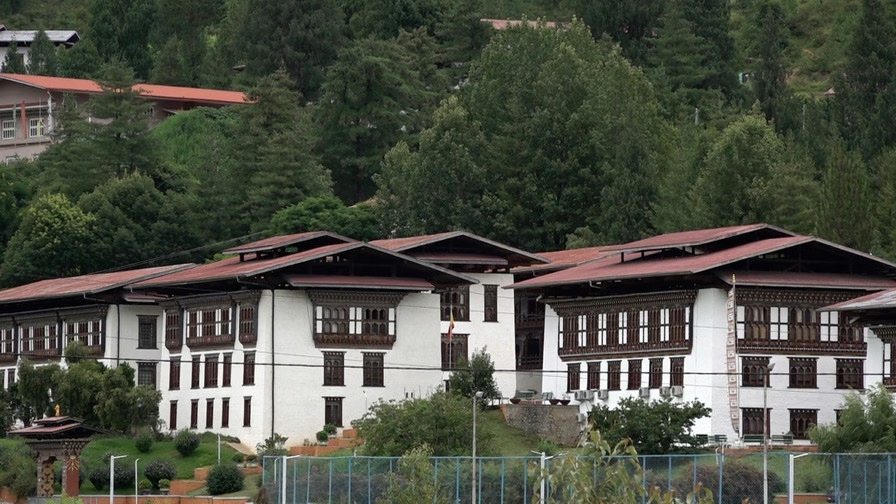
Bhutan's education system is facing an unprecedented mismatch between teacher training output and employment opportunities. This year, the Royal Civil Service Commission announced just 10 vacancies for primary Dzongkha teachers—a shocking decline that has left 69 recent graduates from Paro College of Education grappling with uncertain employment prospects. This dramatic shift represents the lowest recruitment number in five years and signals deeper systemic issues within the country's teacher workforce planning.
The stark reality is difficult to ignore: approximately 100 candidates will compete for merely 10 positions when accounting for graduates from previous years also entering the recruitment pool. This scenario has sparked serious concerns among education stakeholders about the viability of current teacher training programs and the government's capacity to forecast workforce demands accurately.
Understanding the Vacancy Collapse 📉
Historical Trends and Recent Volatility
The primary Dzongkha teacher recruitment landscape has experienced dramatic fluctuations over the past five years. In 2021, the education system announced 50 vacancies—a number that seemed sustainable for the program's annual intake of approximately 70 students. The following year saw a modest reduction to 45 positions, suggesting a gradual adjustment in teacher requirements.
However, 2023 brought unexpected expansion with 120 vacancies announced, indicating a sudden surge in demand for Dzongkha language educators. This spike created optimism among students and administrators alike. Yet this optimism proved premature. The numbers plummeted to 30 vacancies in 2024, followed by 35 positions last year, and now have collapsed to just 10 this year.
This erratic pattern reveals a fundamental problem: primary Dzongkha teacher recruitment lacks predictable planning mechanisms. The volatility suggests that vacancy announcements are reactive rather than proactive, responding to immediate staffing needs rather than strategic workforce development.
The Intake-Vacancy Mismatch
Paro College of Education has maintained a consistent annual intake of approximately 70 students into its B.Ed Primary Dzongkha programme for seven consecutive years. This stability was based on historical employment trends and projected teacher requirements communicated through various government channels. The college's leadership believed they were training students for a predictable job market.
The dramatic reduction in vacancies has exposed a critical flaw in this assumption. When the college was admitting 70 students annually during periods when 30-50 vacancies were typical, the mathematics seemed reasonable. Now, with only 10 positions available, the program appears to be producing seven times more graduates than the system can absorb.
The Graduates' Perspective: Uncertainty and Anxiety 😟
Voices from the Classroom
Speaking anonymously, current graduates have expressed profound frustration about their employment prospects. One recent graduate highlighted the mathematical reality: "There are around 70 graduates this year. But some graduates from last year will also compete with us, which increases the number to around 100 graduates taking the exam this year."
This consolidation of competition has created a high-stakes environment where even strong performers face uncertain outcomes. The graduates invested four years of intensive study, practical teaching experience, and personal development, only to discover that the job market cannot accommodate most of them.
The Employment Crisis Implications
The most sobering assessment came from graduates analyzing worst-case scenarios: "There is a high risk of not getting a job. No matter how many different jobs we may take up, 30 to 40 per cent could still be left without employment." This projection suggests that even if graduates pursue alternative career paths, a substantial portion may remain unemployed.
This employment crisis raises profound questions about educational equity and opportunity in Bhutan. Students from disadvantaged backgrounds who viewed teaching as a pathway to stable, respectable employment now face unexpected barriers. The psychological toll of completing a rigorous four-year program only to discover limited job prospects cannot be understated.
Institutional Responses and Systemic Failures 🏛️
The Ministry's Surprising Position
When the Royal University of Bhutan and Paro College of Education inquired about the dramatic reduction in vacancies, the education ministry provided a startling response: there is currently no requirement for additional Dzongkha teachers. This statement contradicts the college's historical understanding of teacher demand projections and raises questions about communication breakdowns between educational institutions and government planning bodies.
During a recent Meet-the-Press session, the education minister acknowledged that some districts have surplus Dzongkha teachers while others may face shortages. This geographic imbalance suggests that the national vacancy figure of 10 may not reflect the complete picture of teacher needs across Bhutan's diverse districts.
Planning and Forecasting Challenges
The Royal University of Bhutan has repeatedly requested that the Ministry of Education provide multi-year projections of teacher requirements. These requests have gone largely unaddressed, primarily due to difficulties in accounting for teacher attrition rates. When experienced educators leave the profession—whether through retirement, career changes, or relocation—the system struggles to predict replacement needs accurately.
This forecasting challenge is not unique to Bhutan. Many developing nations face similar difficulties in workforce planning for education sectors. However, the consequences are particularly acute in Bhutan's smaller, more interconnected system where miscalculations directly impact hundreds of individual lives.
Broader Context: Global Teacher Workforce Trends 🌍
The International Perspective
While Bhutan grapples with teacher recruitment challenges, many countries worldwide face opposite problems—severe teacher shortages. In developed nations, declining birth rates and changing career preferences have created critical gaps in educator supply. Bhutan's current situation, while locally severe, reflects a different dynamic: oversupply relative to immediate demand.
This distinction matters because it suggests different solutions. Rather than emergency recruitment campaigns, Bhutan may need to carefully calibrate teacher training program intake levels to match realistic employment opportunities. Simultaneously, the country must address underlying questions about whether current teacher distribution adequately serves all regions and student populations.
Quality vs. Quantity Considerations
The reduced vacancies also raise questions about educational quality standards. If fewer teachers are being recruited, will this allow for more selective hiring processes that prioritize excellence? Or will budget constraints and staffing limitations actually compromise teaching quality in schools that already face resource challenges?
Potential Solutions and Future Directions 🔄
Immediate Considerations
The college has committed to holding internal discussions about intake adjustments for the coming year and will consult with the Ministry of Education on appropriate program sizing. However, this forward-looking approach does not address the immediate crisis facing current graduates.
Several options warrant consideration:
- Temporary employment schemes: Creating short-term teaching positions or substitute teacher programs could provide immediate income for graduates while longer-term solutions develop
- Alternative credential recognition: Exploring whether Dzongkha teacher qualifications could facilitate employment in related fields such as curriculum development, educational administration, or language assessment
- Geographic flexibility: Encouraging graduates to consider teaching positions in underserved districts, potentially with incentive packages
- Further education support: Providing pathways for graduates to pursue advanced degrees or specialized certifications that might expand their career options
Structural Reforms Needed
For the education system to function effectively, several structural improvements are essential. The Ministry of Education and the Royal University of Bhutan must establish formal mechanisms for regular communication about workforce projections. This should include:
- Annual forecasting meetings between ministry planners and university administrators
- Transparent publication of teacher requirement projections
- Regular analysis of teacher attrition patterns to improve prediction accuracy
- Coordination between central planning and district-level needs assessments
The Larger Question: Who Bears the Cost? ⚖️
Perhaps the most troubling aspect of this situation is the fundamental inequity it represents. Students who enrolled in the B.Ed Primary Dzongkha programme made educational and life decisions based on reasonable expectations about employment prospects. They completed rigorous coursework, practical teaching components, and professional development activities.
Now, through no fault of their own, they face an employment market that cannot absorb them. The question of whether students should bear the consequences of unanticipated changes in job market conditions is not merely academic—it speaks to the government's responsibility to provide transparent information and reasonable employment pathways for citizens who invest in state-supported education programs.
Looking Ahead: Toward Sustainable Solutions 🌱
The current crisis presents an opportunity for Bhutan's education system to strengthen its planning and forecasting mechanisms. While reducing the B.Ed Primary Dzongkha intake may be necessary, this adjustment must be accompanied by genuine support for current graduates and transparent communication about future program sizing.
Education remains central to Bhutan's development aspirations, and teachers are essential to achieving these goals. However, the system can only function effectively when teacher training production aligns with actual employment opportunities. The 69 graduates facing just 10 vacancies deserve better than a system that failed to anticipate this mismatch.
As Bhutan continues its development journey, investing in robust workforce planning for the education sector should be a priority. The human cost of getting this wrong—in terms of individual career disappointment, wasted educational resources, and potential talent loss—is too significant to ignore.
You May Also Like
Education
EtonHouse Bhutan International School Opens Doors
August 31, 2026
Education
Makeathon Puts Persons with Disabilities at Design Centre
August 28, 2026
Education
Mobile ECCD Centre Transforms Early Childhood Care in Trashigang
August 26, 2026

Education
Bhutanese Student Launches Space Career with Lunar Mission
August 23, 2026