Category:
EducationMakeathon Puts Persons with Disabilities at Design Centre
Revolutionizing Assistive Technology Through User-Centered Design 🎯
Imagine designing a solution without ever speaking to the person who needs it. For decades, this has been the reality in assistive technology development—experts create devices in laboratories, then hope they work for end-users. Bhutan is changing this narrative entirely through an innovative approach that places persons with disabilities directly at the heart of the innovation process.
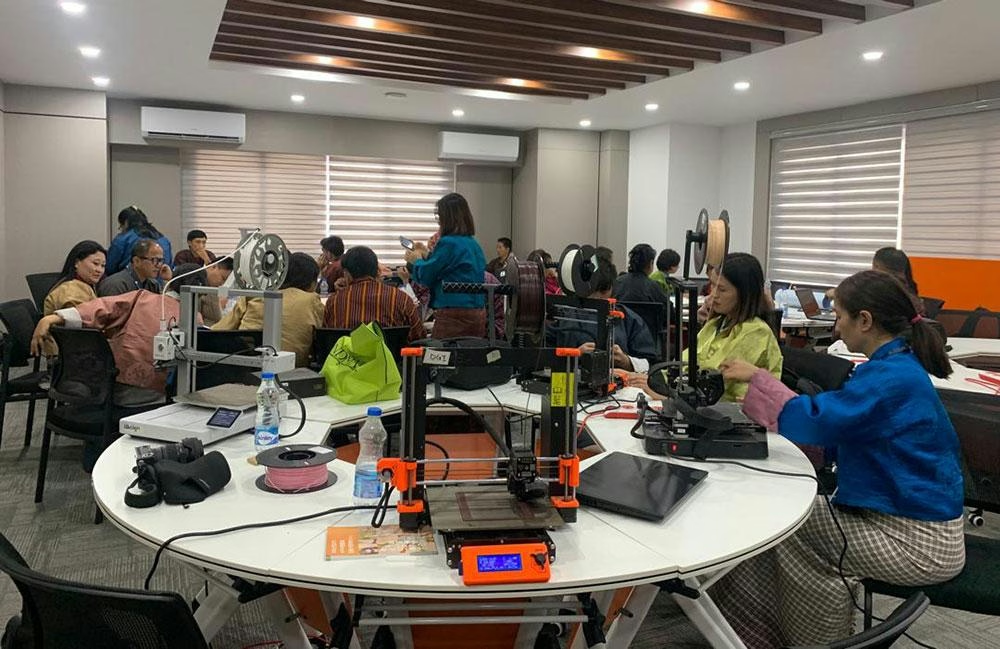
A groundbreaking Inclusive Makeathon recently brought together over 70 participants from across South Asia and beyond to challenge conventional design thinking. This wasn't just another technology conference; it represented a fundamental shift in how we approach assistive technology design and accessibility innovation.
What Makes This Makeathon Different? ✨
The four-day intensive event gathered an unprecedented mix of stakeholders: individuals living with disabilities, educators, caregivers, fabricators, and digital innovation experts from Bhutan, Japan, Bangladesh, India, Nepal, and Sri Lanka. This diversity wasn't accidental—it was strategic.
The core philosophy centers on what experts call "need knowers." These are individuals who experience challenges firsthand and possess irreplaceable insight into real-world problems. Rather than asking designers to imagine solutions, the Makeathon creates direct collaboration between those facing daily obstacles and the makers equipped to build solutions.
The traditional model looks like this:
- Technologists design a device
- Engineers refine the prototype
- Users are consulted for feedback
- Products are modified (if budget allows)
The Makeathon model reverses this entirely:
- Need knowers identify real challenges
- Makers and designers listen and learn
- Collaborative prototyping begins immediately
- Solutions are tested with actual users throughout development
Breaking Records in Assistive Device Creation 🏆
The impact speaks volumes. During the previous year's Makeathon, participants developed more than 450 customized assistive devices. These weren't theoretical prototypes gathering dust on shelves—they were practical solutions that teachers requested, fabricators built, and schools distributed to students who needed them.
This productivity demonstrates something crucial: when you remove the barriers between problem-solvers and problem-experiencers, innovation accelerates dramatically. Special education teachers articulated specific needs, the Jigme Namgyel Wangchuck Super FabLab provided cutting-edge fabrication capabilities, and functional devices reached classrooms within weeks.
The Super FabLab Advantage 🔧
Bhutan's Super FabLab represents one of only four facilities of its kind globally—a distinction that carries enormous responsibility and opportunity. This state-of-the-art digital fabrication center serves as the backbone of the Makeathon, enabling rapid prototyping and customization that would be impossible with traditional manufacturing.
The facility combines advanced technologies including 3D printers, laser cutters, CNC machines, and computer-aided design software. What makes it truly revolutionary is its accessibility philosophy: the Super FabLab isn't reserved for elite researchers or wealthy corporations. It's designed as a community resource where teachers, social workers, and innovators can transform ideas into tangible solutions.
Ministry of Education officials recognize that this facility's potential extends far beyond assistive devices. The same technologies and expertise could produce affordable learning materials for science education, low-cost training models for medical students, and innovative resources for mainstream classrooms. Optimizing this investment ensures Bhutan maximizes returns while advancing educational equity.
International Collaboration Strengthens Innovation 🌏
Digital fabrication experts from Japan, particularly from FabLab Shinagawa, brought specialized knowledge and international best practices to the event. This technical exchange created a unique opportunity for Bhutanese makers to learn from global leaders while sharing their own contextual expertise.
The timing held symbolic significance as well. The Makeathon coincided with celebrations marking 40 years of diplomatic relations between Bhutan and Japan—a partnership that increasingly focuses on technology transfer, sustainable development, and social innovation. This collaboration demonstrates how bilateral relationships can manifest in practical improvements to people's daily lives.
Funding support from the Asian Development Bank (ADB), channeled through the Japan Fund for Prosperous and Resilient Asia and the Pacific (JFPR), provided essential resources. International development organizations increasingly recognize that sustainable solutions emerge when local communities lead innovation rather than receiving externally-designed interventions.
Addressing Real Educational and Mobility Challenges 📚
The Makeathon specifically targets assistive devices addressing everyday obstacles faced by children and young people with disabilities, particularly in educational settings and mobility. These aren't luxury enhancements—they're fundamental tools enabling access to learning and independence.
Consider the scope of need: students with visual impairments require specialized learning materials; children with mobility challenges need classroom modifications; young people with hearing impairments benefit from communication aids. Each situation demands customized solutions reflecting individual circumstances, preferences, and environments.
By bringing educators into the design process, the Makeathon ensures devices integrate seamlessly into actual school environments. Teachers understand classroom logistics, student behaviors, and practical constraints that outside designers might overlook. This embedded knowledge transforms prototypes into genuinely usable solutions.
The Broader Impact on Inclusive Education 🌟
Bhutan's commitment to inclusive assistive technology development signals a broader educational philosophy: that accessibility isn't an afterthought or special accommodation, but rather a fundamental design principle. When institutions invest in tools enabling participation, they communicate that all students belong in mainstream educational spaces.
This approach aligns with international education standards and the Sustainable Development Goals, particularly SDG 4 (Quality Education) and SDG 10 (Reduced Inequalities). Countries that lead in inclusive education innovation often experience broader social benefits: increased employment rates for people with disabilities, improved social cohesion, and stronger economic participation.
Scaling Impact Through Continued Innovation 🚀
The Makeathon model builds on earlier assistive technology initiatives in Bhutan, representing an evolution in how the nation approaches accessibility challenges. Rather than sporadic interventions, this structured, recurring event creates momentum—relationships between makers and need knowers deepen, fabrication expertise accumulates, and solutions become increasingly sophisticated.
Future Makeathons will likely attract even broader participation as success stories spread. Students might join as makers, learning that innovation serves human needs. Parents and caregivers will contribute invaluable perspectives. International participants will bring fresh approaches while learning from Bhutanese context expertise.
Key Takeaways: Why This Matters 💡
User-centered design produces better solutions. When people experiencing challenges directly shape innovation, outcomes dramatically improve.
Technology serves humanity best when community-driven. The Super FabLab's greatest strength lies not in its machinery but in how communities access and direct that machinery.
Inclusive innovation strengthens entire societies. Assistive devices enable participation, which generates economic productivity, social contributions, and individual dignity.
International collaboration accelerates progress. Sharing expertise across borders multiplies impact while respecting local context and leadership.
Bhutan's Inclusive Makeathon represents more than a single event—it embodies a philosophical commitment that technology should center human need, that persons with disabilities possess invaluable expertise, and that accessibility strengthens education for everyone. As other nations observe these outcomes, the model offers a replicable blueprint for inclusive innovation that puts people first.
You May Also Like
Education
Dzongkha Pronunciation and Spelling Challenges in Bhutanese Education
October 10, 2026
Education
Bhutanese Students Reconsider Australia Plans Amid New Visa Rules
October 7, 2026
Education
Motithang Higher Secondary School Zayed Sustainability Prize Finalist
October 6, 2026
Education
Students with Special Educational Needs Showcase Talents
October 6, 2026