Category:
EducationBhutanese Student Launches Space Career with Lunar Mission
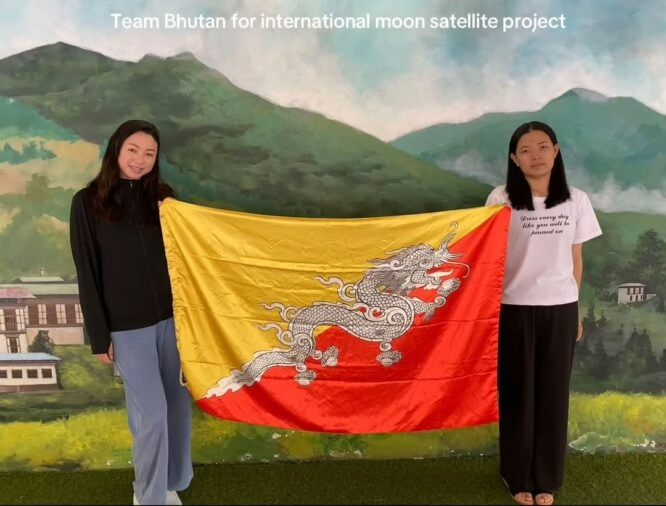
From Classroom to Cosmos: A Bhutanese Trailblazer's Space Journey 🚀
In an inspiring turn of events, a 17-year-old student from the remote Himalayan kingdom of Bhutan is about to experience something most teenagers only dream about—working on actual satellite technology for an international lunar mission. Chimi Cheki Yangzom, a Class 11 student at Yoechen Central School in Pema Gatshel, has been selected as the first Bhutanese participant for Mission ShakthiSAT, a groundbreaking space education initiative based in India.
This remarkable opportunity represents far more than a single student's achievement. It signals Bhutan's emerging role in the global space technology sector and demonstrates how young innovators from smaller nations are breaking through barriers to participate in cutting-edge scientific endeavors.
The Mission: ShakthiSAT's Vision for Female Space Leaders 🌟
Mission ShakthiSAT stands out as a distinctly female-centric space program designed to revolutionize how girls engage with science and technology. The initiative brings together 12,000 young women from 108 countries to collaborate on designing, building, and testing small satellites destined for lunar exploration.
The program's core objectives include:
- Empowering girls through hands-on satellite technology education
- Building practical engineering and coding capabilities
- Creating international networks among young female space enthusiasts
- Advancing lunar mission technology through collaborative innovation
- Promoting STEM careers in underrepresented regions
The lunar mission itself is scheduled for October of this year, with the two satellites playing crucial roles in supporting scientific research and data collection on the Moon's surface. This timing makes Chimi's participation particularly significant, as she will contribute to a live, operational space mission rather than a theoretical exercise.
Breaking Ground: Chimi's Path to Space Technology 💫
Chimi's journey to this extraordinary opportunity wasn't sudden or accidental. Her passion for technology developed gradually through consistent engagement with STEM activities at her school. She actively participated in coding clubs, where she honed her programming skills and demonstrated the kind of technical aptitude that catches the attention of space program recruiters.
Her commitment became even more evident when she represented her school's coding club at a regional coding competition in Trashigang, showcasing her abilities on a broader stage. These experiences built a foundation of technical knowledge and confidence that ultimately led to her selection for Mission ShakthiSAT.
"My interest in space technology has grown through various STEM activities," Chimi explained when discussing her background. Her trajectory illustrates an important principle in science education: consistent engagement with foundational STEM subjects creates pathways to advanced opportunities.
The Eight-Day Intensive: What Awaits in Delhi 🔬
Chimi's eight-day program in Delhi represents an immersive deep-dive into professional satellite operations. Accompanied by an official from Bhutan's GovTech Agency, she will engage with cutting-edge technology and work alongside international peers who share her passion for space science.
Her curriculum will encompass:
- Satellite design principles and architecture
- Payload development and instrumentation
- Programming and software systems
- Testing protocols and quality assurance
- Mission operations and control procedures
This hands-on approach differs dramatically from traditional classroom learning. Rather than reading about satellite technology in textbooks, Chimi will work with actual equipment, troubleshoot real technical challenges, and contribute meaningfully to a functioning space mission.
Why This Matters for Bhutan's Innovation Ecosystem 🏔️
Bhutan's economy has traditionally centered on hydropower, tourism, and agriculture. However, the nation has increasingly recognized the importance of developing a knowledge-based economy and fostering technological innovation. The government's establishment of the GovTech Agency reflects this strategic shift.
Chimi's participation in Mission ShakthiSAT represents a deliberate investment in human capital development. By supporting young Bhutanese students in advanced STEM fields, the nation is building expertise that could eventually support domestic space technology initiatives or contribute to regional scientific collaborations.
According to the GovTech Agency, this opportunity "marks an important step in empowering young Bhutanese innovators and reaffirms the nation's commitment to science, technology, and innovation." Such endorsement indicates official recognition that space technology education has strategic value for Bhutan's future development.
The Broader Context: Women in Space Technology 👩🚀
Chimi's selection also reflects a global movement to increase female participation in space science and engineering. Historically, these fields have been male-dominated, with women representing a small fraction of professionals in aerospace engineering, astrophysics, and satellite operations.
Mission ShakthiSAT specifically addresses this gender disparity by creating spaces where girls can develop expertise without the barriers that often discourage female participation in STEM. By bringing together 12,000 young women from diverse backgrounds and nations, the program normalizes female leadership in space technology and creates mentorship networks that can sustain long-term careers.
Chimi's experience will likely inspire other Bhutanese girls to pursue similar paths, gradually shifting cultural perceptions about who can succeed in technical fields.
Personal Aspirations and Global Connections 🌍
When reflecting on her upcoming experience, Chimi articulated clear learning objectives. "Through this programme, I'm expecting to gain hands-on experience and develop practical and technical engineering skills," she stated. Beyond technical competencies, she recognized the value of international exposure and cross-cultural collaboration.
"I hope to make many international friends and gain valuable exposure," she added, demonstrating awareness that professional networks are as important as technical skills. In today's interconnected world, the relationships built during international programs often prove as valuable as the immediate learning outcomes.
Chimi's perspective reflects a maturity and professionalism that extends beyond her years. She understands that space technology is fundamentally a collaborative enterprise, requiring teams of diverse individuals working toward shared objectives.
A Message for Bhutanese Youth: Possibility Over Limitation 💡
Chimi's advice to fellow students carries particular weight given her achievement. Drawing inspiration from Bhutan's royal leadership, she emphasized a philosophy of action over doubt: "As His Majesty the King said, it is not about whether we can do it or not; it is about whether we do it or not. If we don't back down and give our best to do what we love, nothing is impossible."
This message directly challenges a common limitation many students from smaller or less industrialized nations face—the assumption that certain opportunities are reserved for those from larger, more developed countries. Chimi's selection proves that geographical location and national resources need not constrain ambition or achievement.
Emerging Trends: Space Technology Access in Developing Nations 🛰️
Chimi's participation reflects a broader democratization of space technology education. Historically, space programs were accessible primarily to students in wealthy nations with established aerospace industries. However, initiatives like Mission ShakthiSAT are changing this landscape by making space education globally available.
This shift has several drivers: declining costs for satellite technology, increased international collaboration in space research, and growing recognition that innovation thrives when talent pools are diverse and geographically distributed. Bhutan benefits from these trends, gaining access to world-class space education without requiring massive domestic investment in aerospace infrastructure.
Looking Forward: Potential Career Pathways 🔭
Chimi's eight-day immersion could represent the beginning of a long-term career in space technology. Participants in programs like Mission ShakthiSAT often go on to pursue advanced degrees in aerospace engineering, satellite communications, or related fields. Some eventually work for space agencies, private aerospace companies, or research institutions.
For Bhutan specifically, Chimi's experience could catalyze the development of domestic space technology capabilities. As she gains expertise and potentially mentors other Bhutanese students, she could contribute to building a critical mass of space-technology professionals within the nation.
The Ripple Effect: Inspiring a Generation 🌊
Perhaps the most significant impact of Chimi's opportunity extends beyond her individual achievement. Her selection demonstrates to thousands of Bhutanese students—particularly girls—that participation in cutting-edge global initiatives is possible regardless of where you live or which school you attend.
When a student from Pema Gatshel can contribute to a lunar mission, the message becomes clear: your dreams need not be limited by your location. This psychological shift can have profound effects on educational aspirations across the entire nation.
Chimi is carrying more than Bhutan's representation to Delhi. She carries a message that transcends borders: determination, consistent effort in STEM education, and belief in one's capabilities can open doors to extraordinary opportunities. Her journey from a school coding club to an international space mission represents a template for how young innovators anywhere can reach for the stars—quite literally.
You May Also Like

Education
Bhutanese Students Reconsider Australia Plans Amid New Visa Rules
October 7, 2026
Education
Motithang Higher Secondary School Zayed Sustainability Prize Finalist
October 6, 2026
Education
Students with Special Educational Needs Showcase Talents
October 6, 2026
Education
Local Produce Connects Gongthung Farms and School
September 21, 2026