Category:
EducationBhutanese Students Reconsider Australia Plans Amid New Visa Rules
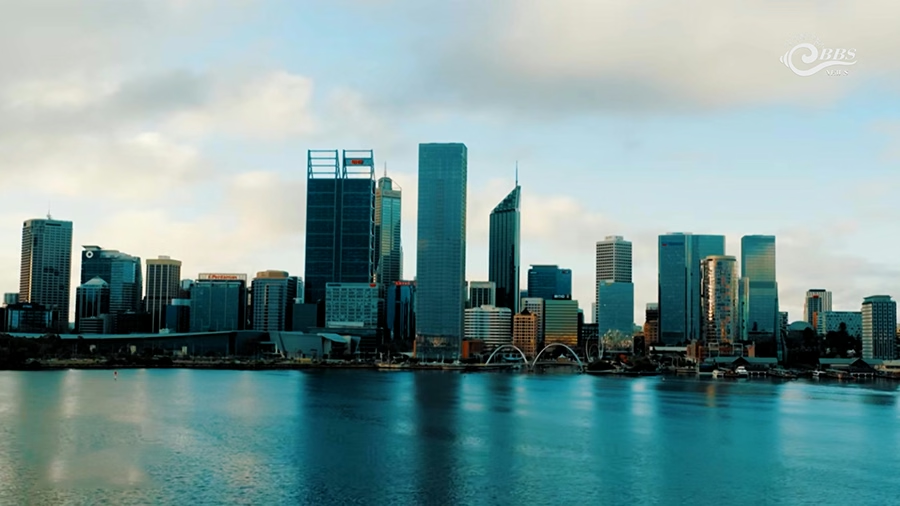
The Shifting Landscape of International Education 🎓
For decades, Australia has represented a golden opportunity for Bhutanese students seeking world-class education and career advancement. However, recent policy changes have fundamentally altered this calculation, prompting thousands of aspiring scholars to reassess their international education strategies. The new Australian visa regulations have created an unexpected crossroads for Bhutanese families, forcing difficult decisions about study destinations and life priorities.
The transformation began when Australia announced stricter immigration guidelines that fundamentally reshape the experience of international students. These policy adjustments represent one of the most significant shifts in Australia's approach to student migration in recent years, with far-reaching implications for educational institutions, consultancies, and aspiring scholars across South Asia.
Understanding the New Australian Student Visa Requirements 📋
The revised regulations introduce substantial restrictions on family accompaniment for international students. Under the updated framework, most international students can no longer bring spouses, partners, or dependent children to Australia during their studies. This represents a dramatic departure from previous policies that allowed greater family flexibility.
However, certain categories retain exemptions from these restrictions:
- PhD candidates pursuing doctoral research
- Government scholarship recipients with official sponsorship
- Students from Pacific and ASEAN nations benefiting from regional agreements
These exemptions acknowledge the unique circumstances of advanced researchers and students from neighboring regions, yet they leave the majority of undergraduate and master's level students facing unprecedented constraints.
The regulations also impact students already residing in Australia. Most temporary visa holders can no longer transition directly to student visas while remaining onshore. Instead, they must depart the country and reapply from abroad—a requirement that disrupts studies, increases costs, and creates significant logistical challenges.
The Emotional and Practical Toll on Bhutanese Families 💔
For many Bhutanese students and their families, the inability to maintain family unity during studies represents more than administrative inconvenience—it strikes at fundamental emotional and practical concerns. The separation anxiety experienced by students contemplating years apart from loved ones has become a primary factor in reconsidering Australia as an educational destination.
One prospective student, speaking anonymously, articulated the profound internal conflict these policies create: "Being away from my partner or children for an extended period creates genuine emotional hardship, particularly when navigating the stress of adapting to a foreign education system. The presence of family provides both emotional reassurance and practical daily support that proves invaluable during challenging academic periods. These new restrictions fundamentally change the calculation of whether Australia remains the right choice."
This sentiment reflects a broader reality in Bhutanese educational planning. For many families, the decision to pursue international education involves significant financial sacrifice and emotional investment. When policies prevent family accompaniment, the psychological burden of isolation often outweighs the educational benefits.
Declining Visa Approval Rates Signal Broader Concerns 📉
The statistical impact of these policy changes has been striking and immediate. Visa approval rates for Bhutanese applicants have plummeted from approximately 90 percent to roughly 30 percent—a dramatic reversal that reflects both stricter processing standards and applicant self-selection as students withdraw applications.
This decline mirrors patterns observed across other nations implementing similar restrictions. The coordinated tightening of international student policies suggests a broader global trend toward more restrictive immigration frameworks, even as educational institutions worldwide depend on international enrollment revenue.
Education consultancy professionals report witnessing unprecedented cancellations and deferrals. According to Tshering Dhendup, Chief Executive Officer at SMART Education Consultancy, the impact has been immediate and substantial: "A significant cohort of students who had firmly committed to Australian universities have fundamentally reconsidered. Some have requested refunds for fees already submitted to institutions, while others have abandoned plans despite receiving formal offer letters. The psychological shift has been dramatic."
The Search for Alternative Study Destinations 🌍
As Australian pathways become less attractive, Bhutanese students increasingly explore alternative international education markets. The geographic and policy diversity of competing destinations offers different advantages and trade-offs.
Primary alternatives gaining traction include:
- New Zealand - Offering similar academic quality with potentially more favorable family policies
- Canada - Known for welcoming international students and more flexible family arrangements
- European countries - Providing diverse educational models with varying visa requirements
These destinations appeal precisely because they either maintain more permissive family accompaniment policies or offer other compensating advantages such as lower tuition costs, post-graduation work opportunities, or pathways to permanent residency.
The shift represents a significant reallocation of educational migration flows. What Australia loses in Bhutanese enrollment, competing nations gain—a redistribution that reflects rational student decision-making in response to policy changes.
Australia's Historical Significance for Bhutanese Education 🇦🇺
Understanding the current disruption requires recognizing Australia's historical importance as an educational destination for Bhutanese citizens. Over the past two years alone, more than 8,000 Bhutanese individuals migrated to Australia, with a substantial portion pursuing educational objectives.
The broader Bhutanese diaspora in Australia has grown substantially. According to the Australian Bureau of Statistics, more than 40,000 Bhutanese residents were living in Australia as of June of the previous year. This established community has traditionally facilitated educational migration by providing cultural networks, practical guidance, and social support for arriving students.
The concentration of Bhutanese in Australian cities has created informal educational ecosystems where new students benefit from mentorship and community connection. However, restrictive visa policies threaten to disrupt these networks by preventing family reunification and limiting new arrivals.
Current Student Perspectives on Uncertainty ⚠️
Students already committed to Australian institutions face their own anxieties about policy implications. Sonam Dema Wangchuk, currently pursuing studies at Edith Cowan University, articulated the concerns of on-site students: "These new visa restrictions create genuine uncertainty about my educational trajectory and post-graduation opportunities. The financial burden of international education is already substantial, and these policy changes raise legitimate questions about whether the investment will yield expected career returns and whether I'll be permitted to remain in Australia following graduation."
This concern reflects a practical reality—many international students view Australian education as a stepping stone toward employment and potential permanent residency. Restrictive visa policies create doubts about the viability of this pathway, potentially deterring enrollment even among students who might otherwise proceed.
Financial Implications and Cost-Benefit Analysis 💰
The economic dimensions of these policy changes deserve serious consideration. International education represents a substantial financial commitment for Bhutanese families, often requiring years of savings and significant financial sacrifice.
When combined with family separation costs—including communication expenses, occasional travel for family visits, and the psychological toll of prolonged separation—the total cost of Australian education rises considerably. For many families, alternative destinations offering lower tuition combined with family accompaniment privileges present more attractive financial propositions.
Education consultancies report increased inquiries about total cost of ownership for various international education destinations. Students and families now conduct more rigorous comparative analysis, evaluating not just tuition costs but also living expenses, family separation implications, and post-graduation employment prospects.
Guidance for Prospective International Students 🎯
Education consultancies emphasize the importance of thorough due diligence before committing to international study. The current environment requires careful consideration of multiple factors:
Essential evaluation criteria:
- Comprehensive policy review - Understanding all visa restrictions before application
- Family impact assessment - Honestly evaluating separation implications
- Financial sustainability - Ensuring adequate resources for entire program duration
- Post-graduation planning - Understanding work visa and residency pathways
- Alternative destination comparison - Evaluating other international options systematically
Tshering Dhendup advises students to "approach international education decisions with comprehensive research and realistic expectations. Policy environments change, and what seemed like a straightforward pathway may involve unexpected complications. Thorough preparation and professional guidance become increasingly valuable."
Looking Forward: The Evolution of International Education Markets 🚀
These policy shifts signal broader transformations in global international education markets. As traditional destinations implement more restrictive policies, competing nations are strategically positioning themselves as more welcoming alternatives.
For Bhutanese education stakeholders—students, families, consultancies, and institutions—the current moment represents both disruption and opportunity. While Australia's policy changes create immediate challenges, they also encourage broader evaluation of international education options and potentially lead to more diversified student distribution across multiple countries.
The long-term implications remain uncertain. Whether Australia's policies prove temporary adjustments or represent permanent strategic shifts will significantly influence educational migration patterns for years to come. In the interim, Bhutanese students must navigate this complex landscape with careful deliberation, professional guidance, and realistic expectations about the trade-offs inherent in international education choices.
The transformation of Australia's appeal as an educational destination reflects broader global trends toward more selective immigration policies. As this landscape continues evolving, the importance of informed decision-making and comprehensive planning becomes increasingly critical for students considering international educational pathways.
You May Also Like
Education
Motithang Higher Secondary School Zayed Sustainability Prize Finalist
October 6, 2026

Education
Students with Special Educational Needs Showcase Talents
October 6, 2026

Education
Local Produce Connects Gongthung Farms and School
September 21, 2026
Education
Two Students Transform Library System Into Digital Solution
September 16, 2026