Category:
EducationDzongkha Pronunciation and Spelling Challenges in Bhutanese Education
The Growing Language Crisis in Bhutanese Classrooms 🎓
Bhutan's national language stands at a crossroads. Despite Dzongkha being the cornerstone of Bhutanese cultural identity and a mandatory subject in schools nationwide, an alarming number of students struggle with basic pronunciation and spelling. This paradox reveals deeper issues within the country's educational system that educators and linguists are now working urgently to address.
The challenge extends far beyond simple academic struggles—it represents a potential threat to the preservation of Bhutan's linguistic heritage in an increasingly globalized world. As English continues to dominate international commerce and digital spaces, the mastery of Dzongkha among younger generations has become increasingly precarious.
Understanding the Core Challenges 🔍
Pronunciation Difficulties Across the Nation
Pronunciation issues have emerged as one of the most persistent obstacles facing Dzongkha learners. Students frequently mispronounce words, creating a ripple effect that undermines their overall language competency. The problem isn't isolated to a single region—it's a nationwide phenomenon affecting schools from rural villages to urban centers like Thimphu.
According to research presented at recent educational forums, students' pronunciation errors stem from multiple interconnected factors. Their mother tongues significantly influence how they articulate Dzongkha words, with local dialects creating distinct pronunciation patterns that deviate from standard Dzongkha. Additionally, the linguistic environment surrounding students—whether at home, in their communities, or within schools—plays a crucial role in shaping their speech patterns.
The Spelling Conundrum
While pronunciation challenges are immediately noticeable, spelling difficulties present a more insidious problem. Students often fail to grasp the underlying rules governing Dzongkha orthography, leading to inconsistent spelling of identical words. This inconsistency compounds over time, creating confusion that becomes increasingly difficult to overcome.
Educators observe that spelling proficiency requires more than mechanical practice. Students must understand the logical framework behind spelling conventions—why certain letters combine in specific ways and how pronunciation relates to written form. Without this conceptual foundation, students resort to memorization rather than genuine comprehension, making spelling errors persistent and recurring.
Environmental and Linguistic Factors 🌍
The Impact of Language Environment
Research findings have illuminated a critical insight: students' home and school environments directly influence their linguistic development. In households where Dzongkha is spoken exclusively, children develop stronger pronunciation and more intuitive understanding of language conventions. Conversely, in multilingual households where English or regional dialects dominate, students receive less exposure to standard Dzongkha and develop pronunciation patterns influenced by these alternative languages.
The phenomenon mirrors linguistic research conducted globally, where bilingual and multilingual environments create distinct language acquisition patterns. Students exposed to multiple languages simultaneously often develop hybrid pronunciation systems, blending phonetic elements from various languages they encounter.
Teacher Influence and Classroom Dynamics
Educators themselves significantly influence student pronunciation patterns. When teachers themselves use non-standard pronunciation or fail to consistently model correct speech, students internalize these variations. This creates a self-perpetuating cycle where pronunciation errors become normalized within the classroom environment.
The quality of teacher training in Dzongkha pedagogy directly correlates with student outcomes. Teachers equipped with specialized training in phonetics and pronunciation instruction produce students with markedly better language skills compared to those taught by educators lacking such specialized preparation.
The Educational Response 📚
Recent Initiatives and Research
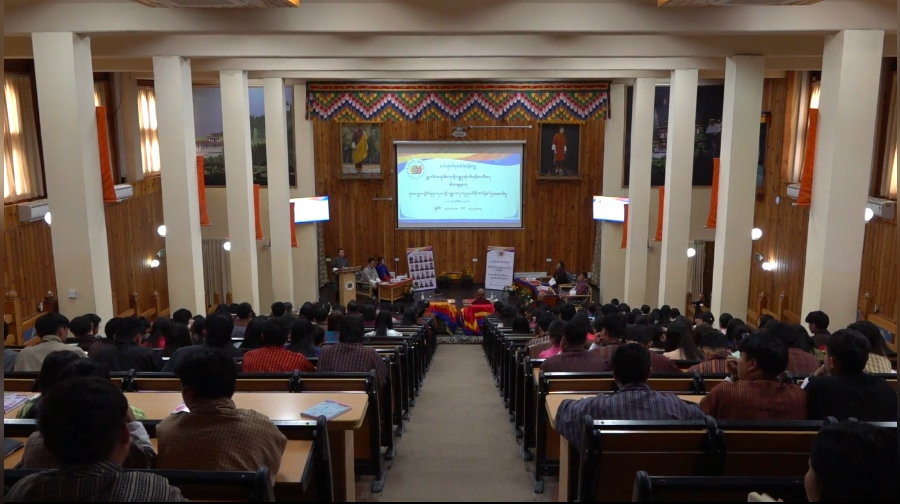
Bhutanese educational institutions have recognized the urgency of this challenge. Recent seminars and conferences dedicated to Buddhist and Traditional Education have brought together educators, linguists, and researchers to examine Dzongkha learning obstacles systematically. These gatherings have produced valuable research identifying specific problem areas and proposing evidence-based solutions.
Paro College of Education has emerged as a leading institution in this research effort, hosting significant academic discussions where educators share findings and collaborate on innovative approaches. The college's commitment to studying these challenges reflects a broader institutional recognition that traditional teaching methods may require substantial revision.
Proposed Solutions and Best Practices
Educators have identified several promising approaches to address Dzongkha pronunciation and spelling difficulties:
Standardized Teaching Methodologies - Developing consistent, research-backed methods for teaching pronunciation and spelling rules ensures that all students receive quality instruction regardless of their school's location or resources.
Integrated Language Practice - Rather than isolating Dzongkha to dedicated language classes, incorporating the national language across other subjects provides students with authentic, varied opportunities to practice and reinforce their skills.
Explicit Phonetic Instruction - Teaching students about phonetics and how sounds correspond to written symbols helps them understand the underlying logic of Dzongkha rather than simply memorizing rules.
Enhanced Teacher Professional Development - Investing in comprehensive training programs that equip educators with specialized knowledge in pronunciation instruction and spelling pedagogy directly improves student outcomes.
Community Language Engagement - Strengthening Dzongkha use in home and community settings creates a supportive linguistic environment that reinforces classroom learning.
Student and Teacher Perspectives 💭
Voices from the Classroom
Student teachers preparing for careers in education recognize the significance of these challenges. Future educators entering the profession understand that their ability to teach Dzongkha effectively will directly impact their students' linguistic development and cultural connection to Bhutan's heritage.
Experienced educators emphasize that the goal extends beyond helping students pass examinations. The ultimate objective is cultivating confident, competent speakers and writers of Dzongkha who can use the language fluently in diverse contexts—from formal academic settings to everyday communication.
The Broader Educational Vision
Educators articulate a vision where Dzongkha proficiency becomes a genuine achievement rather than a mere curriculum requirement. This vision encompasses students who speak the national language with confidence, understand its nuances, and appreciate its cultural significance. Such proficiency requires commitment from multiple stakeholders: teachers, administrators, policymakers, and families.
Systemic Challenges and Barriers 🚧
Resource Constraints
Many schools, particularly in rural areas, lack adequate resources for specialized Dzongkha instruction. Limited access to modern teaching materials, insufficient teacher training opportunities, and inadequate funding for language programs create significant obstacles to improvement.
The English Language Pressure
The global dominance of English creates competing pressures within Bhutanese education. While English proficiency is undeniably important for international engagement and economic opportunity, the emphasis on English sometimes comes at the expense of Dzongkha development. Students may prioritize English learning, viewing Dzongkha as less critical for future success.
Inconsistent Implementation
Even when educational policies recommend particular approaches to Dzongkha instruction, implementation varies significantly across schools. Without consistent oversight and support, well-intentioned policies often fail to produce desired results.
The Path Forward 🌟
Research and Knowledge Sharing
Publishing and disseminating research findings about Dzongkha learning challenges and effective interventions is essential. When educators access peer-reviewed research and practical case studies, they can adopt evidence-based practices rather than relying solely on tradition or intuition.
Conferences and seminars dedicated to Dzongkha education create valuable forums where educators exchange ideas, learn from colleagues' experiences, and collectively problem-solve. These gatherings generate momentum for systemic change and foster a professional community committed to language education excellence.
Curriculum and Pedagogy Innovation
Modernizing Dzongkha curriculum to reflect contemporary teaching methods and learning science can significantly improve outcomes. Incorporating technology, multimedia resources, and interactive learning experiences can make Dzongkha instruction more engaging and effective for today's students.
Holistic Language Support
Addressing Dzongkha pronunciation and spelling challenges requires coordinated effort across multiple domains. Schools must create language-rich environments where Dzongkha is valued and used meaningfully. Families should be encouraged to support language development at home. Communities can celebrate and promote Dzongkha through cultural events and public initiatives.
Implications for Bhutan's Future 🏔️
The challenges facing Dzongkha education carry implications far beyond academic performance. Language preservation is fundamentally connected to cultural preservation. As Bhutan navigates rapid modernization and globalization, maintaining a strong national language becomes increasingly important for preserving unique Bhutanese identity and cultural continuity.
Young people who master Dzongkha develop deeper connections to their heritage, understand their cultural history more fully, and possess tools for meaningful participation in Bhutanese society. Conversely, generations that lose proficiency in their national language risk losing important cultural knowledge and connection to their roots.
Conclusion: A Call to Action 🎯
The pronunciation and spelling challenges facing Dzongkha learners represent a solvable problem—not an insurmountable crisis. With commitment from educators, institutional support, adequate resources, and evidence-based teaching methods, Bhutan can significantly improve student outcomes in its national language.
The work already underway in educational institutions across the country demonstrates genuine commitment to addressing these challenges. As research continues to illuminate effective approaches and educators collaborate to share best practices, momentum builds for meaningful improvement.
For Bhutan's future, investing in Dzongkha education is investing in cultural preservation, national identity, and the development of citizens who can fully participate in their society. The path forward requires sustained effort, but the destination—a generation of confident, competent Dzongkha speakers—is worth the investment.
You May Also Like

Education
Bhutanese Students Reconsider Australia Plans Amid New Visa Rules
October 7, 2026
Education
Motithang Higher Secondary School Zayed Sustainability Prize Finalist
October 6, 2026
Education
Students with Special Educational Needs Showcase Talents
October 6, 2026
Education
Local Produce Connects Gongthung Farms and School
September 21, 2026