Category:
PoliticsJustice Crippled by Confusion and Shortcuts
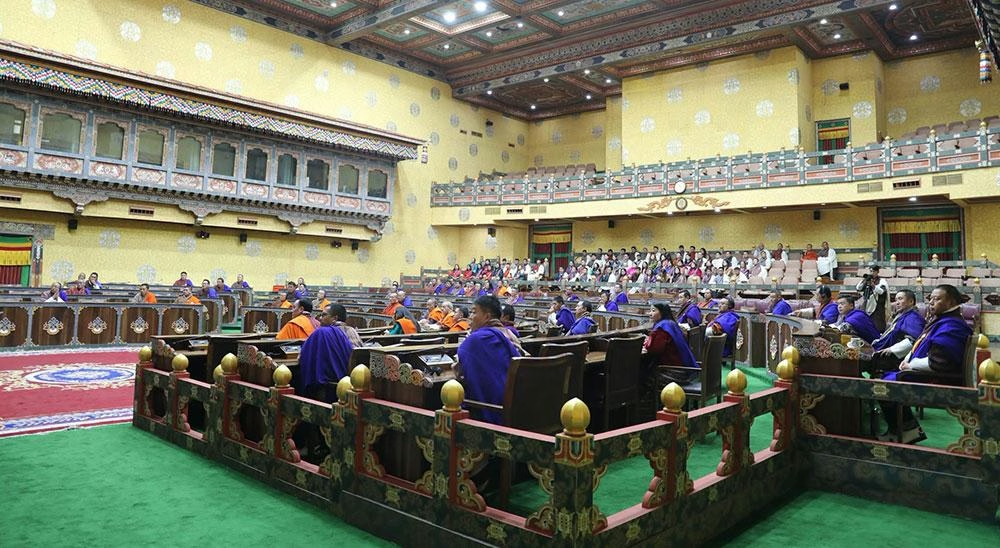
In the realm of justice, clarity and precision are paramount. Yet, recent deliberations in Bhutan's National Council have unveiled a troubling narrative — the Jabmi (Amendment) Bill 2026, meant to enhance the legal system, has instead highlighted profound misunderstandings that threaten the very essence of justice. 🏛️
The Misconceptions of Legal Aid and Pro Bono Services
At the heart of the debate lies a critical confusion between state-funded legal aid and voluntary pro bono services. Legal aid is a statutory mandate ensuring that even the most indigent litigants receive representation through public financing. In contrast, pro bono services are offered voluntarily by lawyers out of goodwill. Collapsing these distinct concepts risks undermining the state's responsibility and transforming pro bono work into an obligatory service. Such a shift could lead to an erosion of the quality and availability of legal assistance for those most in need. 📚
Paralegals in Court: A Double-Edged Sword?
A proposal to allow paralegals to represent parties in court was introduced as a solution to improve access to justice. While the intention is noble, the execution could inadvertently create a two-tier justice system. Wealthier litigants would retain qualified lawyers, while economically disadvantaged individuals might be left with less qualified paralegals. This approach could perpetuate inequality, rather than alleviate it. 🤔
The Value of Experience vs. Formal Education
Proponents argue for the experience of paralegals and court officials. Yet, in professions requiring deep expertise, such as law, experience cannot replace formal education and rigorous training. Just as nurses do not perform surgeries instead of doctors, paralegals should not substitute qualified lawyers in complex legal matters. The intricacies of modern law demand a comprehensive education, spanning multiple years, to ensure competent legal representation. 🎓
The Complexity of Modern Law
Today's legal landscape is a labyrinth of contracts, civil liabilities, and regulatory frameworks. Lawyers undergo extensive education to navigate this complexity. Equating a short diploma to a full-fledged law degree misconstrues the nature of professional expertise. This misunderstanding can lead to inadequate representation and compromise the integrity of legal proceedings. 📜
The Debate on Legal Fees
Assertions made on the Council floor regarding exorbitant legal fees lack empirical backing. Branding the legal profession as predatory without evidence erodes public trust and discourages lawyers from engaging in pro bono work. Legal services vary significantly, and while regulation is necessary, blanket accusations of exploitative fees are counterproductive. Transparency and data-driven discussions are essential to protect both consumers and the profession. 💼
Moving Forward: A Call for Informed Legislation
The deliberations on the Jabmi (Amendment) Bill exemplify the need for informed and data-driven discourse. Engaging with the Bar Council and leveraging empirical data could greatly enhance the legislative process. By crafting amendments with clarity and precision, Bhutan can truly widen access to justice and uphold the integrity of its legal system. 📊
Conclusion: The Path to True Justice
As Bhutan navigates its legal reforms, it must avoid shortcuts and embrace a nuanced approach to justice. By addressing misconceptions and fostering informed discussions, the nation can ensure that its legal system remains robust, equitable, and just. The journey towards justice requires careful consideration and deliberate action — anything less would cripple the very foundations of fairness. 🌟
You May Also Like
Politics
Parliamentary Oversight of Bureaucratic Power: A Democratic Imperative
October 24, 2026
Politics
Future-Ready Governance: The GNH Framework
October 24, 2026
Politics
Mines and Minerals Bill Returns After 5-Year Deadlock
October 21, 2026
Politics
Bhutan and EU Parliamentarians Unite on Climate Action
September 26, 2026