Category:
NewsIndia's Naya Bharat Vision Transforms Bhutan's Future
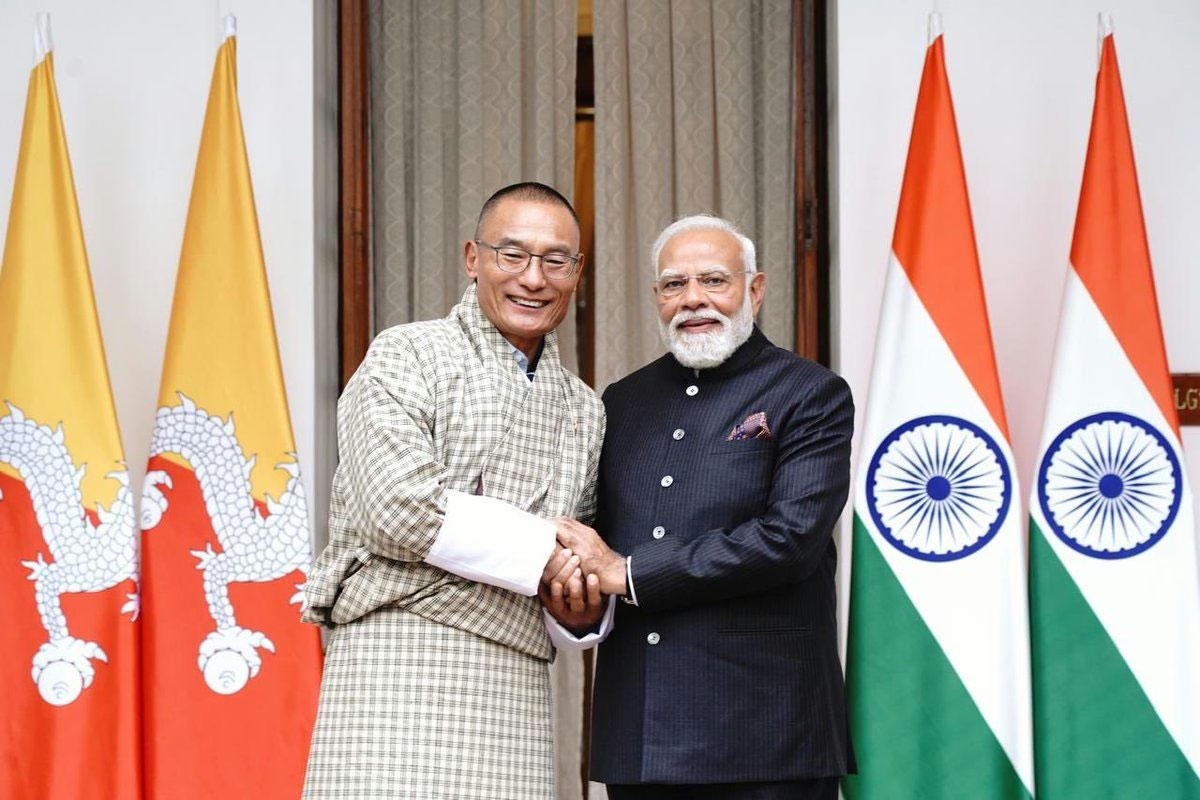
A New Era of Partnership Takes Shape 🌏
When India and Bhutan signed their joint statement in November 2025, observers recognized it as far more than a ceremonial reaffirmation of diplomatic ties. The agreement represented a fundamental reimagining of how two neighboring nations could collaborate during a transformative period—one where India pursues its ambitious "Naya Bharat" vision while Bhutan accelerates its own trajectory toward becoming a high-income nation by 2034.
India's Prime Minister Narendra Modi introduced the concept of "Naya Bharat" (New India) during the nation's 79th Independence Day celebration, positioning it as a comprehensive blueprint for national transformation by 2047. This powerful vision encompasses economic restructuring, technological advancement, and renewed cultural confidence. For Bhutan, this Indian transformation carries profound implications far beyond textbook economics.
Understanding Naya Bharat's True Significance 💡
While international media often describes Naya Bharat in terms of macroeconomic scale—projecting an economy reaching USD 30 to USD 40 trillion—the true measure of this vision's success lies in something more nuanced: its reach and inclusivity toward neighboring regions.
"Naya Bharat is fundamentally about whether India's growth extends with equal confidence to its immediate neighborhood," explains Dawa Penjor, General Secretary of the Bhutan-India Friendship Association based in Gelephu. The evidence supporting this inclusive approach is becoming increasingly tangible, manifesting in concrete infrastructure projects that promise to reshape regional connectivity.
This shift represents a departure from historical patterns. For decades, India-Bhutan relations centered primarily on security cooperation, hydropower development, and bilateral assistance. Today, the conversation has expanded dramatically to encompass technology, artificial intelligence, digital infrastructure, and urban innovation.
The Railway Revolution: Connecting Two Nations 🚂
The most visible symbol of this new partnership era is the Kokrajhar–Gelephu railway project, a groundbreaking infrastructure development that will serve as Bhutan's first-ever cross-border rail connection. Funded entirely by India as part of its "Make in India" initiative, this 69-kilometer railway line represents an investment exceeding Nu 40 billion.
For a landlocked nation like Bhutan, this railway transcends mere transportation infrastructure—it functions as a critical economic lifeline. The rail link will directly connect Gelephu Mindfulness City (GMC) to India's extensive railway network, fundamentally altering regional trade dynamics and accessibility patterns.
"Historically, Gelephu occupied a peripheral position relative to India's major growth centers," notes Penjor. "Today, it is emerging as a genuine gateway between two nations, positioned at the intersection of unprecedented economic opportunity."
The railway project demonstrates India's commitment to regional development through concrete action rather than rhetoric alone. This infrastructure investment signals confidence in Bhutan's economic potential and reflects the broader Naya Bharat philosophy of inclusive growth.
Gelephu Mindfulness City: Where Innovation Meets Tradition ✨
At the heart of this transformation lies Gelephu Mindfulness City, an ambitious urban development envisioned by His Majesty King Jigme Khesar Namgyel Wangchuck as a Special Administrative Region. GMC represents a bold attempt to create a 21st-century city that marries cutting-edge technological innovation with Buddhist principles of mindfulness and sustainable living.
The city's design philosophy attracts three distinct constituencies: wealthy international expatriates seeking quality-of-life advantages, Buddhist pilgrims drawn to its spiritual significance, and technology entrepreneurs seeking a dynamic business environment. This tripartite approach positions GMC as a unique urban laboratory—one that tests whether prosperity and purpose can coexist harmoniously.
"GMC embodies a vision of His Late Majesty Jigme Dorji Wangchuck to transform Gelephu into a Gyalwai Phuntsho Tsog—a center of prosperity, opportunity, and national benefit," explains Lyonpo Sonam Tobgye, former Chief Justice of Bhutan. "The technological vision can harness India's exemplary achievements in technological and developmental strengths while fostering greater regional and global cooperation."
The proposed 108 Jangchub Choetens, scheduled to rise on November 1st, will reconnect Gelephu's spiritual heritage with the broader Buddhist civilization. This spiritual infrastructure complements the secular development initiatives, creating a balanced urban ecosystem.
India's Technological Contributions to GMC 🔬
India's role in GMC's development extends beyond railway construction. Indian digital infrastructure models—particularly the nation's acclaimed public digital systems for identity, payments, and service delivery—are being studied intently by GMC planners.
India has pioneered sophisticated approaches to delivering government services at national scale. These systems, built to serve over 1.4 billion citizens, offer valuable templates for a city seeking to balance technological sophistication with accessibility. GMC planners recognize that India's digital achievements could inform the city's own infrastructure architecture.
The February 2026 meeting between Prime Minister Narendra Modi and Prime Minister Tshering Tobgay expanded cooperation beyond traditional sectors. For the first time, artificial intelligence and digital innovation emerged as formal cooperation priorities. This represents a watershed moment in the bilateral relationship—signaling that both nations recognize technology as central to future prosperity.
"Cooperation in artificial intelligence and digital infrastructure," observes Penjor, "marks a meaningful evolution beyond the hydropower partnership that has long anchored our ties. This represents genuine partnership in the knowledge economy."
The Economic Opportunity for Indian Business 💼
GMC's development has already captured attention from India's largest industrial conglomerates. Reports indicate that major business groups including Reliance and Adani are engaged in related infrastructure projects supporting GMC's establishment.
The city's attractive business environment—featuring low tax rates, luxury residential offerings, and strategic positioning—holds considerable appeal for India's expanding affluent class. For Indian entrepreneurs and investors, GMC represents an opportunity to participate in nation-building while accessing a market that rewards both profit and purpose.
This business interest validates GMC's potential as a genuine economic hub rather than a speculative venture. When India's largest corporations commit resources to a development, it signals confidence in long-term viability.
Educational Exchange: Building Human Capital 🎓
Perhaps most importantly, GMC is being deliberately designed for Bhutan's younger generation. The city represents an opportunity to retain talented Bhutanese professionals who might otherwise seek careers abroad.
"Bhutanese graduates need no longer view opportunity as something found only internationally," Penjor envisions. "Simultaneously, India's engineers, designers, and entrepreneurs will find in Mindfulness City a market that rewards purpose alongside profit."
To realize this vision, educational exchanges, joint training programs, and cross-border internships must be treated as core infrastructure rather than peripheral goodwill gestures. These human capital investments are as essential to GMC's success as the railway line itself.
Bilateral educational cooperation creates mutual benefits. Bhutanese students gain access to world-class Indian institutions, while Indian professionals experience exposure to Bhutanese culture and values. This people-to-people connection strengthens the broader relationship.
India's Conceptual Framework for Development 🎯
Political analysts identify India's approach to regional development as reflecting a broader "conceptual triad" for what India terms "Viksit Bharat" (Developed India):
Suraksha (National Security): Maintaining strategic stability and defense capabilities in the region.
Samriddhi (Prosperity): Building a USD 30 trillion economy that extends benefits to neighboring nations.
Samskriti (Cultural Confidence): Promoting India's civilizational values and spiritual heritage throughout the region.
This framework positions Bhutan not as a dependent recipient of Indian largesse, but as a partner in a shared civilizational project. The relationship transcends transactional development assistance.
"A stronger India should augur very well for Bhutan," notes political analyst Dr. DK Giri. "We are not merely neighbors. We are spiritual and developmental partners bound by shared values and mutual aspirations."
Doubling Down on Development Assistance 📈
India's commitment to Bhutan's development is quantifiable. India's assistance for Bhutan's 13th Five-Year Plan has doubled compared to the previous planning cycle, demonstrating increased investment in bilateral cooperation.
This financial commitment reflects India's strategic prioritization of Bhutan within its regional development framework. The doubling of assistance indicates that New Delhi views Bhutan's successful development as integral to its own regional vision.
Historically, hydropower cooperation anchored the bilateral relationship. While this remains important, the diversification into technology, digital infrastructure, and urban development signals an evolution toward more comprehensive partnership.
A Model for Regional Cooperation 🌟
The India-Bhutan partnership surrounding GMC's development offers a model for how larger and smaller neighboring nations can collaborate during periods of mutual transformation.
Instead of the typical development paradigm where larger nations impose solutions on smaller neighbors, this partnership reflects genuine collaboration. Bhutan brings its own vision—rooted in Buddhist values and Gross National Happiness principles—while India contributes technological expertise, financial resources, and market access.
This mutually beneficial approach stands in contrast to extractive development models that have characterized some international partnerships. Both nations emerge stronger from the collaboration.
Looking Forward: The Next Chapter 🚀
As Gelephu Mindfulness City takes shape and the railway construction progresses, a new chapter in India-Bhutan relations unfolds. The convergence of India's transformative ambitions with Bhutan's development goals creates a compelling narrative of shared prosperity.
The success of GMC will demonstrate whether a city can successfully integrate modern technology with traditional values. The railway will prove whether infrastructure investment can genuinely transform regional economic dynamics. The educational partnerships will show whether human capital development can retain talent while building regional expertise.
These projects collectively represent more than development initiatives. They embody a philosophical commitment to inclusive growth, where larger nations actively extend their prosperity to immediate neighbors. As India pursues its Naya Bharat vision, Bhutan's experience will serve as a crucial test case for whether this vision can meaningfully improve lives beyond India's borders.
The garden of Gelephu is being cultivated by the giant of India—not to dominate, but to nurture shared growth and mutual flourishing.
You May Also Like
News
Women Entrepreneurs Master AI and Digital Tools in Phuentsholing
September 1, 2026
News
Can Samtse Keep Up With Its Growing Workforce?
August 29, 2026
News
Nepal Flood Exposes Critical Gaps in Bhutan's Early Warning Systems
August 29, 2026
News
High Court Overturns Acquittal: Doctor Sentenced to 10 Years for Child Sexual Abuse
August 29, 2026