Category:
NewsSamtse Check Post Congestion: Trade Growth Strains Border Infrastructure
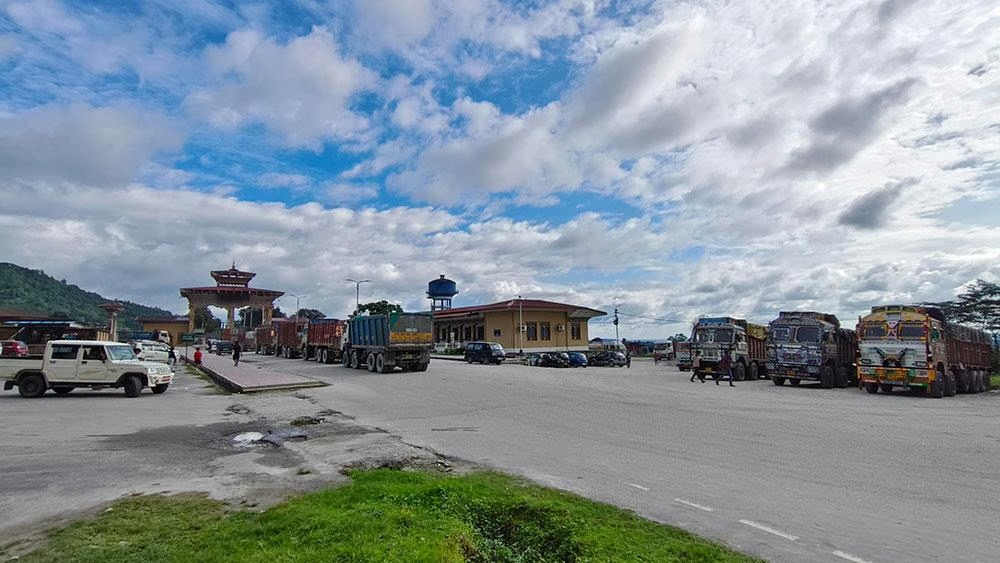
The Growing Crisis at Samtse's Border Gateway 🚛
Bhutan's northeastern trade corridor is facing unprecedented strain as commercial traffic surges through a single bottleneck. What should be a straightforward 2-kilometre journey through Samtse's Integrated Check Post now consumes over two hours for heavy vehicles, creating a cascading effect that impacts businesses, residents, and the broader regional economy.
The situation represents a critical juncture for Bhutanese trade infrastructure. As regional commerce expands and industrial operations multiply across Samtse, the existing border crossing system has become inadequate to handle modern trading volumes. This congestion isn't merely an inconvenience—it's becoming a significant economic drag on enterprises relying on timely cross-border movement of goods. 📊
Understanding the Traffic Volume Challenge 📈
The sheer scale of commercial activity passing through the check post tells the story of Bhutan's expanding trade landscape. Approximately 400 trucks navigate the border crossing daily, each requiring inspection, documentation processing, and customs clearance. Before the pandemic era, such volumes would have seemed unimaginable for a single-lane entry and exit system.
However, the current infrastructure was designed for a different era of commerce. The single-lane configuration creates a fundamental bottleneck that no amount of procedural optimization can fully resolve. When 400 vehicles attempt to pass through a system designed for perhaps 150-200 daily movements, mathematical reality dictates significant delays.
This growth reflects Bhutan's broader economic development trajectory. New industries have established operations throughout the Samtse region, each generating material flows that must transit through this single gateway. Raw materials arrive from India, undergo processing or aggregation, then exit through the same constrained route. 🏭
The Industrial Expansion Factor
The proliferation of manufacturing and processing facilities in Samtse has fundamentally altered traffic patterns. Industrial enterprises operating in the region now depend on consistent, predictable supply chains. Yet the congestion at the check post has made such predictability impossible.
Local business leaders report that traffic composition has shifted dramatically. Previously, boulder and aggregate export vehicles dominated the crossing. Today, raw material imports, finished goods exports, and intermediate product movements create a complex, multi-directional flow that the current system cannot efficiently manage.
This industrial growth represents economic progress for Bhutan. Yet without corresponding infrastructure investment, that progress becomes strangled by its own success. The check post congestion now threatens to undermine the very economic expansion that created it. 💼
The Duarpani Gate Closure: A Critical Missing Link ⛔
The story of Samtse's traffic crisis cannot be told without addressing the Duarpani route. This 2.3-kilometre alternative crossing, connecting Tashijong with Chamurchi in West Bengal through Forest Basti, historically served as a crucial pressure valve for export traffic.
Before pandemic-related closures, the Duarpani route provided essential relief to the main check post. Heavy vehicles carrying boulders, aggregates, and other bulk commodities could utilize this alternate path, distributing traffic across two crossing points rather than forcing everything through a single gateway.
The route's closure has concentrated all heavy vehicle movement at the main Samtse check post. This concentration effect transformed a manageable situation into a critical bottleneck. Infrastructure that once handled distributed traffic loads now bears the entire burden of regional trade. 🚧
Why the Duarpani Gate Remains Closed
Despite efforts to restore functionality, the Duarpani route continues operating under closure restrictions. The Bhutan Exporters Association and local authorities have invested in necessary infrastructure improvements. The physical facilities exist and are operational. Yet bureaucratic and regulatory barriers prevent commercial movement.
India's Sashastra Seema Bal (SSB) has not authorized commercial traffic through the crossing without formal notification from India's central government in New Delhi. This requirement highlights the complex bilateral dimensions of border trade—decisions made in distant capitals directly impact daily operations for Bhutanese businesses and residents.
The Ministry of Foreign Affairs and External Trade has pursued reopening through multiple diplomatic channels since November 2023. Foreign Minister DN Dhungyel acknowledged that while the route was regularly used for trade pre-pandemic, it had never received formal official designation as an international trade route. This administrative gap created the legal ambiguity that now prevents its utilization. 🤝
Bilateral discussions have occurred through Joint Group of Customs meetings, commerce secretary-level talks, and border district coordination meetings. Yet the formal notification required from India's central government remains pending. This administrative process, while procedurally appropriate, has extended the closure far beyond its original intended duration.
The Domino Effect: Cross-Border Commuter Traffic 🚗
Heavy vehicle congestion represents only part of the problem. Light vehicles and motorcycles from both Bhutan and India frequently use the corridor for routine commerce, refueling, and daily errands. These cross-border commuters add another layer of complexity to an already strained system.
While buses, taxis, and private cars currently utilize an internal bypass between Samtse and Phuentsholing, this arrangement provides temporary relief. However, local leaders recognize that shifting this light vehicle traffic back to the primary border route would create total gridlock. The current bypass system, though imperfect, prevents a complete collapse of the crossing.
This situation illustrates how border infrastructure must serve multiple functions simultaneously—international commerce, regional trade, daily commuter movement, and routine cross-border activities. A single-lane system cannot adequately accommodate this multiplicity of demands. 🌉
Environmental and Health Consequences: The Dust Problem 💨
Beyond economic impacts, the congestion creates significant environmental and public health challenges. Residents living and working along the corridor face constant exposure to dust pollution, particularly during dry months when atmospheric conditions concentrate particulate matter.
Heavy trucks idling in queues and crawling through congested stretches generate dense dust clouds that blanket nearby homes, businesses, and pedestrians throughout daylight hours. This dust isn't merely an aesthetic nuisance—it represents genuine health hazard exposure for vulnerable populations including children, elderly residents, and individuals with respiratory conditions.
Local residents report that dust accumulation on structures, vehicles, and personal belongings has become a daily reality. The environmental impact extends beyond immediate residents to affect air quality across the broader Samtse area. As regional trade continues expanding and the Duarpani route remains closed, residents warn that both traffic gridlock and dust pollution will intensify unless heavy vehicle movement is redistributed. 🏥
The Broader Infrastructure Perspective 🌍
Samtse's congestion crisis reflects a wider challenge facing Bhutanese infrastructure planning. The nation's rapid economic development has outpaced physical infrastructure expansion. Border crossings designed for previous-generation trade volumes now struggle with contemporary commerce realities.
This situation isn't unique to Bhutan. Developing economies worldwide face similar challenges—infrastructure investments lag behind economic growth rates, creating bottlenecks that constrain further expansion. The solution requires proactive infrastructure planning that anticipates future demand rather than responding reactively to congestion.
Bhutan's strategic position as a trade bridge between South Asia and Tibet makes border infrastructure particularly critical. Efficient, well-functioning crossing points directly impact regional commerce, employment, and economic development. Conversely, congested, inefficient crossings impose costs throughout the supply chain.
What Needs to Happen Next 🔮
Resolving Samtse's traffic crisis requires multi-faceted action. First and most urgently, reopening the Duarpani route would provide immediate relief by redistributing traffic across two crossing points. This requires securing formal notification from India's central government—a diplomatic objective that the Ministry of Foreign Affairs and External Trade continues pursuing through established bilateral channels.
Second, infrastructure improvements at the main check post should proceed in parallel. Expanding from single-lane to multi-lane entry and exit systems would increase throughput capacity even without additional crossing points. Modern border facilities in comparable regions typically feature multiple processing lanes to handle contemporary traffic volumes.
Third, technological solutions merit exploration. Automated customs processing, pre-clearance systems, and digital documentation could reduce processing times at the check post without requiring physical expansion.
Fourth, regional coordination with Indian authorities should explore whether additional crossing points might be formalized to distribute traffic more effectively across the border.
The Path Forward 🚀
Samtse's congestion crisis represents a critical test of Bhutan's ability to manage rapid economic development while maintaining quality of life for residents and efficient commerce for businesses. The situation is neither insurmountable nor unique—many nations have successfully addressed similar challenges through strategic infrastructure investment and bilateral cooperation.
The reopening of the Duarpani route would provide immediate relief, while longer-term infrastructure modernization at the main check post would ensure sustainable capacity for future growth. These solutions require coordination between Bhutanese and Indian authorities, investment in physical infrastructure, and commitment to modernizing border crossing procedures.
As Bhutan continues its development trajectory, the Samtse check post will remain a critical economic artery. Ensuring its efficient operation isn't merely a local concern—it's essential for national economic health and regional trade relationships. The coming months will reveal whether diplomatic efforts secure the Duarpani route reopening and whether infrastructure modernization proceeds with appropriate urgency. 💪
The resolution of this crisis will demonstrate whether Bhutan can proactively manage infrastructure challenges or whether economic growth will continue outpacing physical capacity. For businesses, residents, and the broader economy, the answer matters considerably.
You May Also Like
News
Women Entrepreneurs Master AI and Digital Tools in Phuentsholing
September 1, 2026
News
Can Samtse Keep Up With Its Growing Workforce?
August 29, 2026
News
Nepal Flood Exposes Critical Gaps in Bhutan's Early Warning Systems
August 29, 2026
News
High Court Overturns Acquittal: Doctor Sentenced to 10 Years for Child Sexual Abuse
August 29, 2026