Category:
NewsSafety Standards at Thimphu's Entertainment Venues
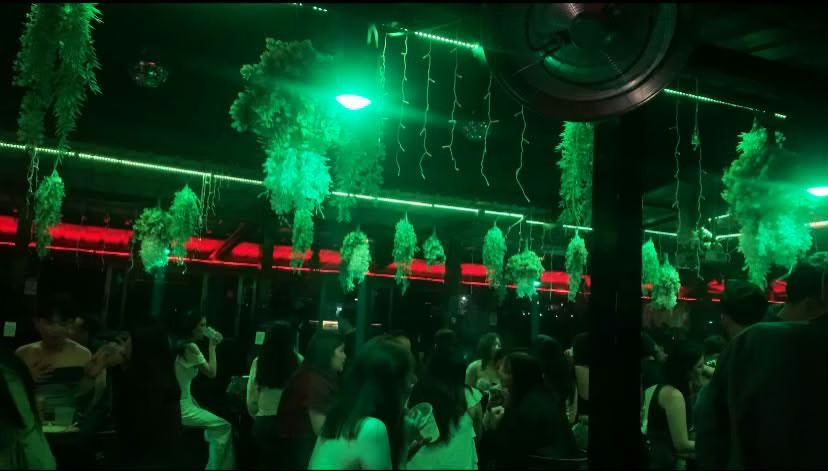
Understanding the Current State of Entertainment Safety in Thimphu 🎬
Thimphu's vibrant nightlife attracts thousands of visitors each week, particularly on weekends when bars, clubs, and entertainment centres reach full capacity. However, beneath the bright lights and energetic atmosphere lies an important question that deserves serious attention: how safe are Thimphu's entertainment centres when emergencies strike?
As crowds surge through venues late into the night, the visibility of safety infrastructure becomes increasingly critical. Emergency exits fade into the background, fire safety equipment becomes obscured, and the sheer density of people creates potential vulnerabilities that could transform a routine evening into a dangerous situation within moments.
The Bangkok Fire: A Cautionary Tale for Thimphu 🚨
The tragic incident in Bangkok during July 2023 serves as a stark reminder of what can happen when safety protocols fall short. A devastating fire at a Thai entertainment establishment claimed 39 lives, with investigators discovering that beer crates and furniture were blocking critical exit routes. Most troublingly, the venue had obtained licensing as a restaurant rather than an entertainment venue, allowing operators to circumvent stricter fire-safety regulations designed specifically for high-occupancy spaces.
This incident resonates particularly for Thimphu's entertainment district, where similar vulnerabilities may exist. The Bangkok tragedy underscores that comprehensive safety frameworks are not luxuries—they are necessities that can mean the difference between a successful evacuation and a catastrophe.
Bhutan's Entertainment Safety Framework 📋
Recognizing these risks, Bhutan's Ministry of Industry, Commerce and Employment introduced the Rules and Regulations for the Places of Entertainment in 2022, establishing a comprehensive regulatory structure for entertainment venues across the nation. This framework represents a significant step forward in standardizing safety requirements and operational guidelines.
The regulations categorize entertainment establishments into three distinct tiers:
- Category A: Discotheques, dance halls, karaoke venues, live music establishments, and snooker bars that serve alcohol
- Category B: Traditional performance spaces, bowling alleys, cinema halls, and gaming arcades (no alcohol service)
- Category C: Specialized entertainment formats including time-bound activities and experimental venues
Each category faces specific requirements tailored to its operational characteristics and associated risks.
Core Safety Requirements Under the 2022 Rules ✅
The regulatory framework mandates several essential safety measures that venue operators must implement before receiving approval:
Structural and Access Requirements:
- Separate, clearly marked emergency exits with illuminated signage
- All exit doors must open outward to facilitate rapid egress
- Discotheques must operate exclusively in basement locations
- Minimum distance of 400 metres from monasteries, hospitals, schools, and other sensitive institutions
Safety Equipment and Personnel:
- Minimum of three serviceable five-litre fire extinguishers
- Functional fire alarm systems throughout the venue
- First-aid kits with at least one trained staff member capable of emergency response
- Metal detectors at entrances for Category A venues
- Trained male and female bouncers for most Category A establishments
Operational Safeguards:
- Age verification for all patrons entering Category A venues (minimum 18 years)
- Prohibition of weapons and sharp objects
- Designated smoking areas compliant with Bhutan's Tobacco Control Act
- Annual licensing with mandatory renewal following compliance verification
The Critical Gap: Rules vs. Real-World Implementation 🔍
While Bhutan's regulatory framework appears comprehensive on paper, significant gaps exist between the written requirements and practical enforcement. The regulations require the Entertainment Licensing Committee (ELC) to conduct inspections at least quarterly, yet the technical checklist used during these inspections reveals concerning limitations.
The current inspection protocol verifies that an emergency exit exists and is illuminated, but it does not assess:
- Exit Width Standards: No minimum specifications for emergency exit dimensions
- Capacity Formulas: No mathematical relationship between floor area and maximum occupancy
- Egress Flow Rates: No evaluation of how many people can safely exit within critical timeframes
- Exit-to-Occupancy Ratios: No requirement that exit capacity matches or exceeds venue capacity
These omissions represent significant vulnerabilities. A venue could technically comply with regulations while remaining fundamentally unsafe during emergencies.
On-the-Ground Observations from Thimphu's Entertainment District 👀
Visits to multiple entertainment venues throughout Thimphu reveal troubling patterns that suggest gaps between regulatory requirements and actual conditions:
Visibility and Accessibility Issues:
- Emergency exits remain largely invisible to unfamiliar patrons, particularly in darkened environments
- Fire extinguishers lack prominent placement and clear signage
- During peak hours, crowding makes navigation toward exits extremely difficult
- Customers unfamiliar with venue layouts would struggle to locate exits during emergencies involving smoke, darkness, or panic
Age Verification Concerns:
- Inconsistent enforcement of age verification requirements
- Digital ID verification via smartphone images raises authenticity concerns, as such images can be easily manipulated
- Some venues appear to conduct minimal or no age verification during busy periods
Noise and Community Impact:
- Sound levels from some establishments extend well beyond property boundaries
- Music continues at high volumes throughout weekdays and weekends
- Local taxi drivers report persistent noise complaints from residents near entertainment districts
Regulatory Enforcement and Compliance 🏛️
The regulatory framework includes penalties designed to incentivize compliance:
- First Violation: Fine equivalent to six months of national minimum daily wage or previous year's Business Income Tax (whichever is higher)
- Repeat Violation: Three-year license cancellation
- Operating Without License: Fine equivalent to 10 years of minimum daily wage plus immediate closure
However, the effectiveness of these penalties depends entirely on consistent enforcement and transparent reporting of violations. Current publicly available data regarding the number of venues inspected quarterly, fines issued, or licenses suspended remains limited.
Industry Trends and the Broader Context 📊
Thimphu's entertainment sector has experienced significant growth over the past decade, with new venues opening regularly to meet demand from both residents and tourists. This expansion has outpaced the regulatory framework's evolution, creating a scenario where enforcement capacity may struggle to keep pace with venue proliferation.
Globally, entertainment venue safety has become increasingly scrutinized following high-profile incidents in various countries. Industry best practices now emphasize:
- Digital occupancy monitoring systems
- Real-time emergency communication systems
- Regular safety drills and staff training
- Transparent public reporting of inspection results
- Capacity limits based on verified egress calculations
Bhutan's current framework addresses foundational requirements but lacks these modern safety innovations.
What Needs to Change: Recommendations for Enhanced Safety 🎯
To bridge the gap between regulatory intent and practical safety, several improvements warrant consideration:
Technical Specifications:
- Establish minimum exit width requirements (typically 44 inches per occupancy code standards)
- Create occupancy formulas based on floor area and exit capacity
- Require documented egress flow rate calculations
- Mandate regular fire safety audits by certified professionals
Enforcement Enhancement:
- Increase inspection frequency during peak operating hours
- Publish quarterly compliance reports for public transparency
- Implement unannounced inspection protocols
- Establish clear procedures for age verification with digital security measures
Staff and Patron Education:
- Require comprehensive safety training for all venue staff
- Mandate regular safety drills with documented participation
- Provide clear emergency procedure signage in multiple languages
- Implement orientation programs for first-time patrons
The Path Forward: Balancing Entertainment and Safety 🌟
Thimphu's entertainment centres play a vital role in the city's social fabric and economy. They provide employment, generate tax revenue, and offer residents and visitors spaces for cultural expression and social connection. However, these benefits must never come at the expense of public safety.
The 2022 regulatory framework demonstrates governmental commitment to establishing safety standards. The next phase requires rigorous, consistent enforcement coupled with modernization of inspection protocols to address real-world risks rather than merely checking regulatory boxes.
Venue operators, regulatory authorities, and patrons all share responsibility for maintaining safe entertainment spaces. Operators must view safety investments as essential business expenses rather than regulatory burdens. Authorities must allocate resources for thorough, professional inspections and transparent reporting. Patrons should demand venues that prioritize their wellbeing and avoid establishments with visible safety deficiencies.
Thimphu's entertainment district can thrive while maintaining the highest safety standards. Achieving this balance requires commitment, resources, and continuous improvement—investments that ultimately protect lives and strengthen community trust in these vital social spaces. 💫
You May Also Like
News
Women Entrepreneurs Master AI and Digital Tools in Phuentsholing
September 1, 2026

News
Can Samtse Keep Up With Its Growing Workforce?
August 29, 2026

News
Nepal Flood Exposes Critical Gaps in Bhutan's Early Warning Systems
August 29, 2026
News
High Court Overturns Acquittal: Doctor Sentenced to 10 Years for Child Sexual Abuse
August 29, 2026