Category:
EnvironmentWBH Conservation Project Delivers Clean Water to Rural Homes
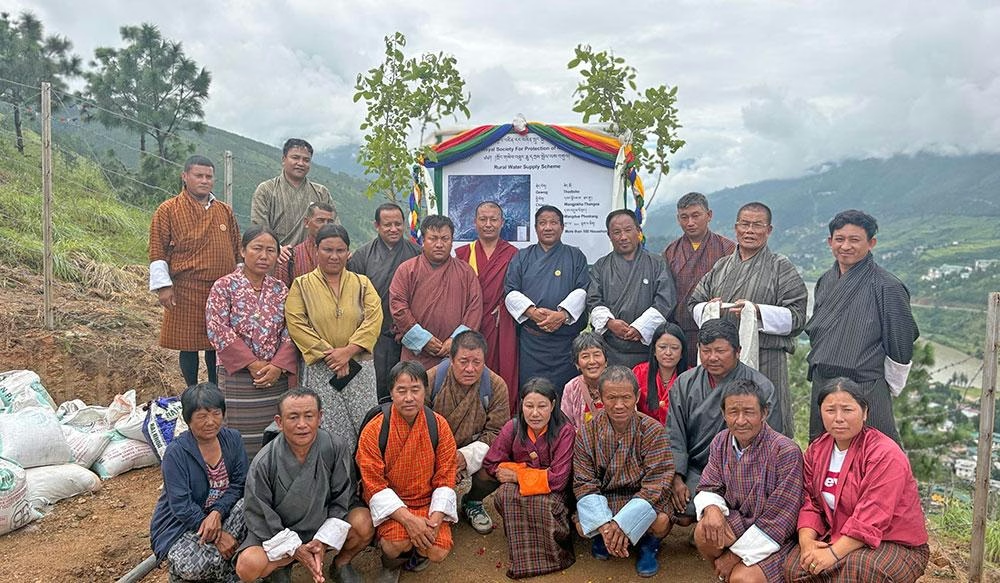
A Lifeline for Rural Communities 💧
For decades, rural residents across Bhutan's remote districts have faced an ongoing struggle that many urban dwellers rarely consider: accessing clean water. What seems like a simple turn of a tap in cities becomes a grueling ordeal in mountainous villages, where families trek hours through dense forests just to maintain aging water sources. The WBH conservation project has fundamentally transformed this reality for thousands of people.
Dema, a 34-year-old resident of Wangjokha in Wangdue District, knows this struggle intimately. Before 2025, every malfunction in her community's water system meant an eight-kilometre journey through the forest—a trek she often made three times monthly during monsoon season. These expeditions weren't simple walks; they involved battling leeches, navigating slippery terrain, and investing hours of labor just to restore basic water access. Today, her life looks dramatically different.
Understanding the WBH Conservation Initiative 🌍
The white-bellied heron (WBH) conservation project represents a sophisticated approach to environmental protection that extends far beyond bird preservation. Officially titled "Developing Ecosystem-Based Solutions for Managing Biodiversity Landscapes in Bhutan," this initiative demonstrates how wildlife conservation can simultaneously address pressing human development needs.
Implemented by the Royal Society for Protection of Nature (RSPN) in partnership with government agencies, the five-year project operates with substantial international support. The International Climate Initiative and Germany's Federal Ministry for the Environment, Nature Conservation, Nuclear Safety and Consumer Protection have invested over Euro 4 million into this ambitious undertaking.
Project Timeline and Scope:
- Launch date: July 2021
- Completion target: 2026
- Geographic coverage: Six districts (Punakha, Wangdue, Dagana, Trongsa, Tsirang, and Zhemgang)
- Water schemes delivered: 15 rural systems
- Population beneficiaries: Thousands across multiple communities
The Intersection of Conservation and Community Welfare 🤝
What makes this initiative particularly innovative is its dual mandate. While protecting the critically endangered white-bellied heron—a species found primarily along the Punatsangchhu and Mangdechhu river basins—the project simultaneously improves living standards for rural populations. This ecosystem-based approach recognizes that environmental conservation and human welfare are inextricably linked.
The project's strategic location along these vital waterways isn't coincidental. These basins represent crucial habitats for the white-bellied heron, making them priority zones for biodiversity protection. By developing infrastructure that benefits both communities and ecosystems, the project creates sustainable outcomes that endure beyond the funding period.
Transforming Daily Life: The Wangjokha-Thangoo Success Story ✨
The completion of the Wangjokha-Thangoo Rural Water Supply Scheme (RWSS) in June 2025 exemplifies the project's transformative impact. Inaugurated at Malung Village on August 26, this scheme draws water from Baychhu in Kazhi Gewog and serves a population of 497 residents across more than 100 households.
Beyond residential units, the system also provides water to a shedra (Buddhist college), a lhakhang (temple), and an early childhood care and development center—demonstrating how single infrastructure projects can support multiple community institutions.
The Numbers Behind Success:
- Construction timeline: April 20 to June 9, 2025 (under two months)
- RSPN investment: Nu 8 million
- Gewog administration contribution: Nu 648,300
- Households benefited: 100+
- Community population served: 497 residents
The Gender Dimension: Women's Lives Transformed 👩🌾
While water access benefits entire communities, the impact on women deserves particular recognition. In rural Bhutan, women traditionally shoulder primary responsibility for water collection and household water management. The previous system forced compromises that affected health, hygiene, and quality of life.
Dema explains the harsh realities women faced: "When water is scarce, personal hygiene is often the first thing we women have to compromise. We prioritise drinking, cooking and feeding the family, so there is little water left for bathing, washing clothes or keeping our surroundings clean."
With reliable home water access, women now enjoy:
- Reduced time spent on water collection and maintenance
- Improved personal and household hygiene standards
- Greater flexibility for income-generating activities
- Enhanced family health outcomes
- Diminished physical labor and associated injuries
Chador Bidha, former Tshogpa of Wangjokha Chiwog, noted that water shortages had previously consumed considerable community time. The new system has liberated residents to focus on productive activities rather than constant infrastructure maintenance.
Beyond Individual Households: Livestock and Agricultural Benefits 🐄
Rural water supply schemes don't merely serve domestic needs—they support agricultural productivity and livestock management. In communities where farming and animal husbandry remain primary livelihoods, reliable water access directly translates to economic improvements.
Residents now have sufficient water for household consumption, livestock watering, and garden irrigation. This diversification of water use enables families to maintain larger herds and expand agricultural production, creating pathways toward greater food security and income generation.
Sangay, 56, experienced particularly acute water scarcity before the scheme's completion. His household previously faced hours without water despite collection efforts. "We would get water for an hour, and then there would be no water for the rest of the day," he recalls. "We had to store whatever water we could collect." This feast-or-famine pattern created constant anxiety and limited household activities.
Comparative Success: Multiple Schemes Across Districts 🏗️
While Wangjokha-Thangoo represents the most recent completion, the WBH conservation project's portfolio extends across multiple districts. In Wangdue alone, the project also supported the Matalungchu RWSS, completed in April 2024.
The Matalungchu project received Nu 4 million in initial funding, with only Nu 2 million ultimately utilized. This efficient resource management allowed reallocation of the remaining Nu 2 million to accelerate the Wangjokha-Thangoo scheme's completion. Such adaptive project management demonstrates RSPN's commitment to maximizing community benefits within budget parameters.
Capacity Building and Long-Term Sustainability 🛠️
Delivering infrastructure represents only the first step toward sustainable development. Recognizing this reality, the WBH conservation project invested heavily in community capacity building and institutional strengthening.
Comprehensive Support Mechanisms:
- Water system operation and maintenance training
- Formation of water management groups
- Development and endorsement of rural water supply and sanitation by-laws
- Distribution of water toolkits to community associations
- Establishment of governance structures for ongoing maintenance
Senior Project Officer Karma Wangchuk from RSPN's Sustainable Livelihood Division emphasized that training and institutional development are integral to project success. Communities receive not just infrastructure but also the knowledge and tools necessary for long-term stewardship.
Thedtsho Gup Chador acknowledged this responsibility, noting: "Reliable water supply was only the first step and responsibility for maintaining and protecting the system falls on the people." RSPN handed over comprehensive water toolkits to the community's water association chairperson, enabling residents to conduct repairs and maintenance independently.
The Broader Context: Water Challenges in Bhutan 🌊
Bhutan's mountainous terrain presents unique water supply challenges. While the country receives abundant precipitation, topography and population distribution create accessibility problems. Many rural communities remain geographically isolated, making water infrastructure projects capital-intensive and logistically complex.
The WBH conservation project addresses these challenges through targeted interventions in biodiversity-critical areas. By prioritizing work along the Punatsangchhu and Mangdechhu basins, the project aligns infrastructure development with conservation priorities, creating synergistic benefits.
International Support and Climate Considerations 🌱
Germany's financial commitment through the International Climate Initiative reflects growing global recognition that climate action and development are interconnected. Climate change threatens water availability in Himalayan regions, making resilient water infrastructure increasingly critical.
The Euro 4 million investment represents international confidence in Bhutan's conservation leadership and commitment to sustainable development. This support enables the country to pursue ambitious environmental goals while simultaneously improving rural living standards.
Looking Forward: Expansion and Replication 🚀
With 15 rural water schemes completed or in progress across six districts, the WBH conservation project has established a proven model for integrating conservation and development. The project's success in Wangjokha-Thangoo and other communities provides blueprints for future interventions.
As the project approaches its 2026 completion date, attention increasingly focuses on sustainability mechanisms and potential replication in other regions. The capacity-building emphasis suggests that communities will continue managing and expanding these systems beyond the project's formal conclusion.
Conclusion: Water as a Development Foundation 💪
The WBH conservation project exemplifies sophisticated development thinking that recognizes interconnections between environmental protection, human welfare, and economic opportunity. By delivering clean water to rural homes while simultaneously protecting critically endangered species, the initiative creates lasting benefits that extend far beyond project timelines.
For Dema, Sangay, Chador Bidha, and hundreds of other residents across Bhutan's six participating districts, clean water represents liberation from daily hardship. It enables health improvements, economic productivity, educational advancement, and quality-of-life enhancements that ripple through entire communities.
As Bhutan continues balancing development aspirations with conservation commitments, projects like this demonstrate that these goals aren't mutually exclusive—they're mutually reinforcing. The white-bellied heron's survival depends on healthy ecosystems; healthy ecosystems support thriving human communities. The WBH conservation project proves this virtuous cycle benefits everyone. 🌟
You May Also Like
Environment
Climate Crisis in the Himalayas: Bhutan's Cold Reminder
August 29, 2026
Environment
HKH Climate Crisis: Why Regional Unity Matters Now
August 29, 2026
Environment
Bhutan's Solar Power Revolution: Energy Security Strategy
August 26, 2026
Environment
Matsutake Decline: Ura's Fight to Save Its Forest Treasure
August 25, 2026