Category:
EnvironmentHKH Climate Crisis: Why Regional Unity Matters Now
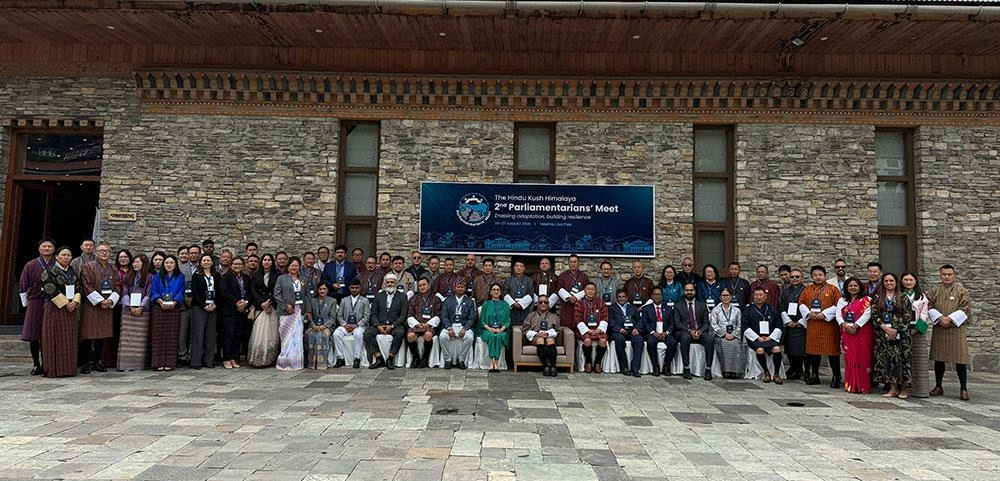
The Hindu Kush Himalaya region stands at a critical crossroads. 🏔️ Rising temperatures, vanishing glaciers, and unpredictable rainfall patterns are reshaping the landscape that sustains nearly two billion people across South Asia. Yet despite these interconnected threats, the countries sharing this vital mountain range remain largely fragmented in their response, creating a dangerous gap between the scale of the climate challenge and the coordinated action needed to address it.
Recent gatherings of regional parliamentarians have highlighted a sobering reality: climate risks in the HKH region no longer respect national boundaries, but policy responses often do. The consequences of this mismatch could be catastrophic for mountain communities, downstream populations, and entire economies dependent on the region's water resources, biodiversity, and agricultural systems.
Understanding the HKH Climate Emergency 🌍
The Hindu Kush Himalaya region encompasses eight countries: Afghanistan, Bangladesh, Bhutan, China, India, Myanmar, Nepal, and Pakistan. This vast mountainous expanse functions as Asia's critical water tower, generating major river systems that irrigate farmland, power hydroelectric facilities, and supply drinking water to approximately two billion people across the continent.
However, this vital ecosystem is undergoing rapid transformation. The region is experiencing unprecedented warming rates, with temperatures rising faster than the global average. Glaciers that have existed for millennia are retreating at accelerating speeds, permafrost is thawing, and traditional snowfall patterns have become increasingly erratic. 📉
These environmental shifts create cascading effects that ripple far beyond mountain peaks. When glaciers shrink, downstream water availability becomes unpredictable. When rainfall patterns shift, agricultural productivity suffers. When permafrost thaws, infrastructure collapses and landslides threaten communities. Each of these impacts crosses borders, yet individual nations often respond in isolation.
The Fragmentation Problem ⚠️
Despite ratifying the Paris Agreement—a commitment made by all eight HKH member states—translating global climate pledges into regional action remains elusive. The fundamental challenge lies in governance: climate impacts are regional, but policy-making remains national.
Consider the practical implications. A glacial melt event in one country affects water flows in downstream nations. Air pollution from industrial activity in one region influences weather patterns across borders. Biodiversity loss in one area disrupts ecological systems that span multiple countries. Yet each nation typically develops climate adaptation strategies independently, often duplicating efforts or, worse, working at cross-purposes.
Secretaries and officials from HKH nations have acknowledged this critical gap. As regional experts have noted, "There are interconnected risks and challenges among the HKH countries, yet the investments and mitigation measures fall upon individual countries." This mismatch between the scope of climate problems and the scale of responses creates inefficiency, waste, and inadequate protection for vulnerable populations. 🔴
The Parliamentary Call for Collaboration 🤝
Recognizing this crisis, regional parliamentarians have begun advocating for transformative change. Recent parliamentary meetings in the region have produced consensus statements calling for stronger cross-border cooperation, integrated data systems, and coordinated financing mechanisms.
Parliamentarians understand something crucial: they occupy a unique position in the climate response chain. Unlike environmental scientists who study problems or international negotiators who broker agreements, legislators can translate climate commitments into binding law, budget allocations, and institutional accountability.
The role of parliamentarians extends beyond passing environmental legislation. They must:
- Connect disparate agencies and sectors across national boundaries to coordinate climate action
- Establish accountability mechanisms ensuring climate budgets translate into tangible community benefits
- Bridge the gap between climate data and implementation, ensuring that early warning systems actually trigger protective responses
- Allocate adequate resources to mountain-specific adaptation projects that account for difficult terrain and dispersed populations
- Oversee regional cooperation frameworks that enable countries to share climate information and coordinate responses
This parliamentary leadership is essential because climate adaptation works only when policy, finance, and knowledge simultaneously reach people, places, and ecosystems. 💡
Water Security and Regional Stability 💧
The HKH region's designation as the "Water Tower of Asia" understates its geopolitical significance. The region's river basins are not merely environmental features—they are the foundation of food security, energy generation, and economic stability for billions of people.
Climate change threatens this foundation. Changing precipitation patterns affect irrigation systems that support agriculture across South Asia. Glacial melt creates temporary water abundance followed by dangerous scarcity. Altered monsoon patterns disrupt agricultural calendars that farmers have relied upon for generations. These changes simultaneously threaten water security, food production, and energy generation across the region.
When water becomes scarce, social stability becomes fragile. Migration increases as people flee degraded agricultural areas. Competition for limited water resources intensifies. Health crises emerge from inadequate water access. These pressures don't stop at national borders—they create regional instability that affects all HKH countries, regardless of individual policy choices.
The Financing Gap: A Critical Barrier 💰
Perhaps the most sobering challenge facing HKH countries is the sheer financial magnitude of climate adaptation requirements. Recent analyses estimate the region needs approximately USD 12.065 trillion between 2020 and 2050 for comprehensive climate mitigation and adaptation efforts—an annual average exceeding USD 768 billion.
To contextualize this figure: China and India alone account for over 92 percent of these estimated financing needs. Smaller HKH nations like Bhutan, Bangladesh, Nepal, and Afghanistan face proportionally greater financial burdens relative to their economic capacity, yet receive smaller absolute amounts of climate finance.
This creates a perverse dynamic. Wealthier HKH nations can invest substantially in adaptation, while poorer nations struggle to implement basic climate resilience measures. The result: uneven adaptive capacity across the region, with vulnerable populations in lower-income countries bearing disproportionate climate impacts.
Climate financing often becomes progressively smaller as it flows from international sources through national governments to local communities. By the time funding reaches mountain villages in difficult terrain, resources may be insufficient for meaningful adaptation projects. This "leakage" of climate finance represents both a practical problem and an equity issue. 🚨
Data, Information, and Early Warning Systems 📊
Parliamentarians have identified a critical but often overlooked challenge: the gap between collecting climate information and acting on it. The HKH region generates substantial climate data through various monitoring systems, research institutions, and satellite observations.
Yet this information frequently fails to translate into timely protective action. Early warning systems can identify incoming hazards—glacial lake outburst floods, landslides, extreme weather events—but data alone does not save lives. Information must trigger coordinated responses: evacuation plans, emergency preparedness, resource deployment, and community communication.
Currently, each HKH country maintains separate monitoring systems with different standards, frequencies, and accessibility. A legislator in one nation may not have access to critical climate data collected in a neighboring country. Regional early warning systems cannot function effectively when data remains fragmented across national boundaries.
Regional leaders have called for an integrated data system covering all eight HKH countries—regularly updated, easily accessible, and designed for policy and planning applications. Such a system would enable countries to anticipate regional climate hazards rather than merely responding to national crises. 🔍
Vulnerability Factors Amplifying Climate Risks 📍
The HKH region's vulnerability to climate impacts extends beyond environmental factors. Rugged terrain, limited infrastructure, widespread poverty, and significant inequality create conditions where climate impacts hit hardest on those least able to adapt.
Mountain communities often lack:
- Adequate transportation infrastructure for emergency evacuation or resource delivery
- Reliable communication systems for receiving early warnings or coordinating responses
- Economic diversification making them dependent on climate-sensitive sectors like agriculture
- Healthcare facilities for treating climate-related injuries and illnesses
- Financial reserves for recovering from climate disasters
These structural vulnerabilities mean that identical climate impacts affect mountain communities far more severely than better-resourced populations. A monsoon failure that reduces agricultural yields by 20 percent represents an inconvenience for wealthy farmers with diversified income sources—but existential danger for subsistence farmers with no alternatives.
Climate adaptation in the HKH must therefore address not only environmental changes but also the underlying poverty and inequality that amplify climate vulnerability. 💔
Moving from Commitment to Action 🎯
All eight HKH countries have formally ratified the Paris Agreement, signaling political commitment to climate action. However, international agreements mean little without domestic implementation. This is where parliamentarians become crucial.
Legislators can:
- Enact climate-specific legislation establishing legal frameworks for adaptation and mitigation
- Allocate adequate budgets ensuring climate action receives sufficient financial resources
- Establish oversight mechanisms holding governments accountable for climate commitments
- Create regulatory frameworks requiring climate considerations in infrastructure, energy, and development projects
- Facilitate cross-border cooperation through bilateral and regional agreements
The transition from international climate agreements to local climate action requires this parliamentary engagement. Without legislators actively translating commitments into law and budgets, even well-intentioned climate pledges remain aspirational rather than transformative. 🔧
Regional Cooperation Models and Best Practices 🌐
While fragmentation remains the dominant pattern, emerging examples of successful regional cooperation offer hope. River basin commissions in some areas have begun coordinating water management across borders. Regional research institutions like ICIMOD (International Centre for Integrated Mountain Development) facilitate knowledge sharing among HKH countries.
These initiatives demonstrate that cooperation is possible when countries recognize mutual interests. Climate adaptation in the HKH requires scaling up such collaborative models across multiple sectors and governance levels.
Successful regional cooperation typically includes:
- Shared data systems with standardized collection and accessibility protocols
- Joint research programs addressing transboundary climate impacts
- Coordinated financing mechanisms pooling resources for regional projects
- Regular diplomatic forums enabling consistent policy dialogue
- Capacity-building programs strengthening climate expertise across nations
Establishing these institutional frameworks requires sustained political commitment and financial investment from all HKH countries. 🏛️
The Mountain Agenda and Collective Responsibility 🗻
Regional leaders emphasize that the "Mountain Agenda"—the collective commitment to support people living in mountainous regions—must now drive collaborative action. This agenda recognizes that mountain communities face unique climate vulnerabilities and require tailored adaptation strategies.
Mountain-specific adaptation differs fundamentally from lowland approaches. High-altitude ecosystems respond differently to climate change than plains. Mountain infrastructure faces distinct hazards. Mountain communities often maintain unique cultural practices and knowledge systems relevant to climate adaptation.
A truly effective climate response in the HKH must acknowledge these mountain-specific realities while enabling cross-border cooperation to address shared risks. This requires both national commitment and regional solidarity. 🤲
What Lies Ahead 🔮
The HKH region faces a pivotal moment. Climate impacts will continue intensifying regardless of current policy choices—the question is whether HKH countries will respond with fragmented national actions or coordinated regional strategies.
The evidence suggests that fragmentation will prove catastrophically inadequate. Interconnected climate risks demand interconnected responses. Water security in downstream Bangladesh depends on glacier management in upstream Bhutan. Food security across South Asia depends on coordinated responses to changing monsoon patterns. Regional stability depends on all nations implementing adequate climate adaptation.
Parliamentarians, officials, and civil society leaders across the HKH region have begun articulating this necessity. Whether their calls for collaboration translate into meaningful institutional change remains uncertain—but the alternative to success is clear: continued vulnerability for nearly two billion people depending on the world's most vital mountain ecosystem. ⏰
The next chapters of this story will be written by whether HKH countries can overcome the fragmentation that currently defines their climate response and build the regional cooperation frameworks that climate science demands.
You May Also Like
Environment
Climate Crisis in the Himalayas: Bhutan's Cold Reminder
August 29, 2026
Environment
WBH Conservation Project Delivers Clean Water to Rural Homes
August 29, 2026
Environment
Bhutan's Solar Power Revolution: Energy Security Strategy
August 26, 2026

Environment
Matsutake Decline: Ura's Fight to Save Its Forest Treasure
August 25, 2026