Category:
EnvironmentBhutan's Solar Power Revolution: Energy Security Strategy
⚡ Bhutan's Bold Shift Toward Renewable Energy Independence
Nestled in the Eastern Himalayas, Bhutan has long relied on its abundant hydropower resources to fuel its economy and maintain energy self-sufficiency. However, climate change is reshaping this narrative. Shifting rainfall patterns and seasonal water scarcity are threatening the nation's traditional energy backbone, prompting policymakers to pursue a more diversified and resilient energy portfolio. At the forefront of this transformation lies an ambitious solar power initiative designed to strengthen energy security and reduce dependence on electricity imports from India.
The stakes are high. During winter months, when river flows plummet and electricity demand peaks for heating, Bhutan faces a critical energy gap. This seasonal mismatch has forced the country into an uncomfortable position of importing power from neighboring India to meet domestic needs. Solar energy now represents a strategic solution—one that could fundamentally reshape Bhutan's energy landscape by 2040.
🌞 The Solar Potential: A Nation-Wide Assessment
Recognizing the urgency, Bhutan's Department of Energy (DoE) has conducted comprehensive assessments of the nation's solar potential. The findings are encouraging: nearly every dzongkhag (district) across the country possesses viable solar resources, with only Gasa lacking significant potential.
The National Solar Energy Roadmap 2025–2040 has identified a remarkable 310 potential solar sites with a combined capacity of 4,300MW. The highest concentration of solar potential clusters in three regions:
- Bumthang - Eastern central region with exceptional solar conditions
- Wangdue - Central-western area with substantial untapped resources
- Trongsa - High-altitude region with favorable solar irradiation
However, identifying potential sites represents only the first step. Site suitability depends on multiple interconnected factors that require meticulous evaluation. According to DoE officials, feasibility assessments must consider solar irradiation levels, topographical slope, elevation, geological stability, environmental impact, road accessibility, water availability, and proximity to existing transmission infrastructure.
🏗️ From Planning to Implementation: Projects Taking Shape
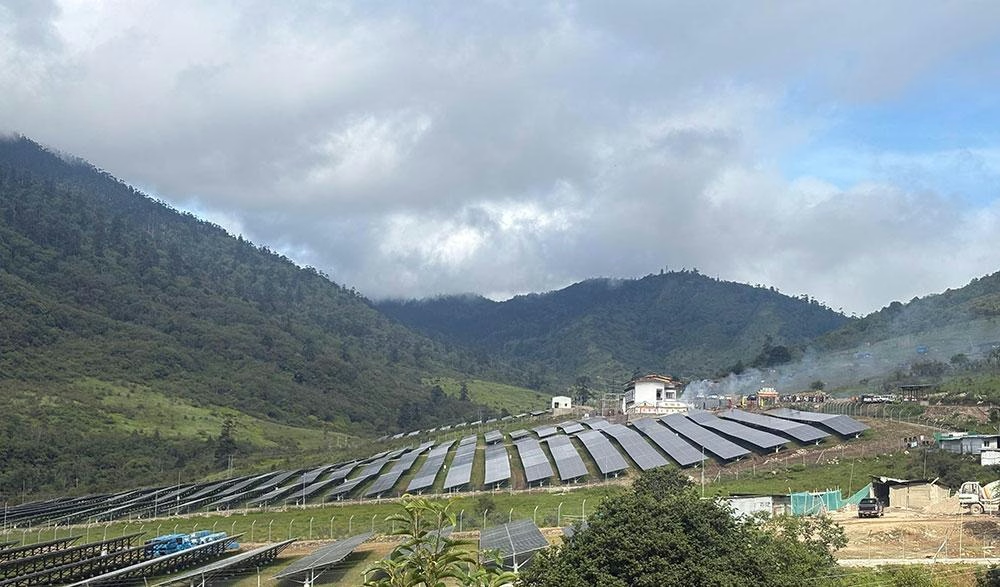
Bhutan's solar ambitions have already transitioned from theoretical planning into concrete action. The nation's first utility-scale solar installation, the Sephu Solar Power Plant (22.38MWp capacity), has already begun operations and is delivering measurable results. Since commencing generation in July 2025, this pioneering facility has produced approximately 29 million electricity units and generated roughly Nu 113 million in revenue—demonstrating the commercial viability of large-scale solar in Bhutanese conditions.
The success of Sephu serves as a critical validation for the broader solar strategy. It provides real-world data on how utility-scale solar installations can integrate into Bhutan's existing electrical grid and complement hydropower generation during lean seasons.
Beyond Sephu, multiple projects are progressing through various development stages:
Active Construction & Development:
- Druk Green Power Corporation's 120MWp Jamjee Solar Project—currently under construction
- Privately developed 146MWp Jungzhi Solar Project—preparing for construction phase
- 200kWp Ecoluxe Solar Power Plant in Bumthang—already commissioned
Pipeline Projects:
- DGPC's 120MWp Wobthang Solar Project in Bumthang—in bidding stage
This staggered development approach allows Bhutan to learn from each project's operational experience while building toward its ambitious capacity targets.
💰 The Investment Challenge: USD 4.6 Billion Required
Achieving Bhutan's vision requires substantial financial commitment. The government has set an ambitious target of reaching 5,000MW of total generation capacity by 2040—a significant expansion from the current installed capacity of approximately 3,576MW, which comprises primarily hydropower installations including the recently commissioned 1,020MW Punatsangchhu-II project and several smaller DGPC facilities.
Reaching this 5,000MW milestone will demand an estimated USD 4.6 billion in investment—a considerable sum for a nation with Bhutan's GDP. This funding will be mobilized through a diversified approach:
- Government-backed DGPC projects - The majority of new capacity will be developed by Druk Green Power Corporation with government support
- Private sector investment - Independent developers will contribute capacity through competitive bidding and development agreements
- Foreign direct investment (FDI) - International investors and development partners will provide capital
- Commercial financing - Banks and financial institutions will fund projects through conventional lending mechanisms
This multi-source financing strategy reflects Bhutan's pragmatic approach to mobilizing the capital necessary for energy transformation.
🌍 Solar as Complement, Not Replacement
A crucial distinction shapes Bhutan's solar strategy: the National Energy Policy 2025 explicitly positions solar as a complementary technology to hydropower, not as a replacement. This nuanced approach acknowledges hydropower's continued importance while addressing its seasonal vulnerabilities.
The strategic logic is elegant: solar generation peaks during dry seasons when hydropower production declines due to reduced water flows. This inverse seasonal pattern creates natural synergy—solar fills the energy gap that hydropower cannot during winter months when demand rises for heating.
This complementary approach offers several advantages:
- Optimized resource utilization - Each technology operates at peak efficiency during its favorable season
- Enhanced grid stability - Diverse generation sources reduce vulnerability to single-source disruptions
- Extended energy independence - Combined capacity provides greater self-sufficiency
- Environmental preservation - Reduced dam construction needs protect river ecosystems
📊 Reducing Import Dependence: Concrete Targets
Bhutan has established specific, measurable objectives for reducing electricity imports. The Department of Energy aims to cut imports by at least 10 percent by 2029–30, with the ultimate goal of eliminating import dependency entirely by 2040.
The Renewable Energy Development Roadmap 2024 projects an even more optimistic timeline, suggesting Bhutan could achieve complete energy independence by 2035 if planned projects proceed as scheduled. These timelines, while ambitious, reflect confidence in the solar sector's trajectory and the feasibility of identified projects.
Successful achievement of these targets would represent a transformative shift in Bhutan's energy sovereignty and economic resilience.
🤝 Public-Private Partnership Models
Recognizing that government resources alone cannot fund this transformation, Bhutan is actively encouraging private sector participation. Both domestic and international developers have identified potential solar sites across multiple dzongkhags.
Private developers have selected locations in:
- Paro - Western gateway region
- Thimphu - Capital city area with high electricity demand
- Wangdue - Central region with strong solar potential
- Trongsa - Eastern central zone
- Bumthang - High-altitude eastern region
The DoE recognizes that private sector site selection may be influenced by operational convenience and proximity to existing infrastructure. However, all projects—whether public or private—must undergo rigorous feasibility assessments and obtain necessary environmental and regulatory approvals.
The government is actively exploring multiple engagement models:
- Public-Private Partnerships (PPPs) - Collaborative projects combining public planning with private efficiency
- Independent Power Producer (IPP) arrangements - Private developers build and operate plants under long-term power purchase agreements
- Foreign Direct Investment (FDI) frameworks - International investors finance and develop projects
🌱 Land Use Considerations and Sustainability
As solar development accelerates, land use emerges as an important consideration. The DoE has explicitly stated that identified projects are not intended to utilize agricultural, forest, or community lands—a commitment reflecting Bhutan's constitutional environmental mandates and cultural values.
However, innovative approaches like agri-voltaic systems—which combine agricultural production with solar generation on the same land—present opportunities for future expansion. Such integrated projects would require appropriate regulatory frameworks and environmental clearances but could optimize land utilization while maintaining agricultural productivity.
This sustainability-conscious approach aligns with Bhutan's global reputation as an environmental steward and its commitment to maintaining at least 60 percent forest cover.
🔮 What Lies Ahead: The Path to 2040
Bhutan's solar power initiative represents far more than a technical energy solution—it embodies a strategic response to climate change while positioning the nation for long-term economic resilience. The convergence of identified solar resources, committed investment, operational pilot projects, and supportive policy frameworks creates genuine momentum for transformation.
The Sephu Solar Power Plant's early success has validated the technical and economic viability of utility-scale solar in Bhutanese conditions. With 310 identified sites and 4,300MW of potential capacity awaiting development, Bhutan possesses the resource foundation necessary to achieve its ambitious 5,000MW target.
Successful execution of this strategy would deliver multiple benefits: enhanced energy security, reduced import dependence, economic growth through project development and employment, and continued environmental leadership. As climate change intensifies pressures on hydropower systems globally, Bhutan's integrated renewable energy approach offers a compelling model for other mountain nations facing similar challenges.
The race toward solar energy independence is well underway, and the coming years will prove whether Bhutan can successfully harness its abundant sunshine to power a prosperous and secure future.
You May Also Like
Environment
Climate Crisis in the Himalayas: Bhutan's Cold Reminder
August 29, 2026
Environment
WBH Conservation Project Delivers Clean Water to Rural Homes
August 29, 2026
Environment
HKH Climate Crisis: Why Regional Unity Matters Now
August 29, 2026

Environment
Matsutake Decline: Ura's Fight to Save Its Forest Treasure
August 25, 2026