Category:
CultureThongsa's Cotton Weavers Face Existential Crisis
A Heritage Under Siege 🧵
High in the remote mountains of Bhutan's Thongsa district, a quiet crisis is unfolding. The ancient art of hand-weaving cotton—a tradition woven into the cultural fabric of communities for generations—faces an uncertain future. In the tranquil Chongshing Gewog, thirteen dedicated women are fighting to preserve their ancestral craft, but mounting pressures threaten to unravel centuries of expertise and cultural identity.
The story of Thongsa's cotton weavers is one of resilience, but also of vulnerability. These artisans represent far more than a cottage industry; they embody a living connection to Bhutan's pre-industrial past, a time when communities were self-sufficient and every garment told a story of place, season, and skill.
The Art of Thongsa Kamthagma: From Soil to Textile ✨
The journey of a traditional Thongsa Kamthagma garment begins not at the loom, but in the earth. Weavers in Chongshing Gewog cultivate cotton entirely within their village, maintaining complete control over the production cycle from seed to finished cloth. This vertical integration of textile production is increasingly rare in the modern world, making their approach both economically challenging and culturally invaluable.
The agricultural phase demands extraordinary dedication. Farmers plant cotton seeds during late winter and early spring, then invest months of labor nurturing the crop through its growth cycle. The work is relentless—the plants require at least five rounds of weeding spread across several months, each intervention carefully timed to ensure optimal plant health and maximize yield potential.
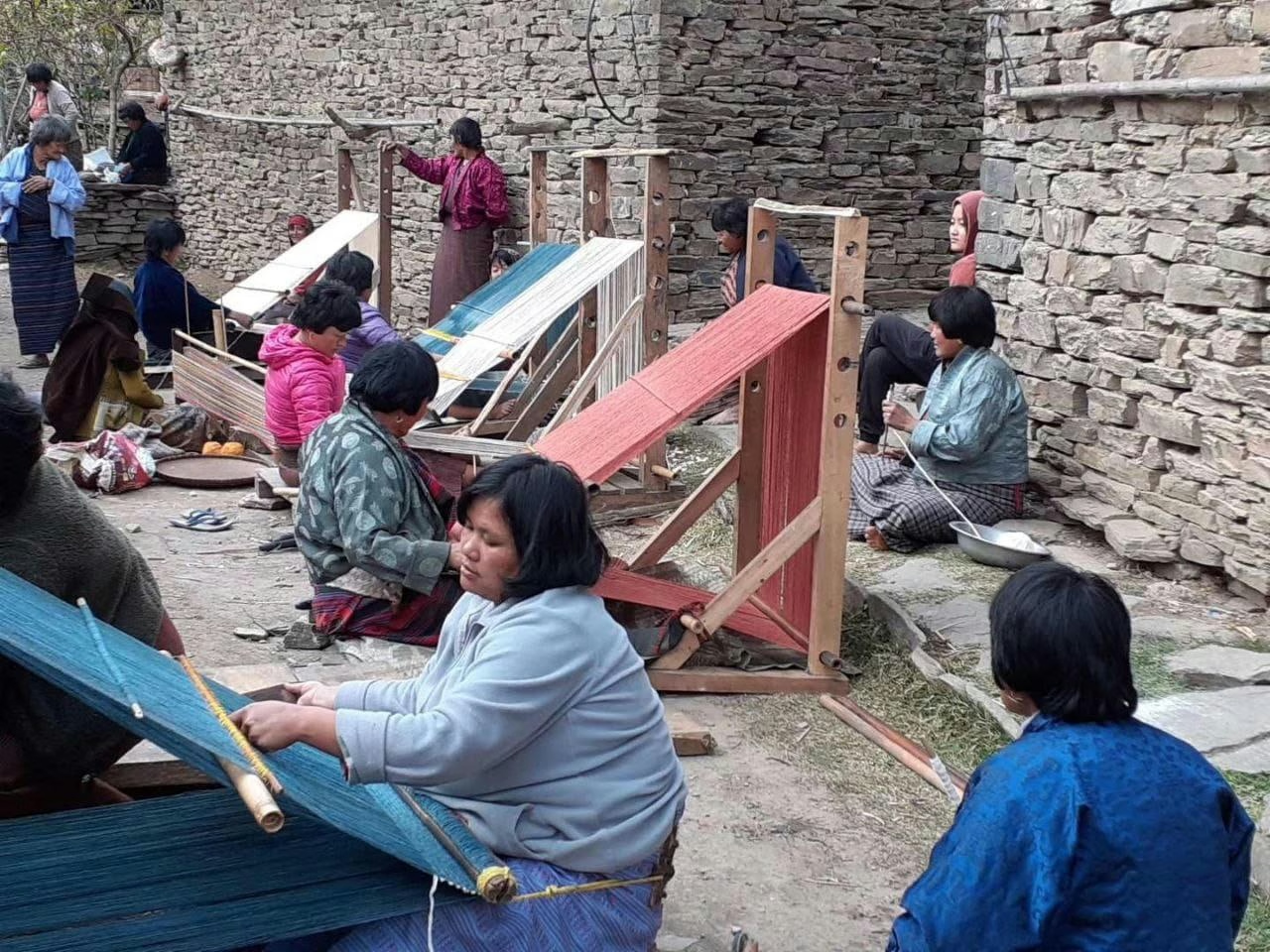
When autumn arrives, the cotton bolls are harvested entirely by hand—a labor-intensive process that cannot be mechanized without compromising quality. The freshly picked bolls are dried under the mountain sun, then brought home for processing. What follows is a meticulous sequence of steps: removing seeds from the fiber, carding to clean and loosen the material, and finally hand-spinning into yarn using traditional methods passed down through countless generations.
Namkha Wangmo, a prominent member of the weaving collective, describes the process with the authority of someone who has dedicated her life to the craft. "Growing cotton demands immense patience and hard work," she explains, emphasizing that every step requires attention and expertise developed over years of practice.
The Chemistry of Color: Natural Dyes and Tradition 🌈
What distinguishes Thongsa textiles from mass-produced alternatives is the use of natural dyes sourced directly from the community's botanical resources. This practice connects the weavers to their environment in profound ways, making each garment a reflection of local ecology and seasonal availability.
Turmeric from local gardens produces warm yellows. Indigo, cultivated in the region, yields deep blues. When these two are combined in precise ratios, they create distinctive greens found nowhere else. Additional plant mixtures—carefully guarded family recipes—produce the full spectrum of colors that characterize authentic Thongsa textiles. After dyeing, the threads are dried once more in the sun before being arranged on the loom for weaving.
This entire process—from cotton seed to finished garment—can take several months, with each step requiring specialized knowledge and considerable physical labor. The resulting textiles are therefore not merely clothing; they are embodiments of cultural knowledge, environmental stewardship, and artistic vision.
Growth and Momentum: The Thongsa Kamthagma Story 📈
The Thongsa Kamthagma weaving group was formally established in 2017, representing an effort to formalize and revitalize the tradition. The initiative showed promise—membership grew from just four founding members to thirteen active weavers, suggesting renewed interest in preserving the craft. This expansion represented a small but significant victory against the tide of cultural erosion affecting rural Bhutan.
The group's formation coincided with broader national efforts to support traditional crafts. Bhutan's government has increasingly recognized that cultural preservation is integral to the nation's development philosophy, particularly as the country navigates modernization while maintaining its unique identity. Support for initiatives like the Thongsa Kamthagma group reflects this commitment.
The Demographic Crisis: When Youth Turn Away 😔
Yet beneath these positive developments lies a troubling demographic reality. The current membership of the weaving collective consists almost entirely of women in their 40s and 50s. Even the youngest active weaver has already reached her forties—a fact that starkly illustrates the generational gap threatening the craft's survival.
This aging profile reflects a broader crisis affecting rural Bhutanese communities. Young people, increasingly attracted to urban opportunities and modern livelihoods, show little interest in traditional crafts. The gewog data paints a sobering picture: Chongshing has only 434 residents spread across 220 households, with a mere 15 residents aged 15 to 29. Perhaps most alarming, 45 houses stand empty—gungtongs in local terminology—testament to rural depopulation.
Namkha Wangmo articulates the fundamental challenge: "The youths are less interested in the tradition, in addition to having little population in our gewog." This statement encapsulates two interconnected problems—cultural disengagement and demographic collapse—that reinforce each other in a downward spiral.
Economic Pressures and Import Competition 💰
Even for those young people who might consider weaving, economic realities present formidable obstacles. A locally woven traditional set commands a price of approximately 13,000 to 14,000 Bhutanese Ngultrum, reflecting the true cost of hand-crafted production. Imported textiles, however, cost considerably less, undercutting local artisans at every turn.
This price differential has profound implications. Buyers, particularly younger consumers less attached to traditional practices, naturally gravitate toward cheaper imports. The economic logic seems inescapable: why pay premium prices for locally made cloth when imported alternatives are available at a fraction of the cost? For young people considering career options, the financial case for weaving becomes increasingly difficult to justify.
Chongshing Gup Pema Dorji acknowledges this challenge directly. While local authorities are actively raising awareness about the cultural and economic value of preserving the tradition, he recognizes that competition from cheaper imports discourages young people from pursuing weaving as a livelihood. The gewog is working to help weavers showcase their products and provide other forms of support, but these efforts struggle against powerful market forces.
Climate Chaos: The Environmental Catastrophe 🌍
If demographic and economic pressures were not sufficient, climate change has emerged as perhaps the most immediate and devastating threat to cotton cultivation in the region. The weavers report increasingly unpredictable weather patterns—excessive sun followed by intense rainfall, erratic temperature fluctuations, and disrupted seasonal cycles that have devastated harvests.
The impact has been catastrophic. Namkha Wangmo cultivates cotton on 60 decimals of land (approximately 0.6 hectares). In previous years, this plot reliably produced around 700 kilograms of cotton annually. This year, she harvested only 60 kilograms—a staggering 91% decline representing a complete collapse of expected productivity.
Tshering Peldon, a 55-year-old weaver, experienced an even more dramatic reversal. Her four-acre plot, which yielded approximately 2,000 kilograms last year, produced merely 60 kilograms this season. These are not marginal fluctuations; they represent the difference between viable livelihoods and economic devastation.
The weavers recognize that if such weather patterns persist—and climate science suggests they will intensify—the sharp decline in harvests could fundamentally undermine their primary source of income. Beyond individual hardship, this threatens the survival of an entire cultural tradition and the rural economy of Chongshing Gewog.
The Interconnected Crisis: When Challenges Compound 🔗
What makes the situation particularly dire is how these challenges reinforce each other. Climate-induced crop failures reduce the raw materials available for weaving, making the craft less economically viable. Lower viability discourages young people from learning the tradition. As fewer young people engage with weaving, knowledge transmission breaks down, and the craft becomes increasingly associated with aging practitioners. This cultural erosion further reduces market appeal and social prestige, completing a vicious cycle.
Moreover, rural depopulation exacerbates each problem. With fewer young people remaining in the gewog, there is less local demand for traditional textiles and fewer potential apprentices to learn the craft. The community becomes too small to sustain cultural transmission, even if economic conditions were favorable.
Preservation Efforts and the Road Ahead 🛤️
Local authorities are not passive observers of this unfolding crisis. Chongshing Gewog is actively working to raise awareness among young people about the cultural significance and income-generating potential of traditional weaving. Efforts include product showcasing initiatives and various forms of support for established weavers. These interventions represent genuine commitment to cultural preservation at the grassroots level.
However, Gup Pema Dorji expresses realistic pessimism about the tradition's prospects without more substantial intervention. The challenges are structural and deeply rooted—individual awareness campaigns cannot overcome the combined weight of demographic decline, economic competition, and environmental catastrophe.
What This Means for Bhutan's Cultural Future 🏔️
The struggle of Thongsa's cotton weavers extends far beyond a single gewog or even a single craft. It represents a microcosm of the broader tension between cultural preservation and modernity that Bhutan navigates constantly. As the nation pursues development and integration into the global economy, traditions like cotton weaving face existential pressure.
Yet these traditions carry irreplaceable value. They represent embodied knowledge developed over centuries, connections to place and environment, and ways of organizing work and community that offer alternatives to industrial capitalism. Once lost, such traditions cannot be easily reconstructed—the knowledge dies with the practitioners, and cultural memory becomes historical artifact rather than living practice.
Conclusion: A Call to Action 🎯
The situation facing Thongsa's cotton weavers demands urgent, multifaceted response. Climate adaptation strategies must be developed to help farmers cope with unpredictable weather. Economic support mechanisms could help local textiles compete with imports. Educational initiatives might rekindle young people's interest in traditional crafts. Most fundamentally, broader societal recognition of cultural value—beyond mere economic metrics—is essential.
The thirteen women of Chongshing Gewog continue their work, maintaining a tradition that connects them to ancestors and to the land. Their dedication deserves more than sympathetic acknowledgment; it demands concrete support and systemic change. The future of Thongsa's textile heritage—and by extension, Bhutan's cultural richness—depends on choices made in the coming months and years. The clock is ticking, and the window for intervention is narrowing with each passing season.
You May Also Like
Culture
German Architect Manfred Gerner: 30 Years Preserving Bhutan's Heritage
November 25, 2026
Culture
Nabhorok: The Sacred Oath of Himalayan Friendship
November 21, 2026
Culture
Traditional Mask Artisans Seek Certification to Preserve Craft
November 14, 2026
Culture
GMC: Bhutan's Sacred Sanctuary as Global Vajrayana Buddhism Hub
November 11, 2026