Category:
CultureNabhorok: The Sacred Oath of Himalayan Friendship
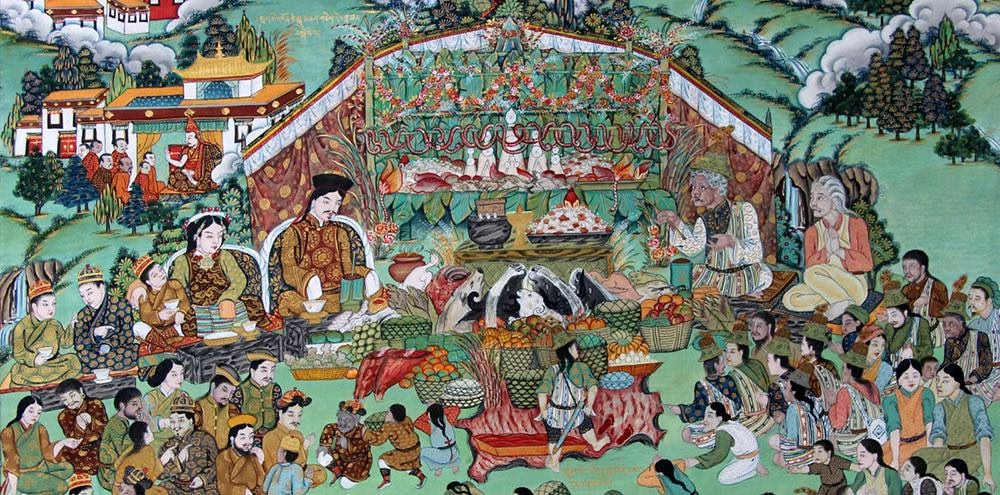
Understanding Nabhorok: A Timeless Tradition 🤝
Deep within Bhutanese folklore lies a profound belief that every oath sworn carries a spiritual weight—each vow severs a nerve in the body, making the commitment irreversible and sacred. This ancient wisdom shaped one of the Himalayan region's most meaningful practices: Nabhorok, a ritual bond between families that transcends ordinary friendship. The term itself reveals layers of cultural significance, breaking down into three essential components: "na" (oath), "bho" (summon), and "rok" (friend)—together forming the concept of a companion who answers the call to support through life's greatest challenges.
Nabhorok represents far more than a casual agreement between households. It embodies a philosophical approach to kinship and mutual obligation that has sustained communities across the eastern Himalayas for centuries. Those who entered into such bonds understood they were making lifetime commitments, sealed not merely by words but by ritual, intention, and spiritual witness.
The Sacred Ritual of Oath-Binding ✨
The ceremony establishing Nabhorok maintains an elegant simplicity that belies its profound significance. When two families decided to bind themselves through oath, they would gather for a ceremonial meal or shared drink—a moment laden with intentionality and reverence.
The ritual unfolds through carefully observed steps:
- Preparation and offerings are made to invoke protective deities, most notably Palden Lhamo, the fierce protector of Bhutan
- Solemn vows are exchanged, with both families pledging mutual support through all life's tribulations and sorrows
- Spiritual consequence is invoked—participants agree that should they betray the oath, the very sustenance before them would transform into poison
- Binding documentation is created, typically inscribed on traditional daysho paper and bound with red tora cloth
This ceremonial framework transformed abstract promises into tangible, spiritually enforced commitments. The threat of poisoning served not as literal danger but as metaphorical representation of the oath-breaker's spiritual corruption and social death.
A Historic Bond: The Sisi Cheum and Rhenock Athing Families 🏰
The mid-twentieth century witnessed a remarkable example of Nabhorok tradition when two distinguished households—one Bhutanese, one Sikkimese—formalized their eternal friendship through oath. This union linked families whose histories intertwined with the political destinies of their respective nations.
The Bhutanese side brought the Sisi Cheum, a noble lineage of extraordinary historical importance. This distinguished house produced three of Bhutan's most significant Druk Desis—the 19th, 21st, and 23rd holders of that prestigious title. The family's prominence traced back to their early support of Zhabdrung Ngawang Namgyal during his foundational years in Bhutan, earning them the coveted title "Cheum" bestowed by the nation's spiritual and temporal leader.
Across the mountain ranges stood the Sikkimese family of Rhenock Athing, descendants of warriors and statesmen. Their ancestor Chagzöd Chogthub had earned his place in regional history through military valor, fighting against the invading Gorkha forces during a critical period of Himalayan conflict. This lineage of service continued through subsequent generations, including Sonam Dahdul (1883–1965), who rose through the Sikkimese court hierarchy to become Chief Officer of the royal guard, manager of the Chogyal's private estates, and ultimately Private Secretary and State Council member. In 1926, during King Emperor's birthday honours, Sonam Dahdul received the title Rai Sahib, recognition of his decades of distinguished service.
The Personal Connection: Dasho Gaza and Aum Phub Sithub 💫
The direct linkage between these two powerful families came through an intimate family connection. In 1943, Dasho Gaza (1930–2019), a respected royal servant in the court of Bhutan's Second King, married Aum Phub Sithub (1929–1954), daughter of the Sisi Cheum's Choezhi Nado. The couple's union produced two daughters: Singye Dem (born 1945) and Sangay Dem (1949–1989).
Tragedies often test the strength of family bonds, and Dasho Gaza faced such a trial when his beloved wife passed away in 1954 after merely eleven years of marriage. Singye Dem would later recall that her father, then only 24 years old, demonstrated his devotion through traditional means—completing the elaborate funerary rituals in Bhutan before undertaking a spiritual pilgrimage to Lhasa, where he offered 1,000 butter lamps in his late wife's memory.
During his return journey from this sacred pilgrimage, Dasho Gaza made a fateful stop in Sikkim to visit his late wife's blood relatives, the family of Rhenock Athing Rai Sahib Sonam Dahdul. Yet this initial encounter proved uncomfortable. Singye Dem recounted that her father felt deeply self-conscious during the visit, believing his Sikkimese hosts possessed a more refined sophistication in their lifestyle and appearance. The cultural gap—real or perceived—weighed heavily on Dasho Gaza, who felt inadequate in his presentation and demeanor. Overwhelmed by these feelings of embarrassment, he abbreviated his stay and returned to Bhutan, his heart perhaps harboring unresolved tensions.
Bridging the Distance: Reconciliation and Renewal 🌉
A decade passed before the two families would reconnect, but when they did, the reunion carried profound significance. In 1964, the Sikkimese family undertook the journey to Bhutan, spending several days at the Sisi Cheum manor in Sisina. This return visit marked a turning point in the relationship.
Singye Dem vividly remembered her Sikkimese relatives carrying with them a sealed agreement document—the physical manifestation of their Nabhorok oath. She recalled glimpsing the deed, inscribed on traditional daysho paper and bound with red tora cloth, preserved in her family's home. Though this precious document has since been misplaced, its temporary appearance served as powerful reminder of the spiritual contract binding the families across generations and geography.
The visit proved transformative for Singye Dem herself. Five years later, in 1969, she traveled to Sikkim with greater confidence and preparation than her father had mustered. Unlike Dasho Gaza's abbreviated stay, Singye Dem remained for five nights, fully immersing herself in her relatives' world. She recalled the splendor of their grand residence, complete with peacocks wandering the grounds—symbols of wealth and sophistication that had once intimidated her father now impressed her as testament to her family's connection to such distinguished people.
The Practical Legacy: Innovation and Enterprise 🐓
Beyond the ceremonial and emotional dimensions of Nabhorok, the families' bond manifested in practical, entrepreneurial ways. Singye Dem's memories of her 1969 visit included witnessing an artificial incubator—a remarkable technological innovation for the era—that her Sikkimese relatives used for hatching Rhode Island Red chickens, a breed prized for egg production.
This detail connects to broader historical accounts confirmed through family descendants. Yarpa Tse Ten Tashi (1911–1971), grandfather to Tenzin C. Tashi (who now resides in Gangtok), pioneered modern poultry farming in Sikkim. According to family records, Yarpa Tse Ten sold his Rhode Island Red eggs to the India House, the Palace, and various notable establishments throughout the region. This agricultural enterprise represented the kind of practical cooperation that Nabhorok bonds facilitated—knowledge transfer, business opportunity, and mutual prosperity flowing naturally from the deeper spiritual and familial connection.
Ancient Roots: Blood Brotherhood in the Himalayan Tradition 🏔️
While the twentieth-century Nabhorok between Sisi Cheum and Rhenock Athing represents a compelling modern example, oath-bound kinship practices in the eastern Himalayas trace back considerably further into antiquity. Historical and anthropological records reveal that such sacred pacts formed the foundation of inter-ethnic and inter-family relationships for over a millennium.
One of the most significant documented examples dates to the thirteenth century, when Tibetan chief Gye Bumsa and Lepcha chief Thekong Tek swore an eternal, hereditary blood brotherhood pact. This oath transcended mere friendship or political alliance—it established a bond intended to persist across generations, binding descendants to the same obligations as the original oath-takers.
The ceremony accompanying this ancient blood brotherhood reveals the gravity with which such oaths were undertaken. The ritual involved raw animal hides, entrails, and feet placed in a vessel of blood, with local deities called upon to witness the proceedings. Powerful curses were invoked against any who would betray the oath, creating spiritual consequences far more terrifying than physical punishment. Many scholars and cultural historians link this ancient ritual to the modern Pang Lhabsol festival, celebrated annually on the fifteenth day of the seventh month of the Tibetan lunar calendar, suggesting continuity of cultural memory and practice across centuries.
Political Dimensions: Oaths and Succession in Sikkim 👑
The historical significance of oath-bound relationships extended into the political sphere, where such bonds influenced succession disputes and territorial control. According to The Royal History of Sikkim: A Chronicle of the House of the Namgyal, as narrated by the Ninth Chogyal Thutob Namgyal and Gyalmo Yeshe Dolma, the third Chogyal Chagdor Namgyal (r.1700–1717) faced a succession crisis rooted in complex family relationships and competing claims.
Chagdor Namgyal's older half-sister, Sem Phande Wangmo, posed a potential threat to his succession. Sem Phande Wangmo's mother, Nambi Ongmo, was Bhutanese and had served as one of the queens of Sikkim's Second Chogyal—a connection that created potential Bhutanese interest in Sikkimese succession. To secure young Chagdor Namgyal's safety, supporters including Yugthing Deshey and monk Agyal Pobdig spirited him away to Tibet.
Meanwhile, the Second Chogyal's natural son, Yugthing Arub, remained at Rabtentse Palace under the charge of the Lhopos and Lepchas. This vulnerable position left him exposed when Bhutanese militia, led by Tasa Ngawang Thinley and Dron Phenlay, invaded Sikkim. They captured Arub, seized the palace, and occupied it for nearly eight years—a military occupation that demonstrated how oath-bound relationships between regional powers could dramatically shift political fortunes.
Following his capture, Arub was transported to Bhutan and imprisoned by Desi Zhidar, who initially responded with anger because Arub had previously thwarted an assassination plot against the young Chogyal. Yet as stories of Arub's extraordinary spiritual and magical abilities circulated among guards—tales of him appearing in two places simultaneously, of knotting warriors' weapons—the Desi's curiosity overcame his anger.
When finally brought before the Desi, Arub demonstrated remarkable composure and spiritual power. He produced a turquoise stone from his hair and offered it as a gift. The Desi, intrigued and testing Arub's reputed abilities, placed two swords before the prisoner and issued an ultimatum: demonstrate the magical powers attributed to him or face execution. Arub calmly knotted both swords, his spiritual mastery evident to all witnesses. Such moments of demonstrated spiritual power often influenced political outcomes, suggesting that oath-bound relationships and spiritual authority intertwined in complex ways throughout Himalayan political history.
Nabhorok in Contemporary Context 🌍
Today, the practice of Nabhorok has largely faded from active use among Bhutanese families, though its cultural memory persists. The modernization of society, increased geographic mobility, and changing family structures have reduced the prevalence of such formal oath-binding ceremonies. Yet the tradition remains culturally significant as a window into Bhutanese values regarding loyalty, mutual obligation, and the spiritual weight of commitments.
The story of the Sisi Cheum and Rhenock Athing families serves as a poignant reminder of how such bonds functioned in practice—not as abstract philosophical concepts but as living relationships that bridged geographic distance, cultural differences, and personal insecurities. The initial awkwardness of Dasho Gaza's visit, followed by eventual reconciliation and genuine familial connection, demonstrates the resilience of bonds formed through oath and intention.
Key Takeaways: Understanding Sacred Friendship 🔑
The Nabhorok tradition encapsulates several profound insights about Himalayan culture and human relationships:
- Spiritual accountability matters more than legal enforcement—the belief that oath-breakers face cosmic consequences creates powerful deterrents
- Ritual and ceremony transform abstract promises into tangible, memorable commitments with lasting psychological and social force
- Intergenerational bonds created through oath persist across generations, creating networks of mutual obligation and support
- Cross-cultural connection becomes possible when families commit to understanding and accepting differences
- Practical cooperation naturally flows from deeper spiritual and familial bonds
The Nabhorok tradition represents a sophisticated approach to building and maintaining social cohesion in pre-modern Himalayan societies. As contemporary Bhutan navigates modernization while seeking to preserve cultural heritage, understanding practices like Nabhorok offers valuable lessons about commitment, community, and the enduring power of sacred promises.
You May Also Like
Culture
Traditional Mask Artisans Seek Certification to Preserve Craft
November 14, 2026
Culture
GMC: Bhutan's Sacred Sanctuary as Global Vajrayana Buddhism Hub
November 11, 2026
Culture
108 Jangchub Chortens: Bhutan's Historic Monument to Unity
November 7, 2026
Culture
Tunnel 26 Secures Historic International Distribution Deal
November 7, 2026