Category:
NewsPongchula Airport Cancellation: Eastern Bhutan's Connectivity Crisis
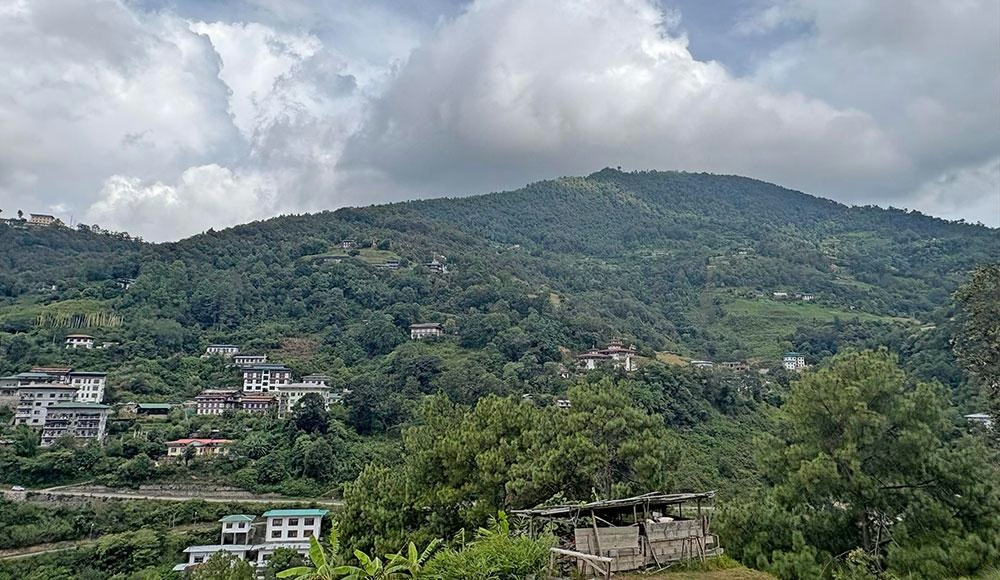
A Dream Deferred: The Pongchula Airport Story 🌍
The eastern dzongkhags of Bhutan face a significant setback as technical assessments have concluded that the proposed Pongchula airport development is fundamentally unsuitable for aviation operations. After seven years of comprehensive evaluation, government agencies have determined that geographical constraints make the site unviable for commercial air traffic, leaving residents in Mongar grappling with dashed expectations and unfulfilled electoral promises.
This decision represents more than just a failed infrastructure project—it reflects the broader challenges of connectivity and economic development in Bhutan's remote eastern regions, where geographical terrain continues to pose formidable obstacles to progress.
The Foundation of Hope: Why Mongar Needed an Airport ✈️
Mongar's aspiration for an airport emerged from legitimate connectivity challenges. The existing Yonphula Domestic Airport, while historically significant, has become increasingly unreliable due to weather-related disruptions that frequently ground flights and disrupt travel schedules. For a region that serves as the central hub for eastern Bhutan's healthcare, commerce, and administrative functions, such interruptions create cascading problems across multiple sectors.
The proposed Pongchula airport was envisioned as a transformative infrastructure project that would:
- Enhance regional connectivity: Direct flights from Paro would reduce travel time from 8-10 hours to approximately 45 minutes
- Support economic development: Improved accessibility would attract tourism and facilitate business expansion
- Strengthen healthcare services: The regional referral hospital would benefit from faster patient transfers and specialist access
- Create employment opportunities: Construction and ongoing operations would generate local jobs
- Reduce transportation costs: Lower flight times would decrease operational expenses for regional services
Community Expectations and Personal Aspirations 💭
For residents like Sonam Zangmo, a 46-year-old farmer from Phosorong village just six kilometres from Mongar town, the airport represented tangible economic opportunity. She and her neighbors envisioned opening homestays, launching small tourism-related businesses, and diversifying income streams beyond subsistence agriculture. The prospect of welcoming international visitors directly to their doorstep symbolized integration into Bhutan's growing tourism economy.
Kinley Tshering, a 55-year-old community member, articulated the broader regional perspective: an airport in Mongar would have benefited all eastern dzongkhags by reducing travel time and expenses for residents, patients, and business travelers alike. Given that the eastern region comprises approximately 20 percent of Bhutan's population and 30 percent of its settlements, the connectivity implications were substantial.
The emotional investment extended beyond mere optimism. Community members invested significant labor, hospitality, and hope in supporting survey teams over multiple years. Residents cleared dense forest pathways, carried meals and refreshments up mountainous terrain, and took turns cooking for technical personnel—all without direct compensation, driven by genuine belief in the project's viability.
The Technical Reality: Seven Years of Assessment 📊
Initial feasibility studies conducted in 2018 identified significant geographical challenges, including terrain misalignment, narrow operational space, and potential crosswind complications. However, these preliminary findings did not definitively close the door on the project.
A comprehensive reassessment spanning from May 2021 through May 2025 provided definitive answers. This multi-agency study, coordinated by the Department of Air Transport and the Bhutan Civil Aviation Authority in collaboration with the National Centre for Hydrology and Meteorology, Department of Infrastructure Development, National Land Commission, and local airlines, revealed critical constraints:
Wind Analysis: Contrary to initial concerns, comprehensive wind data demonstrated that 95 percent of recorded wind speeds remained at or below eight knots, effectively eliminating crosswind hazards as a primary barrier.
Terrain Limitations: The fundamental problem proved insurmountable—even with substantial earthworks, the maximum achievable runway length would be approximately 1,000 metres. This length falls significantly short of requirements for standard commercial aircraft operations.
Aircraft Incompatibility: The ATR 42-600 turboprop aircraft currently used for Bhutan's domestic services and the PC-24 jets considered for regional expansion both require runway lengths exceeding 1,000 metres for safe operations under normal conditions.
Financial Constraints: Terrain modification alone would require approximately 641 million Ngultrum in expenditure, excluding actual airstrip construction, landing infrastructure, and operational facilities.
The Disappointment Factor: Political Promises and Public Trust 🗳️
The Pongchula airport cancellation carries particular sting because the project had been prominently featured in electoral campaigns. Political parties had championed the airport as a development priority, generating public enthusiasm that now transforms into frustration and cynicism.
One frustrated voter expressed the sentiment succinctly: "If any political party comes with a pledge about the airport, we will not vote for them." This reaction reflects broader concerns about electoral accountability and the disconnect between campaign promises and feasibility assessments.
Mongar Member of Parliament Naiten Wangchuk acknowledged these concerns while attempting to reframe the discussion. He noted that while Pongchula itself may not be immediately viable, aviation connectivity remains essential for long-term eastern regional development. The MP emphasized that poor connectivity continues to represent a major constraint on tourism expansion, economic growth, and poverty reduction initiatives.
Alternative Pathways Forward 🛤️
Rather than abandoning the connectivity agenda, government discussions have shifted toward exploring multiple approaches:
Alternative Site Studies: Technical feasibility assessments are continuing for Nganglam and other potentially suitable locations in the eastern region. These studies will employ the same rigorous evaluation standards applied to Pongchula.
Economic Corridor Development: Enhanced coordination between aviation authorities and the Department of Roads aims to develop strategic economic corridors that leverage existing transportation infrastructure while identifying future connectivity opportunities.
Helicopter Services Enhancement: Policy reviews are examining helicopter procurement and remote-area subsidy programs as interim connectivity solutions for underserved communities.
Road Infrastructure Investment: Shorter, road-connected economic hubs offer a complementary approach to aviation development, potentially providing cost-effective connectivity improvements while supporting regional commerce.
Capacity Building: Any future aviation services will require adequate technical personnel, including pilots, engineers, and maintenance specialists. Workforce development initiatives must precede infrastructure expansion.
Broader Context: Bhutan's Aviation Development Strategy 🌏
Bhutan's aviation sector has experienced significant evolution over recent decades. The nation operates a carefully calibrated air transport system balancing tourism accessibility with environmental preservation and fiscal responsibility. Current domestic services connect Paro International Airport with Yonphula (serving eastern regions) and Bumthang, providing essential connectivity while maintaining operational sustainability.
The challenge of expanding this network reflects global aviation realities. Establishing commercially viable airports in mountainous, sparsely populated regions requires substantial capital investment, technical expertise, and sufficient passenger demand to justify operational costs. Bhutan's experience mirrors challenges faced by other Himalayan nations attempting to balance connectivity aspirations with economic constraints.
The Path Forward: Realistic Expectations and Strategic Planning 📈
The Economic and Finance Committee's recommendations emphasize several critical principles for future development:
- Technical rigor must precede commitment: Substantial public resources should not be allocated without thorough feasibility analysis
- Transparency prevents disappointment: Clear technical communication prevents unrealistic public expectations
- Long-term strategic vision: Aviation connectivity should remain part of regional development strategy even when specific projects prove unviable
- Diversified solutions: Multiple approaches—aviation, road infrastructure, helicopter services—should be pursued simultaneously
- Parliamentary accountability: Regular updates to elected representatives ensure accurate information reaches constituents
Lessons for Regional Development 💡
The Pongchula experience offers valuable lessons for infrastructure planning in developing nations with challenging geography. Key takeaways include:
1. Separate Campaign Promises from Technical Feasibility: Electoral commitments should be grounded in preliminary technical assessment to avoid raising false hopes.
2. Invest in Early-Stage Research: Comprehensive feasibility studies conducted before electoral campaigns prevent costly misalignments between political promises and reality.
3. Maintain Community Engagement: Regular, honest communication with affected populations demonstrates respect and builds long-term trust even when outcomes disappoint.
4. Pursue Complementary Strategies: Single-solution approaches often fail in complex development contexts; diversified strategies prove more resilient.
5. Recognize Regional Equity: Eastern Bhutan's connectivity challenges deserve sustained attention through alternative mechanisms when specific projects prove unviable.
Moving Forward: Hope and Realism 🌟
While the Pongchula airport cancellation represents a genuine setback for Mongar residents and eastern Bhutanese communities, it need not represent the end of connectivity improvements. The government's commitment to exploring alternative sites, strengthening road infrastructure, and pursuing helicopter services demonstrates ongoing recognition of regional development needs.
Mongar Member of Parliament Naiten Wangchuk's acknowledgment that "aviation connectivity should remain part of the long-term development strategy" signals that the conversation continues rather than concludes. The eastern region's 20 percent population share and 30 percent settlement proportion justify sustained investment in connectivity solutions.
For residents like Sonam Zangmo and Kinley Tshering, the immediate disappointment will gradually transform into pragmatic engagement with alternative development strategies. The labor they invested in supporting survey teams, while not directly productive toward an airport, demonstrated community commitment to regional progress—a commitment that remains valuable regardless of which specific projects ultimately succeed.
Bhutan's development path requires balancing optimistic vision with realistic assessment. The Pongchula decision, while disappointing, reflects mature governance prioritizing fiscal responsibility and technical integrity over electoral expediency. As discussions continue regarding alternative connectivity solutions, this foundation of honest assessment offers the best prospect for sustainable, viable improvements to eastern regional connectivity.
You May Also Like
News
Women Entrepreneurs Master AI and Digital Tools in Phuentsholing
September 1, 2026
News
Can Samtse Keep Up With Its Growing Workforce?
August 29, 2026
News
Nepal Flood Exposes Critical Gaps in Bhutan's Early Warning Systems
August 29, 2026
News
High Court Overturns Acquittal: Doctor Sentenced to 10 Years for Child Sexual Abuse
August 29, 2026