Category:
CultureSacred Heart of 108 Chortens: Bhutan's Spiritual Masterpiece
A Vision Taking Shape in Sarpang Dzong 🏛️
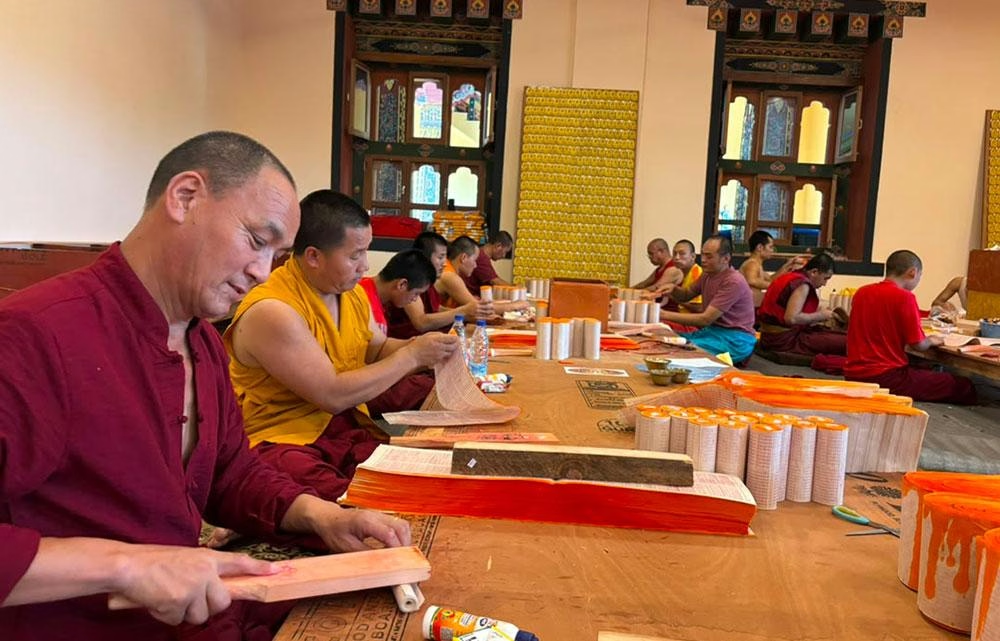
In the sweltering heat of southern Bhutan, an extraordinary spiritual undertaking is unfolding behind the walls of Sarpang Dzong. Monks from monastic institutions across the nation have gathered in a single room, their fingers moving with practiced precision as they prepare the sacred inner essence for 108 chortens that will soon rise along the Mao River in Gelephu Mindfulness City. This ambitious project represents one of the most significant spiritual construction initiatives in contemporary Bhutanese history.
The convergence of these religious scholars—ranging from a 60-year-old master craftsman to a 16-year-old novice—demonstrates the intergenerational transmission of sacred knowledge that has sustained Bhutanese Buddhism for centuries. Their collective effort, undertaken during the oppressive heat of late August, showcases the devotion required to manifest His Majesty The King's visionary project into physical and spiritual reality.
Understanding Thezung: The Spiritual Heart Within 💫
While most visitors to a chorten perceive only its external beauty—the pristine white walls, the graceful dome, and the spire pointing skyward—the true essence lies hidden within. This inner substance, known as thezung, represents the spiritual heart of the structure, invisible to the eye yet fundamental to its sacred purpose.
Thezung comprises far more than simple relics. According to Buddhist tradition, it embodies:
- Sacred relics representing enlightened masters
- Representations of body, mind, and speech of realized beings
- Hand-rolled scriptures and mantras prepared with meticulous care
- Symbolic offerings arranged according to ancient protocols
- The sokshing, a specially prepared wooden pole serving as the spiritual spine
Without thezung, monks explain, a chorten becomes merely an architectural structure—a body without vital force, lacking the spiritual animation that makes it a living beacon of compassion and enlightenment. The preparation of this inner essence demands not only technical expertise but profound spiritual commitment.
The Meticulous Art of Scripture Preparation ✍️
The process begins deceptively simply: sacred texts must be transformed into precisely rolled cylinders through a technique that appears elementary until attempted. Each scroll requires unwavering focus, steady hand pressure, proper alignment, and intuitive understanding of tension and balance.
The fundamental steps involve:
- Positioning the sacred paper with careful attention to alignment
- Guiding the roll with fingertips while maintaining consistent pressure
- Tightening without tearing the delicate material
- Finishing cleanly to prepare for the next roll
- Repeating this meditative process hundreds of times
Sangay Rinchen, a 60-year-old master from Trongsa Dratshang, initially experienced profound uncertainty when learning of the 108-chorten initiative. Throughout his decades of practice, he had prepared relics for individual chortens or small monastic projects—perhaps one or two annually. The prospect of simultaneously preparing sacred hearts for 108 structures seemed incomprehensible.
Yet as weeks progressed within Sarpang Dzong's heat-drenched workshop, the impossible gradually transformed into reality. Stacks of meticulously prepared rolls accumulated, each one a meditation made manifest. "To be part of a project this massive, words cannot express the satisfaction," Rinchen reflected, recognizing that his labor fulfilled both the Dharma and the King's vision for spiritual development.
Knowledge Transfer Across Generations 🧑🏫
At 16 years old, Dorji Wangchuk represents the youngest member of this sacred assembly. Originating from Laya's cool alpine regions, his journey to Sarpang presented a profound cultural transition. The dense forests, oppressive humidity, and encounters with elephants and snakes created an entirely unfamiliar landscape.
More significantly, Dorji had never previously encountered thezung preparation. His initial attempts proved inadequate—rolls loosened, shapes collapsed, requiring complete reworking. Rather than discouragement, he experienced patient mentorship from senior monks who demonstrated proper paper positioning and optimal finger pressure through repeated demonstration.
Gradually, his hands internalized the technique. The environmental challenges that once overwhelmed him became manageable, even familiar. What began as observation transformed into embodied knowledge—a tradition literally moving from one pair of fingers to another, one precisely executed roll at a time.
This intergenerational knowledge transfer represents something profound within Bhutanese spiritual culture. Between the oldest and youngest workers stretched six decades of lived experience, yet their hands performed identical motions. The sacred heart of 108 chortens would ultimately contain the combined dedication of monks spanning the full spectrum of monastic life.
Community Participation and Pure Intention 🙏
The monks do not labor in isolation. Despite the challenging conditions—including a power failure that transformed the workshop into a sealed metal box radiating oppressive heat—a steady stream of visitors arrives bearing offerings and sustenance.
Donors bring:
- Chilled beverages and cooked meals
- Fresh fruits and nutritional support
- Sacred objects and ritual implements
- Heirlooms, jewelry, and precious ornaments
- Ordinary tools representing daily labor—axes, hoes, ploughs, and spades
This inclusive participation transforms the 108-chorten project into a collective spiritual endeavor extending far beyond monastic walls. The inclusion of everyday implements carries profound significance, embedding the lives and labors of ordinary citizens into the sacred interior of these spiritual structures.
However, Sangay Rinchen emphasizes a crucial distinction: the monetary value of offerings matters far less than the intention accompanying them. An expensive object presented for recognition carries fundamentally different spiritual weight than a simple gift offered with genuine devotion. "The truest offering expects nothing back," he explains. "What matters is not how much a person can afford. It is the intention with which the person lets it go."
This principle has permeated even the kitchen operations supporting the project, where meals are prepared with the same conscious intention as the sacred work itself.
The Gelephu Mindfulness City Context 🌍
The 108 chortens form a spiritual corridor along the Mao River, anchoring the broader vision for Gelephu Mindfulness City—an innovative development project integrating Buddhist principles with contemporary urban planning. This initiative reflects Bhutan's distinctive approach to development, prioritizing spiritual and environmental wellbeing alongside economic progress.
The scheduled completion date of November 1 represents a significant milestone in Bhutanese spiritual and cultural development. These 108 structures will create a landscape where prayer, circumambulation, and contemplation become woven into the physical environment, offering visitors and residents alike spaces for spiritual practice and reflection.
The number 108 itself carries deep significance within Buddhist tradition, representing auspiciousness and completeness. The chortens will collectively create a mandala-like arrangement, transforming the landscape into a three-dimensional representation of Buddhist cosmology.
Perseverance Through Adversity ⚡
The August 20 power failure at Sarpang Dzong—occurring when temperatures had climbed to 32 degrees Celsius—tested the monks' dedication. The room, suddenly without ventilation, became almost unbearably hot. Sweat soaked through robes as workers continued their meticulous task.
Thirty minutes later, electricity returned and fans resumed operation. Yet the monks barely acknowledged this relief, immediately resuming their work with minimal interruption. This response encapsulates the spiritual discipline underlying the entire project—the recognition that external comfort matters far less than fulfilling sacred responsibility.
A Living Tradition Continues 🌟
The preparation of thezung for the 108 chortens represents far more than a construction project. It embodies the continuation of sacred knowledge, the transmission of spiritual techniques across generations, and the collective intention of an entire nation toward spiritual development.
When these chortens rise along the Mao River, their outer beauty will inspire visitors. But the true power will reside within—in the carefully prepared sacred hearts created through months of devoted labor, community participation, and pure intention. The hands that rolled each scripture, the hearts that offered each gift, and the minds that maintained unwavering focus throughout this extraordinary undertaking will all become part of these enduring spiritual monuments.
As Bhutan continues navigating the complexities of modern development, projects like these demonstrate the nation's commitment to preserving spiritual values while embracing progress. The 108 chortens stand as testament to what becomes possible when a community unites around shared spiritual vision, when ancient traditions meet contemporary aspiration, and when the sacred heart of a culture beats visibly within its landscape.
You May Also Like
Culture
When Colour Drains From the Scene: Spiritual Gatherings in Bhutan
August 15, 2026

Culture
The Vanishing Trade of Drukor: Bhutan's Fading Cultural Exchange
August 15, 2026
Culture
Yojay: Ancient Buddhist Prayer Practice Goes Global
August 12, 2026
Culture
Changyuel Galem House Restoration: A Heritage Preservation Challenge
August 8, 2026