Category:
CultureThe Vanishing Trade of Drukor: Bhutan's Fading Cultural Exchange
A Proverb That Tells an Economic Story 📚
In the remote valleys of Trashigang, an old Bhutanese saying echoes through generations: "Merak and Sakteng have butter, but no butter to feed the children; Radhi and Phongmey have rice, but no rice to feed the children." What began as a children's joke carries profound meaning—it captures the intricate economic interdependence that once defined life in eastern Bhutan's highland and lowland communities.
This proverb perfectly encapsulates the essence of Drukor, a traditional bartering practice that sustained communities for centuries through the exchange of highland dairy products for lowland grains. Today, this cultural institution faces an uncertain future as modernization reshapes the landscape of Bhutanese commerce and community relationships.
Understanding Drukor: More Than Just Trade 🏔️
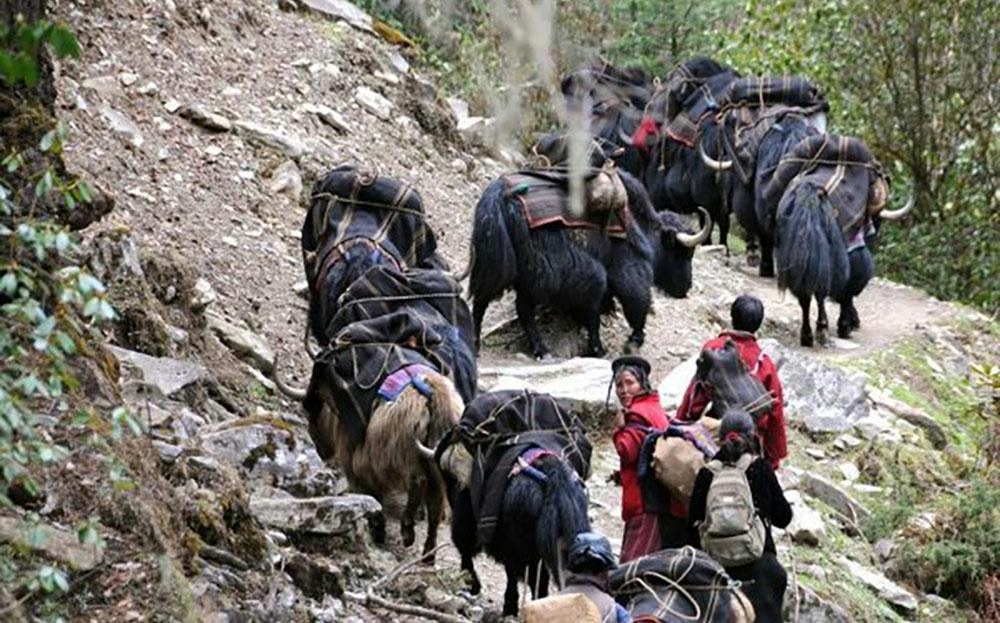
Drukor represents far more than a simple commercial transaction. For the Brokpa highlanders of Merak and Sakteng, it was a seasonal migration pattern that created bonds between geographically isolated communities. The practice emerged from geographic necessity—the high-altitude regions where Brokpas herded yaks and cattle produced abundant dairy products but could not sustain grain cultivation, while the lower valleys flourished with rice and maize.
The relationship operated through a network of trusted connections called "Nepos"—village hosts who maintained long-term relationships with Brokpa families. These weren't merely transactional relationships; they were kinship-like bonds reinforced by annual exchanges, gifts, and mutual obligation. Lobzang Tashi, a 60-year-old from Merak, recalls bringing between 200 to 300 kilograms of butter and cheese down to lower villages, trading with three to five different Nepo families across multiple gewogs.
"Whenever we came down, which was not very often, we used to bring around 200 to 300 kilograms of butter and cheese," Lobzang Tashi explained, reflecting on the substantial quantities involved in these seasonal expeditions.
The Economics of Highland-Lowland Exchange 💱
The Drukor trade system operated on clearly understood exchange rates that varied seasonally. During the pre-harvest period, Brokpas received 13 to 14 changdeys of rice (approximately 26-28 kilograms) from communities like Radhi and Phongmey in exchange for just one kilogram of butter. For fermented cheese (yosha), the rate was slightly lower—around 12 changdeys of rice per kilogram.
The scale of these exchanges was impressive. A single Brokpa family might transport approximately 30 bags of unhusked rice and 30 bags of maize back to the highlands, with each bag weighing 100 kilograms. Some families also engaged in textile trade, exchanging hand-woven woollen blankets for substantial quantities of maize and dried chillies—280 changdeys of maize from a single household in Thrimshing for just two blankets.
Former Sakteng Mangmi Lhendrup noted that the Drukor practice was highly organized by family networks. "About 50 families from Merak go to Shingkhar Lauri in Samdrupjongkhar, 48 to Khaling, about 30 to Kangpara, and so on," he explained, illustrating how specific families maintained traditional routes and relationships across generations.
A Journey Measured in Seasons ⏰
The Drukor journey typically commenced in late October and extended across four months of winter. Brokpa traders would spend approximately one week in each village, methodically collecting grain and exchanging their dairy products. The logistics were complex—families were constantly on the move, transporting grain home before setting out again to other villages.
This wasn't a rapid commercial operation but rather a deliberate, relationship-focused process that allowed for social interaction and community bonding. The extended timeline reflected the pre-industrial nature of the trade, where personal connections mattered as much as economic benefit. Families would share meals, exchange stories, and strengthen ties that transcended mere commerce.
Interestingly, the Brokpas' trading networks extended beyond Bhutan's borders. Communities from Merak and Sakteng also engaged in trade with Tawang and Bomdila in Arunachal Pradesh, India, further diversifying their grain sources and economic relationships.
The Road to Decline: Infrastructure and Modernization 🛣️
The transformation of Drukor began with infrastructure development. Before road connectivity reached remote gewogs, Brokpas traveled considerable distances to Trashigang, Rangjung, and Khaling towns to purchase essential items like salt and cooking oil. These journeys reinforced the necessity of the Drukor system and kept highland-lowland relationships vibrant.
"Now we don't go that far. Almost everything is available in the village shops," noted Lobzang Dorji, reflecting the dramatic shift in accessibility. The proliferation of small shops throughout gewogs eliminated the need for highlanders to journey to distant towns, fundamentally altering the economic calculus that sustained Drukor.
Modern transportation technology further accelerated the decline. Merak Gup Nima observed that Brokpas now rely on Bolero trucks instead of traditional horse caravans, compressing what once took weeks into a single day's journey. This efficiency, while economically rational, strips away the social dimensions that once defined the practice.
The Weakening of Community Bonds 💔
The visible markers of Drukor have largely disappeared from Bhutanese towns. Brokpas are no longer seen in Trashigang, Rangjung, and Khaling carrying the distinctive leather bags of fermented cheese that once identified them as highland traders. This absence signals a deeper transformation in community relationships.
Pema Dorji from Radhi articulated the shift succinctly: "In the past, there was a constant exchange between the Brokpas and the local communities here. The relationship still exists, but it is not as strong or as frequent as it once was."
The frequency and duration of visits have contracted dramatically. Where Brokpas once spent weeks traveling between villages and engaging with host families, many now complete their trading obligations in brief visits. The extended stays that once allowed for genuine social bonding have been replaced by efficient, transactional encounters.
Why Drukor Persists Despite Modernization 🐄
Despite its decline, Drukor hasn't entirely vanished. The fundamental geographic reality that created it remains unchanged—the highlands of Merak and Sakteng still cannot produce grain, and herds require maize to survive the harsh winters. Merak Gup Nima emphasized this enduring necessity: "We still need to do Drukor because nothing grows in the village and, more importantly, we need maize to feed our herds."
However, the practice has fundamentally transformed. Modern Brokpas approach Drukor as a practical necessity rather than a cultural institution. They maintain the exchange relationships but have stripped away the ceremonial and social dimensions that once made it meaningful.
Cultural Preservation in the Modern Era 🌍
The vanishing of Drukor reflects broader tensions in Bhutanese society between preserving cultural identity and embracing modernization. Bhutan's commitment to "Gross National Happiness" emphasizes cultural preservation, yet economic development and infrastructure inevitably transform traditional practices.
The decline of Drukor raises important questions about cultural sustainability. As younger generations grow up with shops, trucks, and modern commerce, will they maintain knowledge of traditional bartering systems? Will the relationships between highland and lowland communities continue to erode?
Some observers suggest that documenting and celebrating practices like Drukor becomes increasingly important as they fade. Cultural institutions and educational programs might help preserve understanding of how Bhutanese communities historically solved economic challenges through cooperation and reciprocal exchange.
The Broader Context: Bhutan's Development Paradox 🏛️
The story of Drukor mirrors broader developments in Bhutan's economy and society. The nation has achieved remarkable economic growth and development indicators while maintaining cultural distinctiveness. Yet this progress comes with trade-offs—traditional practices decline, younger generations migrate to urban centers, and time-honored economic relationships transform.
Bhutan's emphasis on sustainable development and cultural preservation makes the fate of practices like Drukor particularly significant. They represent institutional knowledge about how communities can meet needs through cooperation rather than market dependence, a lesson potentially valuable as Bhutan navigates its development path.
Looking Forward: Memory and Meaning 🔮
Today, 67-year-old Dorji Wangdi remembers Drukor from childhood, while younger Brokpas experience it as an obligation rather than an adventure. The saying that once united communities—"Merak and Sakteng have butter, but no butter to feed the children"—now sounds like a historical artifact rather than a description of present economic reality.
The vanishing of Drukor represents more than the decline of a commercial practice. It symbolizes the transformation of community relationships, the acceleration of economic life, and the ongoing negotiation between tradition and modernity that defines contemporary Bhutan.
As infrastructure continues to expand and commerce becomes increasingly digitized and centralized, the memory of Drukor may become primarily a cultural artifact—something studied in schools and recalled by elders rather than practiced by thriving communities. Yet the values it embodied—reciprocity, trust, and interdependence—remain relevant to discussions about sustainable community development and economic resilience.
You May Also Like
Culture
When Colour Drains From the Scene: Spiritual Gatherings in Bhutan
August 15, 2026
Culture
Yojay: Ancient Buddhist Prayer Practice Goes Global
August 12, 2026
Culture
Changyuel Galem House Restoration: A Heritage Preservation Challenge
August 8, 2026
Culture
Obtsho Dzong Ruins: Bhutan's Major Conservation Project
August 5, 2026