Category:
EnvironmentRAA Pressures DECC to Launch Taba Waste Facility
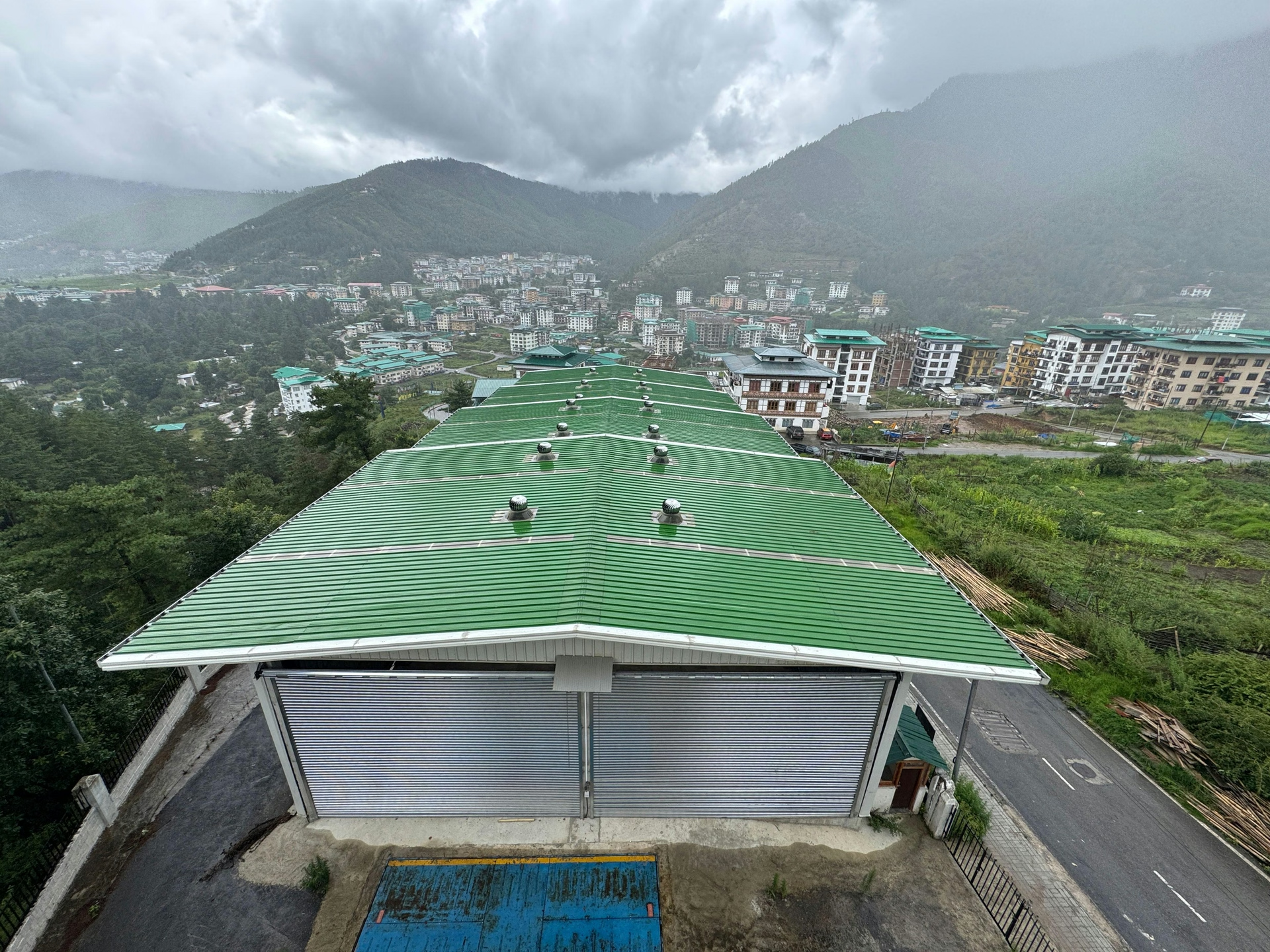
Bhutan's Stalled Waste Management Project Faces Accountability Push 🚨
Bhutan's waste management infrastructure faces a critical juncture as the Royal Audit Authority (RAA) escalates pressure on the Department of Environment and Climate Change (DECC) to operationalise a long-delayed facility. The Material Recovery Facility (MRF) at Taba in Thimphu, which has consumed over Nu 80 million in public funds, remains shuttered despite being handed over more than a year ago. This situation underscores broader challenges in Bhutan's infrastructure development and project management practices.
The audit directive, issued on June 30, represents a significant escalation in oversight. The RAA has given DECC a three-month window to submit a comprehensive action plan, with accountability measures targeting leadership directly. This move signals growing frustration with the project's prolonged stagnation and reflects the government's commitment to fiscal responsibility.
Understanding the Taba MRF Project 🏗️
Project Origins and Investment
The Material Recovery Facility at Taba was conceived as a critical component of Thimphu's waste management infrastructure. Funded through a Government of India grant, the project aimed to support waste segregation and resource recovery for the northern regions of Thimphu Thromde. The initial design and construction contract, valued at Nu 92.95 million, was awarded to a joint venture between D Lhen Private Limited and APECS Thimphu in June 2021.
The ambitious timeline called for completion within 14 months. However, the project encountered persistent challenges that would eventually require five contract extensions before the original contractor was terminated in March 2024 for breach of contract. This extension pattern is emblematic of infrastructure delivery challenges frequently encountered in developing nations, where complex technical projects often exceed initial timelines and budgets.
Financial Investment Breakdown
The financial commitment to this facility has been substantial:
- Original construction contract: Nu 74.42 million
- Rectification and balance works: Nu 6.06 million
- Total investment: Approximately Nu 80.48 million
This significant public investment makes the facility's non-operational status particularly concerning from a fiscal stewardship perspective. The extended delays have raised questions about project oversight mechanisms and the effectiveness of quality assurance protocols in Bhutan's infrastructure development processes.
Technical Complications Emerge 🔧
Structural and Safety Concerns
When the Department of Infrastructure Development (DoID) conducted a comprehensive site assessment in June 2025, assessors discovered troubling structural issues that had gone unaddressed during construction. The facility's machinery was generating substantial vibrations that propagated through the first-floor slab, beams, and columns.
Most alarmingly, one steel column exhibited significant deviation from its vertical alignment, creating serious structural integrity concerns. These findings suggest that critical design recommendations—specifically the installation of vibration isolation pads and damping systems beneath machine foundations—had not been implemented during the original construction phase.
The RAA has mandated that before operationalisation, the facility must undergo:
- Immediate installation of vibration isolation pads and damping systems
- Structural reassessment incorporating dynamic load modelling
- Urgent retrofitting of the displaced steel column
- Comprehensive safety validation before machinery commissioning
Root Cause Analysis
These technical failures reveal systemic deficiencies in project execution. The RAA's audit findings highlight gaps in multiple critical areas:
- Project planning: Inadequate initial design validation
- Construction supervision: Insufficient oversight of structural installation
- Quality assurance: Failure to verify compliance with engineering specifications
- Work acceptance: Premature handover without addressing known deficiencies
These issues reflect broader infrastructure development challenges that Bhutan, like many developing nations, continues to address as it modernises its public facilities.
Location and Environmental Challenges 🏘️
Proximity Issues and Community Concerns
Beyond structural problems, the Taba facility faces an equally significant challenge: its location within a residential township. During a joint site visit on May 19, 2026, officials from DECC, Thimphu Thromde, and DoID acknowledged that the facility's proximity to residential settlements creates substantial operational challenges.
Key concerns identified include:
- Noise pollution from machinery operation
- Odour emissions from waste processing activities
- Community resistance to facility operations
- Long-term sustainability of operations in a populated area
These environmental and social factors represent a fundamental planning oversight. Material recovery facilities, while essential for waste management, typically generate noise and odour that makes them unsuitable for densely populated residential areas. The failure to anticipate these concerns during the initial planning phase demonstrates inadequate environmental and social impact assessment protocols.
The Relocation Proposal 🔄
Exploring Memelakha as an Alternative
In response to mounting concerns, DECC has proposed relocating the facility's machinery and operational components to Memelakha, a location further removed from residential areas. This proposal emerged during discussions involving multiple government agencies, including the Department of Local Governance and Disaster Management (DLGDM).
Interestingly, the Taba site has attracted alternative interest. DLGDM expressed interest in utilising the pre-engineered building structure and administration block for a Humanitarian Staging Area centre, supporting the nation's disaster preparedness initiatives. This potential repurposing demonstrates how failed projects can sometimes be redirected to serve other public needs.
Implementation Challenges
However, the relocation proposal remains preliminary. The RAA audit notes that DECC has not yet developed:
- Formally approved relocation decision
- Technical feasibility assessment
- Cost-benefit analysis
- Funding arrangements
- Detailed implementation plan
Additionally, relocating operations to Memelakha would necessitate transporting residual waste after material recovery, significantly increasing logistics and transportation costs. This economic consideration adds complexity to what might appear as a straightforward relocation solution.
Accountability Framework 📋
RAA's Enforcement Mechanism
The RAA has established clear accountability measures. The audit finding explicitly states that if DECC fails to implement the required action plan, the Director of DECC, Sonam Tashi, will be held accountable both directly and in a supervisory capacity for the project's failures.
This direct accountability framework represents a significant shift in how Bhutan addresses infrastructure project failures. Rather than allowing responsibility to dissipate across multiple agencies and timeframes, the RAA has created specific, measurable consequences for non-compliance.
DECC is required to submit a comprehensive action-taken report by September 30, providing a clear deadline for demonstrating progress. This timeline creates urgency while allowing sufficient opportunity for meaningful remedial action.
Broader Implications for Project Management
The Taba facility situation has prompted broader reflection on Bhutan's infrastructure development practices. An RAA official noted that while the project's failures occurred in the past, the positive response from current leadership—taking responsibility and actively working toward solutions rather than dismissing past problems—represents progress in institutional accountability.
This perspective acknowledges that infrastructure projects in developing nations frequently encounter unexpected challenges. What matters, ultimately, is how institutions respond to failures and whether they implement systematic improvements to prevent recurrence.
Lessons for Bhutan's Infrastructure Development 🎯
Key Takeaways from the Taba Experience
The Material Recovery Facility project offers several critical lessons for Bhutan's ongoing infrastructure modernisation:
Enhanced Design Validation: Future projects must incorporate rigorous design review processes, particularly for facilities with complex mechanical systems. Independent engineering assessments should validate all technical specifications before construction commences.
Environmental and Social Assessment: Facility location decisions must include comprehensive environmental and social impact evaluations, with genuine community consultation. This is especially critical for waste management infrastructure.
Construction Supervision: Strengthening on-site supervision and quality assurance protocols can prevent the structural deficiencies that plagued the Taba facility. Regular third-party inspections should verify compliance with engineering standards.
Adaptive Project Management: When issues emerge—as they inevitably do in complex projects—institutions should respond quickly with transparent assessment and corrective action rather than allowing delays to compound.
The Path Forward 🌱
Three-Month Timeline and Expectations
The RAA's three-month directive creates a critical window for DECC to demonstrate commitment to resolving the facility's operational status. This timeline is ambitious but achievable if DECC prioritises the project and coordinates effectively across relevant agencies.
Successful operationalisation would require:
- Immediate structural remediation of vibration and column alignment issues
- Completion of dynamic load analysis and safety validation
- Final decision on relocation feasibility and cost implications
- Secured funding for any required retrofitting or relocation activities
- Operational readiness including staff training and systems testing
Significance for Waste Management in Bhutan
Once operational, the Taba MRF—or its relocated equivalent—could significantly enhance Bhutan's waste management capabilities. Material recovery facilities are increasingly recognised as essential components of circular economy strategies, reducing landfill dependence while creating opportunities for resource recovery and recycling.
For Thimphu specifically, which generates approximately 400-500 tonnes of waste daily, having functional material recovery infrastructure is critical for achieving the nation's environmental sustainability objectives. The facility's eventual operationalisation would demonstrate Bhutan's commitment to managing urban waste responsibly while maintaining the environmental quality that defines the nation's development philosophy.
Conclusion: Accountability Meets Opportunity 💡
The RAA's directive represents a crucial moment for Bhutan's infrastructure governance. By establishing clear timelines, specific requirements, and direct accountability, the audit authority is signalling that public resources demand rigorous stewardship and transparent project management.
The Taba Material Recovery Facility, despite its troubled history, remains an important investment in Bhutan's environmental infrastructure. The three-month deadline creates urgency for DECC to move from discussion to decisive action. Whether the facility operates at its current Taba location or is relocated to Memelakha, the critical imperative is to transform this stalled project into a functioning asset that serves Bhutan's waste management needs.
This situation ultimately reflects broader institutional maturation—the capacity to acknowledge past failures, implement corrective measures, and maintain focus on delivering public value. As Bhutan continues developing its infrastructure, the lessons from Taba will inform more effective project planning, execution, and oversight for future initiatives.
You May Also Like
Environment
Climate Crisis in the Himalayas: Bhutan's Cold Reminder
August 29, 2026
Environment
WBH Conservation Project Delivers Clean Water to Rural Homes
August 29, 2026
Environment
HKH Climate Crisis: Why Regional Unity Matters Now
August 29, 2026
Environment
Bhutan's Solar Power Revolution: Energy Security Strategy
August 26, 2026