Category:
EnvironmentAgriculture Sector Struggles to Meet Emission Reduction Targets
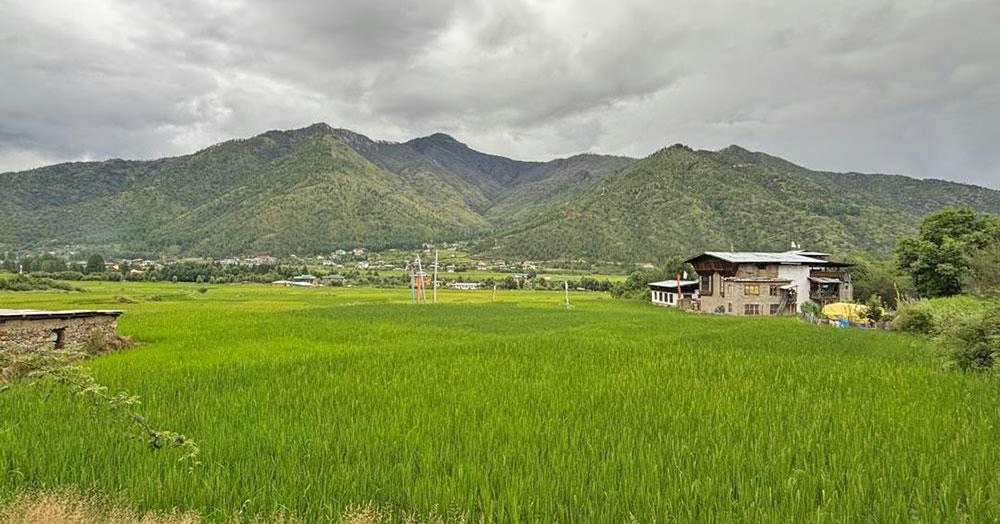
The Challenge Facing Bhutan's Agricultural Future 🌾
Bhutan's agriculture and livestock sector stands at a critical juncture. Despite ambitious climate commitments and comprehensive strategies, the nation is falling short of its agricultural emission reduction targets, raising concerns about the effectiveness of current mitigation efforts and implementation frameworks.
The gap between aspiration and achievement reveals deeper systemic issues that extend beyond simple oversight. Emission targets for agriculture have become increasingly difficult to meet, not due to lack of strategy, but rather fragmented implementation, insufficient funding mechanisms, and inadequate monitoring systems.
Understanding the 2025 Emission Target Shortfall 📊
In 2021, Bhutan established an ambitious goal to reduce agriculture and livestock emissions by 266.28 kilotonnes of CO₂ equivalent (ktCO₂e) by 2025. Today, as we approach the deadline, this target remains substantially unmet, with no verified quantified reduction established against the baseline.
This shortfall represents more than a missed numerical goal—it reflects fundamental challenges in how the nation approaches agricultural sector emission reductions. The Ministry of Agriculture and Livestock (MoAL) and the Ministry of Energy and Natural Resources (MoENR) have acknowledged that despite implementing proposed mitigation activities, concrete measurable progress has been elusive.
The disconnect between policy and practice stems from several interconnected factors:
- Limited implementation readiness across farming communities
- Fragmented delivery through existing programmes without cohesive coordination
- Weak linkages between mitigation initiatives and financing frameworks
- Insufficient integration with broader agricultural transformation priorities
The Livestock Emissions Crisis 🐄
Livestock production remains the single largest source of emissions within Bhutan's agricultural sector. The nation's Low Emission Development Strategy (LEDS) for Food Security identified this subsector as the primary focus for intervention, with significant mitigation potential available through targeted actions.
The strategy outlined six priority mitigation actions designed to substantially reduce livestock-related emissions:
- Domestic biogas systems for waste management and energy generation
- Improved dairy cattle production techniques
- Enhanced animal feed formulations for better nutritional efficiency
- Better manure management practices at the farm level
- Selective breeding programs to improve productivity
- Integrated feed and fodder production systems
While these interventions represent sound science-based approaches, their implementation has proceeded unevenly across the country. The national biogas programme has installed approximately 8,687 domestic biogas plants to date, benefiting smallholder livestock-owning households. However, broader adoption of breed improvement, feed management, and dairy production system upgrades remains at different stages of deployment.
Monitoring and Measurement Gaps 📈
A critical weakness in Bhutan's approach to agriculture emission reduction lies in the absence of a comprehensive, fully operational monitoring system. Currently, no regular measurement system tracks greenhouse gas emissions against the 2015 baseline used in the LEDS framework.
The Department of Environment and Climate Change conducts national greenhouse gas inventories every two years for the Biennial Transparency Report submitted to the United Nations Framework Convention on Climate Change. However, this biennial schedule falls short of the recommended annual domestic inventory compilation necessary for effective real-time monitoring and adaptive management.
This measurement gap creates confusion about actual progress. While combined agriculture emissions reportedly fell from 2,183.25 ktCO₂e in 2015 to 410.18 ktCO₂e in 2022—a reduction of 1,773.07 ktCO₂e—much of this decline resulted from decreased irrigated paddy cultivation rather than deliberate mitigation interventions. Irrigated paddy area contracted from 49,325 acres in 2015 to 23,995 acres in 2022, and paddy cultivation represents the single largest source of agricultural greenhouse gas emissions.
Broader Climate Commitments at Risk ⚠️
The 2025 target represents just the first milestone in Bhutan's long-term climate strategy. The nation has committed to even more ambitious reductions:
- 710.09 ktCO₂e reduction by 2030
- 3,563.19 ktCO₂e reduction by 2050
Failing to achieve the 2025 target raises serious questions about the feasibility of these subsequent goals. The structural issues preventing current progress—insufficient funding, weak coordination, and inadequate monitoring—will require substantial remediation to enable future success.
Complementary Agricultural Initiatives 🌱
Beyond livestock-focused interventions, the Department of Agriculture has implemented several supporting measures that contribute to emission reductions either directly or indirectly:
Agroforestry programs integrate trees with crop production, sequestering carbon while improving soil health and rural incomes. Sustainable land development practices reduce erosion and enhance productivity on marginal lands. Climate-resilient irrigation infrastructure and micro-efficient irrigation conveyance systems reduce water waste and associated energy consumption.
These initiatives support rural livelihoods and climate resilience while contributing to the broader mitigation agenda. However, their scaling and adoption rates vary significantly across districts.
The Financing Challenge 💰
One of the most significant barriers to meeting agricultural sector emission targets involves inadequate financing frameworks. Mitigation activities often remain disconnected from available funding mechanisms, leaving farmers without the financial resources to adopt recommended practices.
The updated Low Emission Development Strategy for the Agrifood Sector 2026—which replaces the 2021 LEDS—specifically addresses this gap by mapping potential funding opportunities. This revised strategy also incorporates actionable solutions, productivity considerations, commercial viability, and on-the-ground feasibility assessments that the original framework lacked.
Sectoral Coordination and Accountability 🤝
Responsibility for implementing and monitoring agricultural emission reductions is distributed across multiple agencies, creating coordination challenges. The MoAL leads sectoral implementation while the DECC under MoENR oversees national-level climate reporting and monitoring capacity development.
This division of labor, while logical on paper, has resulted in gaps between what is implemented at the farm level and what is reported through national climate frameworks. Clear accountability mechanisms and regular inter-agency coordination meetings are essential to closing these gaps.
Organic Manure Production Progress 🌿
One measurable success in Bhutan's agricultural emissions work involves organic manure production. According to the First Biennial Transparency Report 2024, the country produced 1,191 metric tonnes of organic manure domestically. Organic manure production units have been revived and established across the country, with a combined annual production capacity of 4,800 metric tonnes.
This expansion represents important progress in improving manure management practices, a key component of the livestock emission reduction strategy. Better manure management prevents methane emissions from waste decomposition while creating valuable soil amendments.
What Lies Ahead 🔮
Bhutan's struggle to meet its 2025 agricultural emission reduction target should serve as a wake-up call for policymakers and stakeholders. The gap between policy ambition and practical achievement is real and substantial, but not insurmountable.
Success requires several concurrent actions:
- Establishing robust, real-time monitoring systems for agricultural emissions
- Aligning financing mechanisms with on-the-ground mitigation activities
- Strengthening coordination between implementing agencies
- Accelerating farmer adoption of proven mitigation technologies
- Integrating climate considerations into broader agricultural transformation priorities
The updated 2026 agrifood sector strategy provides a foundation for renewed efforts. However, implementation readiness and sustained political commitment will ultimately determine whether Bhutan can achieve its climate goals while maintaining productive, prosperous agricultural sectors that support rural communities.
The path forward demands both ambition and pragmatism—ambitious targets paired with realistic assessment of implementation challenges and honest acknowledgment of the resources required to succeed.
You May Also Like
Environment
Climate Crisis in the Himalayas: Bhutan's Cold Reminder
August 29, 2026

Environment
WBH Conservation Project Delivers Clean Water to Rural Homes
August 29, 2026

Environment
HKH Climate Crisis: Why Regional Unity Matters Now
August 29, 2026
Environment
Bhutan's Solar Power Revolution: Energy Security Strategy
August 26, 2026