Category:
NewsHealthcare Access Crisis: Thousands in Thimphu Struggle to Reach Care Services
🚨 A Growing Accessibility Challenge in Bhutan's Capital
Thimphu faces a critical infrastructure challenge that often goes unnoticed in discussions about urban development. Recent data reveals a troubling reality: thousands of residents in the nation's capital cannot easily access essential care services, despite the city's reputation as a modern, well-planned metropolis. This accessibility gap affects vulnerable populations including young children, elderly citizens, and persons with disabilities—precisely those who need support most urgently.
The newly launched care services map has illuminated what many residents already knew intuitively: proximity to care facilities remains unequally distributed across Thimphu's neighborhoods. This isn't simply about the number of services available, but rather whether people can physically reach them when they need help.
📊 The Numbers Tell a Stark Story
The data paints a concerning picture of service accessibility in Thimphu:
Children Under Five: More than 3,600 youngsters live beyond a 10-minute walk from childcare services, making it difficult for working parents to balance employment with childcare responsibilities.
Elderly Population: Approximately 2,777 seniors are situated more than 30 minutes away from age-appropriate care facilities, limiting their access to essential support services.
Persons with Disabilities: About 979 individuals with disabilities cannot access disability services within a 30-minute step-free walk, highlighting accessibility barriers beyond mere distance.
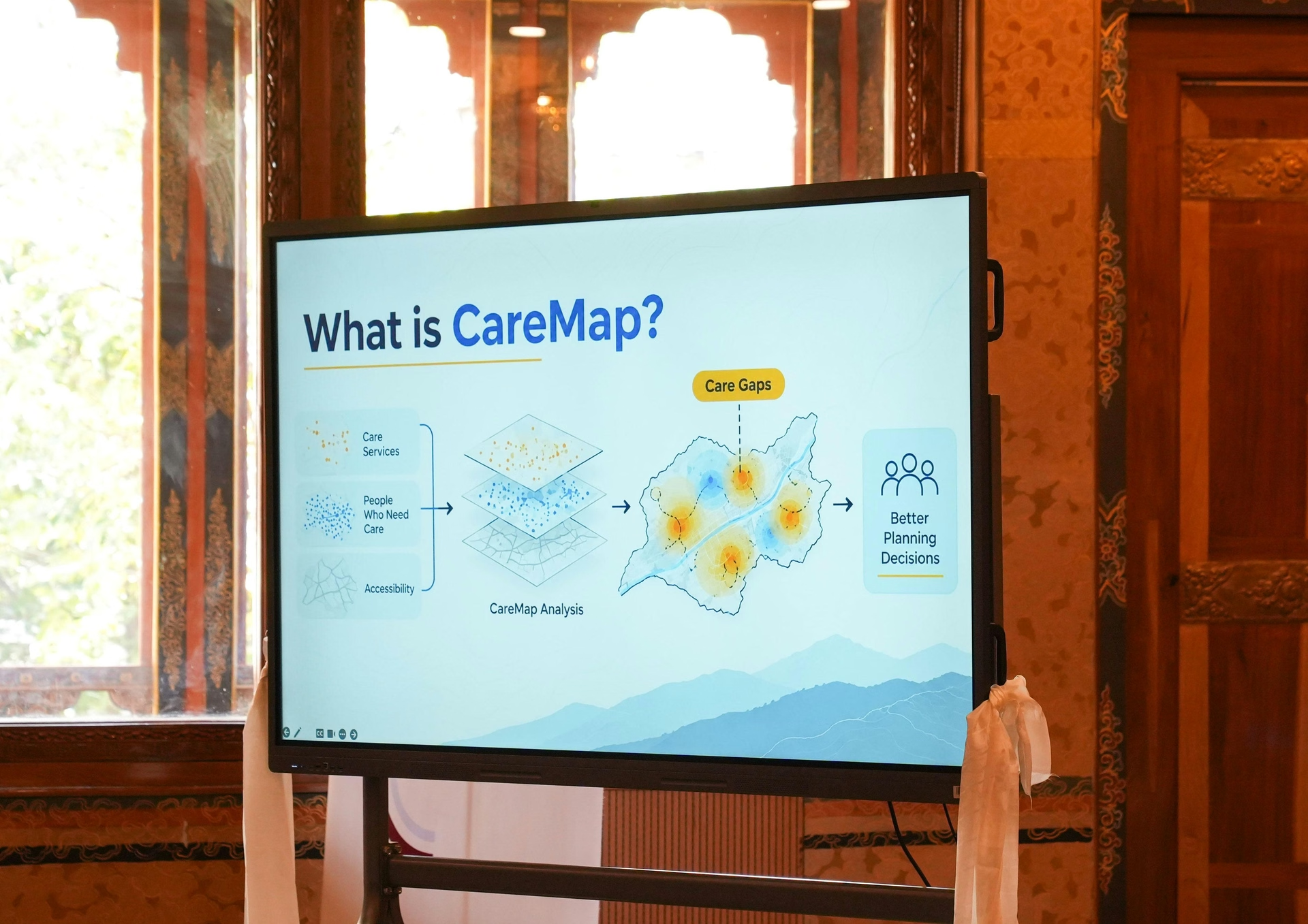
These figures represent real families facing daily challenges. A working parent in a distant neighborhood must wake earlier, travel longer, and spend more money to access childcare. An elderly person without nearby support services faces isolation and increased health risks. A person with mobility challenges encounters infrastructure designed without their needs in mind.
🏘️ Geographic Disparities Across Neighborhoods
The care services map reveals that four specific neighborhoods bear the brunt of this accessibility crisis:
- Lungtenphu
- Simtokha
- Hejo Samtenling
- Babesa
These areas collectively account for approximately 39 percent of the city's children under five, 34 percent of its elderly population, and 34 percent of persons with disabilities. This concentration creates a perfect storm—areas with the highest concentration of vulnerable populations paradoxically have the poorest service accessibility.
The disparity reflects Thimphu's rapid urban expansion. As the city has grown, residential areas have extended into peripheral zones without corresponding infrastructure development. Planning has often lagged behind population growth, leaving newer neighborhoods underserved.
🏥 Existing Infrastructure Falls Short
Thimphu currently operates 73 care services with a combined capacity of 4,296 places. At first glance, this might seem adequate for the city's population. However, the real challenge emerges when examining operational realities:
Childcare Service Limitations:
- Only 10 of 58 childcare centers maintain standard working hours (8:30 AM to 5:30 PM)
- Zero childcare facilities operate on weekends
- Merely 8 centers accept children under two years old
These operational constraints create impossible situations for working parents. A parent working standard business hours may find that childcare facilities close before their workday ends. Weekend workers have virtually no options. Parents with infants face particularly severe challenges given the scarcity of age-appropriate facilities.
👵 Elderly Care and Disability Services Gaps
Beyond childcare, elderly care services face their own accessibility and capacity challenges. Many older adults in peripheral neighborhoods lack convenient access to health monitoring, recreational activities, or social engagement programs that could significantly improve their quality of life.
For persons with disabilities, the situation involves both distance and infrastructure. Even when facilities exist nearby, many lack basic accessibility features:
- Ramps for wheelchair access
- Accessible toilet facilities
- Step-free pathways and entrances
- Appropriate transportation connections
These physical barriers transform a 10-minute journey into an impossible trek for someone with mobility limitations.
👩💼 The Invisible Care Economy: Unpaid Labor and Gender Disparities
Beyond institutional services lies a broader care reality that shapes daily life for thousands. Care encompasses not just professional services but also the unpaid work families perform: childcare, elder support, household maintenance, cooking, and emotional labor.
This invisible care economy carries profound gender implications. Women and girls in Bhutan dedicate approximately 2.5 times more hours to unpaid care work than men. This disparity directly undermines women's economic opportunities, educational advancement, and personal development.
When institutional care services are inaccessible or inadequate, this burden falls disproportionately on women and girls. A girl might leave school to help with younger siblings. A woman might decline employment because childcare options don't align with work schedules. An elderly woman might sacrifice her own health needs to care for grandchildren.
This gender dimension of the care crisis intersects with Bhutan's broader development goals around women's empowerment and economic participation.
🏛️ Government Commitment and Policy Context
Bhutan's leadership has consistently emphasized the nation's commitment to social welfare. Finance Minister Lekey Dorji highlighted how the country's free healthcare and education systems reflect this philosophical commitment to caring for citizens. However, leaders also acknowledge that care extends beyond these formal services to encompass family support systems and community networks.
This recognition is crucial. Sustainable solutions require not just expanding institutional capacity but also valuing and supporting unpaid care work performed within families and communities.
🗺️ The Care Services Map: A Planning Tool for Change
Developed through collaboration between the Department of Human Settlement, Thimphu Thromde, and the United Nations Development Programme, the care services map represents a significant step toward evidence-based urban planning.
This tool enables government planners to:
- Identify service gaps with geographic precision
- Assess accessibility from residents' actual locations
- Determine priority areas for new facility development
- Evaluate expansion potential for existing services
- Track progress toward equitable service distribution
Maps like this transform abstract statistics into actionable planning information.
📋 Recommended Solutions and Next Steps
The care services map proposes several specific interventions:
Immediate Priorities:
- Expand childcare capacity across the city
- Establish specialized facilities for infants under two
- Extend childcare operating hours to accommodate varied work schedules
- Create weekend care options for non-traditional workers
Geographic Focus:
- Establish shared care facilities in Hejo Samtenling
- Develop new services in Simtokha
- Address accessibility gaps in Lungtenphu and Babesa
Accessibility Infrastructure:
- Install ramps at all disability service facilities
- Upgrade toilet facilities to accessibility standards
- Ensure step-free pathways throughout care centers
- Improve transportation connections to peripheral neighborhoods
🌍 Broader Implications for Bhutan's Development
Thimphu's care service challenges reflect tensions inherent in rapid urbanization across Asia. As cities expand and traditional family structures evolve, formal care infrastructure becomes increasingly essential. Yet many developing economies struggle to build this infrastructure quickly enough to meet growing demand.
Bhutan's approach—combining data-driven planning with recognition of unpaid care work—offers a model potentially valuable for other nations navigating similar transitions.
🔮 Looking Forward: Building Equitable Care Infrastructure
Addressing Thimphu's care service accessibility requires sustained commitment and adequate investment. The newly launched care map provides the diagnostic framework; implementation requires political will and budgetary resources.
Success will ultimately be measured not in statistics but in lived experiences: parents able to work without anxiety about childcare, elderly citizens maintaining social connection and dignity, persons with disabilities accessing services independently, and women freed from disproportionate unpaid care burdens to pursue their own aspirations.
Thimphu's care infrastructure challenge is simultaneously a planning problem, an equity issue, and a gender justice concern. Addressing it comprehensively will require integrated solutions that expand institutional capacity, improve accessibility, value unpaid care work, and center the needs of vulnerable populations in urban planning decisions.
The care services map has named the problem clearly. Now comes the harder work of building solutions.
You May Also Like
News
Child Safety Crisis: Addressing Violence Against Girls
November 11, 2026

News
Bhutan's GNH Philosophy Shapes Global Development Debate
November 11, 2026
News
Kabesa Schoolgirl Case: Understanding Violence Against Bhutanese Children
November 11, 2026
News
Trust Takes Centre Stage at Trans-Himalayan Conference
November 11, 2026