Category:
TourismBumthang Tourism Growth: Local Businesses Push for Better Facilities
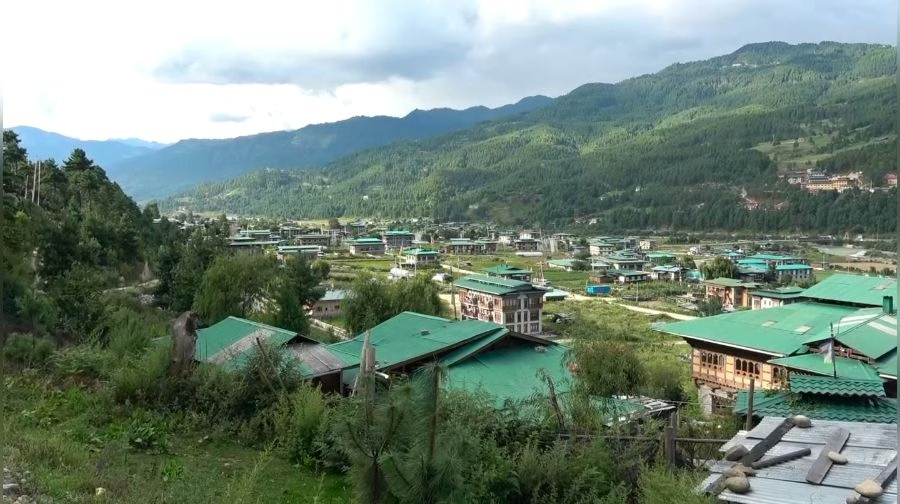
Bumthang's Tourism Challenge: Why Low Occupancy Threatens Local Businesses 🏨
Bumthang, one of Bhutan's most culturally significant districts, faces an unexpected paradox. Despite being home to some of the kingdom's most sacred monasteries, breathtaking mountain valleys, and world-renowned pilgrimage sites, the region's tourism sector struggles with persistently low occupancy rates. Local business owners are now sounding the alarm, demanding comprehensive infrastructure improvements and expanded tourism facilities to unlock the district's considerable potential.
The issue isn't a lack of natural beauty or cultural heritage—Bumthang possesses both in abundance. Rather, the challenge lies in converting visitor interest into sustained economic activity. Hotels operating at only 50 percent capacity during peak season represent a significant untapped revenue opportunity, and business owners are increasingly vocal about what needs to change.
Understanding Bumthang's Tourism Landscape 🏔️
Bumthang has long captivated travelers seeking authentic Bhutanese experiences. The district's reputation rests on its monasteries, sacred pilgrimage routes, and pristine natural landscapes that showcase the kingdom's commitment to environmental preservation. Visitors arrive expecting cultural immersion, spiritual connection, and adventure—elements that Bumthang genuinely offers.
However, the national tourism context reveals a disconnect. Bhutan's Annual Tourism Snapshot 2025 reports that the country welcomed over 200,000 international visitors throughout the year. Yet Bumthang captures only a modest fraction of this total traffic, suggesting that most tourists concentrate their time in more developed regions like the Paro and Thimphu areas.
This distribution pattern reflects a broader infrastructure reality: while Bumthang possesses cultural and natural attractions, it lacks the diverse recreational and entertainment facilities that modern travelers increasingly expect. The gap between demand and available experiences directly correlates with the low occupancy challenges plaguing local hotels and guesthouses.
The Business Community Speaks: What's Missing? 💼
During recent Business Regulation Reform National Consultation meetings held in the district, entrepreneurs articulated specific concerns about tourism facility gaps. Their message was clear: without expanded attractions and improved infrastructure, Bumthang will continue losing market share to competing destinations.
Local business leaders highlighted historical activities that once thrived in the region. Rafting operations previously attracted international visitors, including officials from the Swiss Office who utilized these services. Hot air balloon experiences, powered by traditional gas systems, once provided unique attractions unavailable elsewhere in Bhutan. These activities weren't frivolous luxuries—they represented revenue-generating experiences that extended visitor stays and increased spending.
Perhaps most intriguingly, business owners identified untapped potential for adventure tourism infrastructure. Zipline operations, properly developed and regulated, could attract thrill-seeking tourists while generating sustainable income for local operators. Yet current permitting processes and regulatory frameworks actively discourage private investment in such ventures.
Regulatory Barriers: The Hidden Problem 📋
Beyond facility gaps, Bumthang's business community faces a more insidious challenge: bureaucratic complexity. Obtaining necessary licenses and permits requires navigating multiple clearance processes, with entrepreneurs needing separate documentation from various government offices. This fragmented system creates unnecessary delays, discourages investment, and frustrates business owners attempting to expand operations.
Thromde officials acknowledged these challenges, noting that the current system forces applicants to collect four separate clearance documents before proceeding. Streamlining this process—ideally through a unified office where all necessary approvals could be obtained simultaneously—would significantly reduce friction and encourage business expansion.
The government has begun addressing these concerns. Many services have migrated online, reducing in-person bureaucratic touchpoints. However, business leaders argue that further consolidation remains necessary to truly facilitate private sector growth and tourism development.
Government Response and Future Initiatives 🤝
The Minister for Industry, Commerce and Employment acknowledged the concerns raised during consultation meetings, indicating that the cabinet would deliberate on proposed solutions. Government acknowledgment represents progress, though business owners remain cautiously optimistic about implementation timelines.
District administration has begun developing concrete tourism infrastructure projects. Plans include establishing new parks and developing trekking trails to provide visitors with additional attractions beyond cultural and religious sites. These initiatives demonstrate commitment to diversifying Bumthang's tourism offerings.
However, business leaders emphasize that government-led infrastructure development alone cannot solve the occupancy challenge. Private sector participation, particularly in adventure tourism and hospitality services, remains essential. Current regulatory frameworks must evolve to encourage rather than discourage private investment in tourism facilities.
The Broader Tourism Industry Context 📊
Bumthang's struggles reflect broader dynamics within Bhutan's tourism sector. The kingdom has successfully positioned itself as a premium, sustainable destination, with policies emphasizing quality over quantity. This approach has generated strong international demand and maintained high per-visitor spending rates.
Yet this strategy creates regional disparities. Facilities concentrated in Paro and Thimphu capture the majority of visitor spending, while peripheral regions like Bumthang receive insufficient traffic to support comprehensive hospitality infrastructure. Breaking this pattern requires deliberate policy interventions and private sector confidence.
The tourism industry globally demonstrates that diverse attractions and multiple activity options significantly influence destination competitiveness. Regions offering varied experiences—combining cultural immersion with adventure activities, wellness offerings, and entertainment—consistently outperform single-focus destinations. Bumthang possesses the cultural foundation but lacks the activity diversity necessary to compete effectively.
Addressing Low Occupancy: A Multi-Faceted Approach 🎯
Resolving Bumthang's occupancy challenges requires coordinated action across several dimensions:
Infrastructure Development: Expanding parks, trekking trails, and recreational facilities creates tangible reasons for extended visitor stays. These investments should complement rather than compete with cultural attractions.
Private Sector Enablement: Regulatory frameworks must facilitate rather than obstruct private investment in adventure tourism, hospitality services, and entertainment facilities. Clear permitting processes and transparent approval criteria reduce business uncertainty.
Marketing and Positioning: Enhanced promotion of Bumthang's unique offerings—positioning the district as a comprehensive adventure and cultural destination—could attract visitors currently unaware of available experiences.
Capacity Building: Training local entrepreneurs in hospitality management, adventure tourism operations, and business administration strengthens the region's ability to deliver quality services.
Infrastructure Connectivity: Improving road conditions and transportation links between Bumthang and other districts facilitates multi-destination tourism circuits, increasing visitor traffic.
What Success Looks Like 🌟
Imagine Bumthang in five years: hotels operating at 75+ percent occupancy year-round, adventure tourism activities attracting adventure-seekers alongside cultural pilgrims, diverse accommodation options serving different visitor segments, and local entrepreneurs confidently investing in tourism-related businesses. This scenario isn't unrealistic—it requires deliberate policy choices and private sector engagement.
Business owners emphasize that they possess entrepreneurial energy and willingness to invest. What they require is regulatory clarity, streamlined approval processes, and government confidence in private sector capability. When these elements align, market dynamics typically generate competitive, quality-driven tourism infrastructure.
Looking Forward: Momentum for Change ✨
The consultation meetings represent a turning point. Business leaders articulated specific concerns with concrete examples, government officials acknowledged these challenges, and administrative planning has commenced. While bureaucratic processes often move slowly, the foundation for meaningful reform appears to be solidifying.
Bumthang possesses genuine competitive advantages: authentic cultural heritage, stunning natural landscapes, and entrepreneurial local communities. Converting these assets into sustainable economic activity requires removing regulatory barriers, facilitating private investment, and developing comprehensive tourism infrastructure. The district's business community has clearly articulated what's needed. The challenge now lies in translating consultation recommendations into implemented policy changes.
The next months will prove revealing. If government commitments translate into concrete regulatory reforms and infrastructure investments, Bumthang could emerge as a thriving tourism destination offering visitors diverse experiences while generating sustainable income for local businesses. The potential clearly exists—now it requires decisive action to realize it.
You May Also Like
Tourism
Tsirang's Tourism Transformation: From Highway Pit Stop to Destination
August 15, 2026
Tourism
24-Hour SDF Waiver Expansion: Transforming Phuentshogling into a Tourism Destination
August 9, 2026

Tourism
Tergola Red Panda Trail: Bhutan's Community-Led Wildlife Tourism Model
August 8, 2026
Tourism
Phuentsholing's Urban Transformation: A Gateway City Reimagined
August 5, 2026