Category:
EducationKhamdang LSS Students Innovate Eco-Friendly Pens
A Groundbreaking Solution to Plastic Waste in Bhutanese Schools 🌱
In the heart of Trashiyangtse, a remarkable initiative is transforming how students think about everyday writing instruments. Young innovators at Khamdang Lower Secondary School have developed a solution that addresses two critical environmental challenges simultaneously: the mounting problem of plastic pen waste and the need for reforestation efforts across Bhutan. This eco-friendly pen project represents a powerful convergence of environmental consciousness, practical innovation, and youth-led action.
The initiative, branded as Green Heart Ngugu, has already garnered significant recognition. The project claimed first place in the junior category at the fourth annual National Innovation Challenge 2026, celebrated under the inspiring theme "UPSHIFT for a Greener Bhutan." This achievement highlights how young people in educational institutions are becoming catalysts for sustainable change in their communities.
Understanding the Eco-Friendly Pen Innovation 🎯
What Makes These Pens Different?
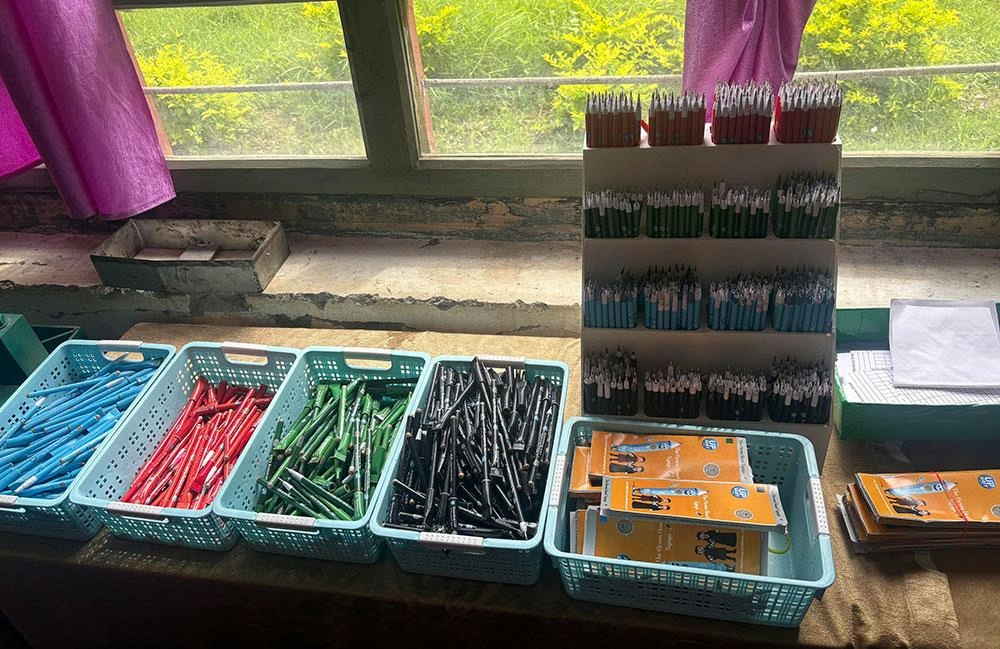
The biodegradable paper pens developed by Khamdang LSS students represent a creative reimagining of a mundane object. Each pen is crafted from recycled waste paper and features an ingenious addition: plantable seeds embedded in the pen's cap. This dual-purpose design means users aren't simply purchasing a writing instrument—they're investing in an environmental action plan.
The concept elegantly solves a persistent problem. Traditional plastic pens, used millions of times daily across schools worldwide, contribute significantly to landfill accumulation. In Bhutan's educational sector alone, the volume of discarded plastic pens represents a measurable environmental burden. By converting waste paper into functional writing tools, these students are closing a resource loop while simultaneously promoting afforestation initiatives.
The Production Process: Innovation in Action ✨
The manufacturing journey of these eco-friendly pens demonstrates remarkable ingenuity within resource constraints. The process begins with collection and sorting of discarded paper from school waste streams. Once sorted, the paper is carefully stacked and cut to precise dimensions—a critical step ensuring consistency in the final product.
The next phase involves wrapping paper strips around standard pen refills using a specialized rolling machine. This mechanized step represents a crucial innovation, as it enables the students to maintain quality while increasing production capacity. Adhesive secures each wrap, and the pens then undergo a drying period spanning several hours.
Once dried, a seed is affixed to the pen's barrel end, transforming the writing instrument into a potential seedling. Decorative labels are applied, final trimming occurs, and the finished product emerges—a fully functional, biodegradable pen ready for use.
The Environmental Impact: Beyond the Classroom 🌍
Addressing Plastic Waste in Education
Bhutan's commitment to environmental sustainability is well-documented through its constitutional mandate of maintaining 60% forest coverage and its carbon-negative status. However, this national commitment must be reflected at grassroots levels, particularly within educational institutions where consumption patterns are established early.
Plastic pens represent a seemingly minor contributor to waste streams, yet their cumulative impact is substantial. A single school of 500 students, assuming each uses just five pens annually, generates 2,500 plastic pens destined for landfills. Across Bhutan's educational system, this translates to thousands of tons of non-biodegradable writing instruments entering waste cycles annually.
The Khamdang LSS initiative directly counters this trend by recycling paper that would otherwise be discarded. This approach transforms a waste material into a valuable resource, embodying the circular economy principles increasingly essential for sustainable development.
Promoting Afforestation Through Everyday Actions 🌳
The seed-embedded design introduces an innovative dimension to environmental consciousness. Each pen sold becomes a potential tree or plant, with users having the agency to contribute to Bhutan's reforestation efforts. This gamification of environmental action makes sustainability tangible and personally rewarding.
Bhutan's forestry sector has consistently worked toward increasing green cover, particularly in regions affected by deforestation or degradation. By distributing thousands of seeds through pen usage, the Khamdang LSS project creates a distributed, community-driven reforestation network. This approach democratizes environmental restoration, placing agency directly in the hands of students and their families.
The Student Vision: Environmental Awareness Meets Action 💚
Voices from the Innovation Team
The driving force behind this project extends beyond mere technical innovation. Students involved in the initiative demonstrate sophisticated understanding of environmental challenges and their personal responsibility in addressing them.
Class VIII student Karma Phuntsho articulates a critical insight: many students discard plastic pens without considering their environmental trajectory. By offering a tangible alternative, the project shifts consumption consciousness. The availability of a biodegradable option removes the excuse of convenience, instead positioning environmental responsibility as the default choice.
Pema Yangchen, another UPSHIFT club member, emphasizes an equally important dimension: economic accessibility. The team has engineered their eco-friendly pens to be approximately 80% biodegradable while maintaining affordability. This pricing strategy specifically targets low-income families within their school community, recognizing that environmental solutions must be democratically accessible.
This dual focus—environmental impact and economic equity—reflects mature thinking about sustainable development. True environmental progress cannot exclude economically disadvantaged populations; it must serve them.
Scaling Challenges and Future Aspirations 🚀
Current Operational Constraints
Despite their award-winning success, the Khamdang LSS team operates within significant limitations. Currently, production occurs in a school sports room—a space not designed for manufacturing operations. This constraint affects production capacity, quality consistency, and worker safety.
The project's guiding teacher, Jigme Zangmo, identifies the core bottleneck: lack of a dedicated production facility and insufficient funding for manufacturing equipment. These aren't minor inconveniences; they represent the difference between a successful school project and a scalable social enterprise.
Expansion Plans and Partnership Vision 🤝
With adequate funding and infrastructure, the team envisions a significant expansion strategy. Their plan involves partnering with neighboring schools, creating a regional network for waste paper collection. In this model, participating schools would supply waste paper in exchange for receiving eco-friendly pens at reduced rates.
This partnership approach offers multiple benefits:
- Distributed waste management: Schools reduce their waste streams while participating in environmental action
- Supply chain efficiency: Centralized collection from multiple sources increases production viability
- Community building: The initiative strengthens inter-school relationships around shared environmental values
- Economic sustainability: Revenue from pen sales funds continued operations and potential expansion
Jigme Zangmo emphasizes that even without external funding, the 54-member UPSHIFT club remains committed to continued production. Their determination to supply affordable pens to their school community demonstrates intrinsic motivation beyond financial incentives.
The Broader Context: Youth Innovation in Bhutan 🌟
National Innovation Challenge as Catalyst
The National Innovation Challenge 2026, under the UPSHIFT for a Greener Bhutan theme, represents Bhutan's strategic investment in youth-led environmental solutions. By creating platforms for student innovation, the nation recognizes that sustainable development requires engaging young minds in problem-solving.
The Khamdang LSS project's first-place recognition validates this approach. The students didn't simply imagine environmental solutions—they engineered practical, scalable interventions addressing real problems within their communities.
Alignment with Bhutanese Values and Policy
Bhutan's Gross National Happiness framework emphasizes environmental conservation as a core pillar. Educational initiatives like Green Heart Ngugu operationalize this philosophy, transforming abstract values into concrete actions. Students learn that environmental stewardship isn't imposed from above but emerges from personal commitment and community participation.
The project also aligns with Bhutan's commitment to sustainable development goals, particularly SDG 12 (Responsible Consumption and Production) and SDG 13 (Climate Action). By addressing plastic waste and promoting afforestation through an educational initiative, the students contribute meaningfully to national sustainability targets.
What This Means for Education and Sustainability 📚
Reimagining School-Based Environmental Action
The Khamdang LSS initiative demonstrates that environmental solutions don't require advanced technology or massive budgets. Instead, they require creativity, commitment, and willingness to challenge conventional practices. Schools across Bhutan—and beyond—can adapt this model to their specific waste streams and environmental priorities.
Economic Opportunity Within Environmental Action
Crucially, this project proves that environmental sustainability and economic viability aren't contradictory. By creating affordable products addressing real needs, the students generate revenue while advancing environmental goals. This model offers a template for social enterprises that benefit both communities and ecosystems.
Building Environmental Citizenship
Participation in this initiative transforms students from passive consumers into active environmental stewards. They understand the lifecycle of products they use, recognize their personal impact, and experience agency in creating positive change. These lessons extend far beyond pen production, shaping lifelong environmental consciousness.
Looking Forward: The Potential Impact 🎊
The success of Green Heart Ngugu opens possibilities for scaling and replication. With appropriate support, the model could expand to other schools, regions, and even develop into a sustainable business enterprise employing young people while addressing environmental challenges.
The immediate priorities remain clear: securing dedicated production space and obtaining funding for equipment. These resources would unlock the project's full potential, transforming a school initiative into a meaningful contributor to Bhutan's environmental and economic goals.
The students of Khamdang LSS have demonstrated that environmental innovation flourishes when young people are empowered to identify problems and engineer solutions. Their eco-friendly pens represent more than writing instruments—they embody hope that sustainable futures are achievable through creativity, determination, and community action. 💫
You May Also Like
Education
Local Produce Connects Gongthung Farms and School
September 21, 2026
Education
Two Students Transform Library System Into Digital Solution
September 16, 2026
Education
Strengthening School Support for Students Unable to Afford Tuition
September 13, 2026
Education
Student Citizen Journalism: Breaking Silence on Bullying
September 12, 2026