Category:
NewsAmochu Road Crisis: Dust, Potholes Plague Residents
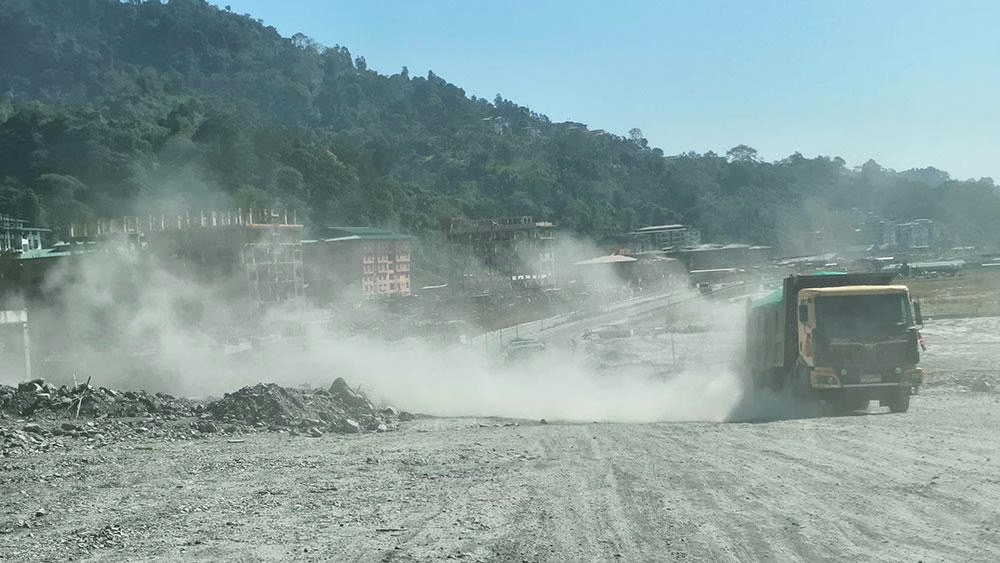
Infrastructure Crisis Unfolds on Key Regional Highway 🚧
Months have passed since the monsoon season wreaked havoc on one of Bhutan's critical transportation corridors, yet the Phuentsholing-Samtse highway at Amochu remains in a deplorable state. What was once manageable monsoon damage has evolved into a persistent infrastructure crisis affecting thousands of daily commuters, local businesses, and residents who call this region home.
The deteriorating conditions tell a troubling story about infrastructure maintenance challenges in Bhutan's southern dzongkhags. Heavy vehicles rumble through sections scarred by seasonal flooding, kicking up clouds of dust that settle over nearby homes and businesses. Potholes have grown increasingly treacherous, and visibility issues create genuine safety concerns for drivers navigating this crucial trade route.
The Dust Dilemma: A Quality of Life Crisis 💨
For residents living adjacent to the Amochu road, the dust problem has become suffocating—both literally and figuratively. The fine particles that once fell as mud during the rainy season have now transformed into airborne irritants that permeate daily life.
"We cannot dry our clothes or keep anything outside as they get covered with dust within no time," explained one frustrated resident, capturing the daily reality faced by families in the affected areas. This isn't merely an inconvenience; it represents a genuine degradation of living standards in a community that already faces geographic and infrastructural challenges.
The dust issue stems from a specific cause: the heavy traffic of aggregate-laden trucks operated by river extraction businesses stationed at Amochu. These commercial operations, while economically significant for the region, have created unintended consequences for the surrounding community. As vehicles traverse the damaged road surface, loose soil becomes suspended in the air, creating visibility hazards and coating everything in the vicinity.
Traffic Safety Concerns Escalate 🚗⚠️
Beyond the nuisance of dust accumulation, serious safety implications have emerged on this heavily-traveled corridor. When multiple heavy trucks travel in convoys—a common occurrence given the aggregate export operations—visibility diminishes dramatically. Other drivers find themselves navigating through clouds of dust, unable to see oncoming traffic or road hazards clearly.
The potholes scattered across the damaged sections compound these safety risks. Light vehicles, particularly motorcycles and smaller cars, face significant challenges when encountering these road defects at speed. The combination of poor visibility, large potholes, and heavy commercial traffic creates a hazardous environment that demands urgent attention.
Industry data from road safety organizations indicates that dust-related visibility issues contribute to approximately 15-20% of road accidents in developing nations with similar infrastructure conditions. Bhutan's commitment to road safety makes this deterioration particularly concerning.
The Multi-Agency Coordination Challenge 🤝
Phuentsholing Thrompon Deepen Ghallay has acknowledged the severity of the situation, confirming that the Thromde cannot single-handedly resolve the crisis. The restoration effort requires coordination among multiple stakeholders—a reality that has complicated resolution efforts.
The agencies involved in this coordination effort include:
- Phuentsholing Thromde – Local municipal authority responsible for urban infrastructure
- Phuentsholing Township Development Project (PTDP) – Development initiatives affecting the broader region
- Bhutan Exporters Association – Representative body for commercial operations utilizing the route
- Phuentsholing Dungkhag – District-level administrative body
The Thrompon revealed that the Thromde has already invested more than Nu 2 million in attempted repairs and maintenance efforts. However, without coordinated action from other agencies and stakeholders, these investments have yielded limited results. The absence of a unified restoration timeline remains a significant concern for residents and businesses.
Corporate Social Responsibility Questions Arise 💼
As the aggregate export industry continues operations at Amochu, community members have begun questioning whether businesses are adequately fulfilling their corporate social responsibility (CSR) obligations. The exporters benefit economically from the road infrastructure, yet the surrounding community bears the environmental and quality-of-life costs.
Historically, water tanker deployments have provided temporary relief from dust accumulation. These vehicles would periodically sprinkle water on road surfaces to suppress dust particles. However, residents report that even these basic mitigation measures have become sporadic or unavailable in recent months.
This raises important questions about burden-sharing in resource extraction industries. Should commercial operators contribute more directly to infrastructure maintenance and environmental remediation? Should CSR frameworks in Bhutan's export sector include mandatory dust suppression measures in high-impact areas?
The Amochu Walking Trail: Collateral Damage 🚶
The infrastructure damage extends beyond the main highway. The Amochu walking trail, developed as part of the Phuentsholing Township Development Project, has also suffered degradation. This recreational amenity serves local residents seeking morning and evening exercise opportunities—a health and wellness resource that has been compromised by the same environmental conditions affecting the main road.
The trail's deterioration represents a broader concern about how infrastructure damage cascades through interconnected systems and projects. When primary infrastructure fails, secondary developments that depend on or relate to that infrastructure inevitably suffer as well.
Proposed Solutions and Long-Term Fixes 🔧
Different stakeholders have proposed varying approaches to address the underlying problems. Some drivers and residents have suggested concrete paving as a permanent solution, pointing to successful implementations in nearby Pasakha as proof of concept.
Concrete surfacing offers several advantages over traditional asphalt or gravel roads:
- Durability – Concrete withstands monsoon damage better than conventional materials
- Reduced maintenance – Lower ongoing repair costs compared to gravel or damaged asphalt
- Dust suppression – Solid surfaces eliminate dust generation from vehicle movement
- Long-term cost efficiency – While initial investment is higher, lifecycle costs may be lower
The Thrompon has outlined immediate measures to address the crisis while longer-term solutions are developed. An excavator will be deployed to drain water that has pooled in the road's center at the flood-affected site—water accumulation that exacerbates both safety and structural concerns. Additionally, water tanker operations will resume to suppress dust temporarily.
Infrastructure Maintenance: A Broader Bhutanese Challenge 🇧🇹
The Amochu road situation reflects larger infrastructure maintenance challenges facing Bhutan's development agenda. As the nation invests in road networks connecting remote areas and facilitating commerce, the question of sustained maintenance and rapid response to damage becomes increasingly critical.
Bhutan's Five-Year Plan framework emphasizes infrastructure development, but maintenance budgets often lag behind construction investments. This creates situations where newly developed or recently damaged roads deteriorate faster than repair capacity can address.
The monsoon season remains a predictable challenge in Bhutan's climate cycle. Yet infrastructure planning that accounts for seasonal damage and includes rapid response protocols remains inconsistently implemented across different regions.
What Residents Need Now 📋
For the communities affected by the Amochu road's deterioration, immediate relief measures are necessary while permanent solutions are developed:
- Consistent dust suppression – Regular water tanker operations during dry seasons
- Pothole repair – Immediate filling of the most dangerous road defects
- Visibility improvements – Possibly including road markings or signage to warn of hazards
- Traffic management – Potentially staggered scheduling of heavy vehicle movements
- Environmental monitoring – Tracking dust levels and health impacts on nearby residents
Looking Forward: Timeline and Expectations ⏰
While the Thrompon has acknowledged the issue and committed to coordinated action, a specific restoration timeline has not been publicly announced. This uncertainty creates frustration for residents and businesses dependent on the route.
For a road of this significance—serving daily commuters, supporting major export operations, and providing access to recreational facilities—a clear restoration schedule would provide stakeholders with reasonable expectations. The lack of timeline transparency suggests either that coordination among agencies remains incomplete or that resource constraints are limiting restoration capacity.
Conclusion: Infrastructure as Community Responsibility 🌟
The Amochu road crisis exemplifies how infrastructure challenges ripple through communities in ways that extend far beyond mere transportation inconvenience. Dust affecting residents' homes, safety risks threatening drivers, and deteriorating recreational facilities all stem from a single underlying infrastructure failure.
Resolution requires genuine coordination among government agencies, commercial stakeholders, and local communities. The Thromde's acknowledgment that this problem cannot be solved unilaterally is an important first step, but the community awaits concrete action and timelines.
As Bhutan continues its development trajectory, the Amochu road serves as a case study in the importance of rapid infrastructure response, adequate maintenance budgeting, and stakeholder collaboration. The residents and businesses of this region deserve both immediate relief measures and a credible pathway toward permanent restoration. The time for coordinated action is now.
You May Also Like
News
Bhutan's Vision for Inclusive Future on World Children's Day
November 21, 2026
News
Year-Round Irrigation Transforms Agriculture in Wangdue and Zhemgang
November 21, 2026
News
SOM Designs Visionary New Precinct for Gelephu Mindfulness City
November 21, 2026

News
NA Extends Potato Marketing Debate as Farmers Struggle
November 19, 2026