Category:
NewsRoyal Prayer Ceremony Honors Nepal and China Flood Victims
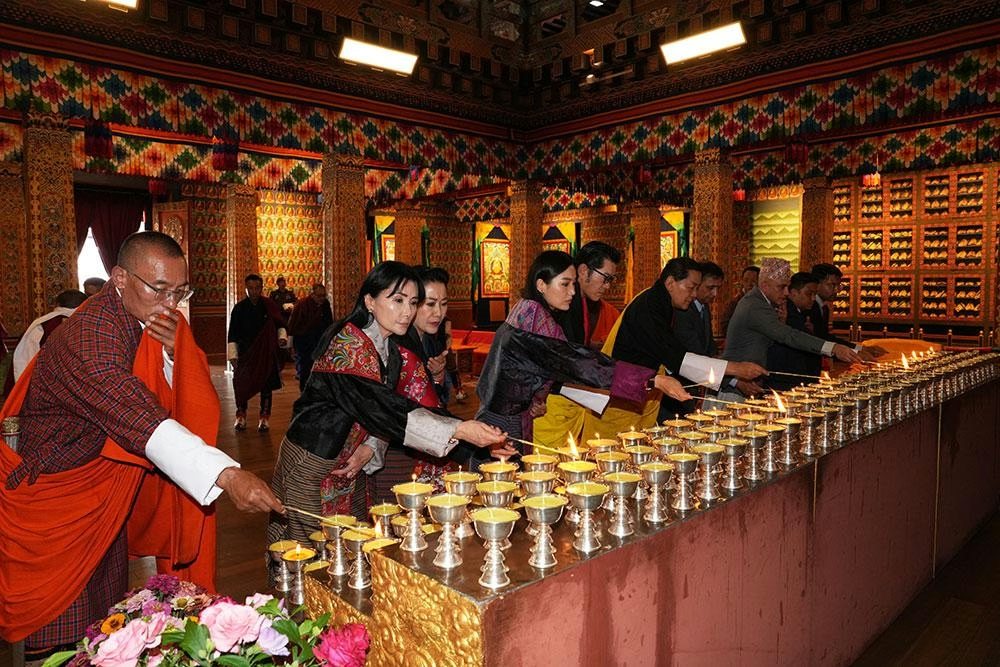
A Moment of Solidarity and Compassion 🙏
In a powerful display of regional solidarity and spiritual compassion, Bhutan's highest-ranking officials gathered at the sacred Grand Kuenrey of Tashichhodzong to honor the lives lost in devastating floods that swept through neighboring Nepal and China. The solemn ceremony brought together the nation's leadership in a unified gesture of remembrance, demonstrating Bhutan's deep commitment to supporting its regional partners during times of crisis.
The gathering represented more than a ceremonial obligation—it reflected Bhutan's cultural values of compassion and interconnectedness with the broader South Asian community. In an era where natural disasters increasingly threaten multiple nations simultaneously, such coordinated expressions of solidarity have become essential in fostering regional unity and humanitarian response.
The Royal Family Leads the Way 👑
The ceremonial prayers were led by His Majesty The King and His Majesty the Fourth Druk Gyalpo, accompanied by Her Majesty The Queen and Their Majesties the Queen Mothers. Members of the extended Royal Family also participated, underscoring the significance the nation's leadership placed on acknowledging this tragedy.
The illumination of a thousand butter lamps—a traditional Buddhist practice symbolizing the dispelling of darkness and ignorance—created a poignant atmosphere of remembrance. Each flame represented prayers for those who perished, those still unaccounted for, and the families grappling with unimaginable loss.
The ceremonial elements included:
- Recitation of sacred Buddhist texts and prayers
- Lighting of ceremonial butter lamps throughout the evening
- Collective meditation for the deceased and affected communities
- Formal expressions of condolence and support
Government Leadership Unites in Prayer 🕯️
Beyond the Royal Family's participation, the ceremony drew the Prime Minister and senior government officials, reflecting the multi-institutional nature of Bhutan's response to the disaster. This comprehensive representation demonstrated that disaster response transcends individual departments—it requires whole-of-government commitment.
Notably, Nepali citizens residing and working in Bhutan were invited to participate in the ceremony. This inclusive approach recognized the personal connections many Bhutanese residents share with the affected regions and allowed expatriate communities to grieve collectively while feeling supported by their host nation.
The presence of Nepali workers underscored an important reality: natural disasters in neighboring countries directly impact Bhutanese communities through personal relationships, family ties, and shared cultural heritage. By including these voices, Bhutan's leadership demonstrated genuine empathy rather than performative sympathy.
Understanding the Scale of the Disaster 📊
The floods that triggered this memorial ceremony represented one of the most severe weather events to impact the region in recent years. Monsoon rains combined with geographical vulnerabilities created catastrophic conditions across multiple provinces and districts in both Nepal and China.
Climate scientists have documented an alarming trend in the Himalayan region: increased frequency and intensity of extreme weather events. The combination of glacial melt, altered precipitation patterns, and deforestation has created perfect conditions for flash floods that develop with minimal warning.
Key factors contributing to flood severity in the region include:
- Rapid snowmelt from high-altitude glaciers
- Concentrated monsoon rainfall in mountainous terrain
- Deforestation reducing water absorption capacity
- Limited early warning infrastructure in remote areas
- Inadequate drainage systems in densely populated valleys
A Message of Shared Sorrow 💔
Their Majesties released an official condolence message that captured the emotional weight of the moment. The statement acknowledged the heartbreaking scale of the tragedy while offering spiritual comfort to grieving families.
"Bhutan shares in the sorrow of our neighbours," the message conveyed, emphasizing that regional disasters transcend political boundaries and affect the collective consciousness of South Asia. This sentiment reflects Buddhist principles of universal compassion and interconnectedness that deeply influence Bhutanese governance and foreign policy.
The message specifically addressed the anguish of families awaiting news of missing loved ones—a reality that extends far beyond casualty statistics. Each missing person represents a family living in agonizing uncertainty, a dimension of disaster impact that often receives insufficient attention.
Bhutan's Humanitarian Response Framework 🤝
Bhutan's approach to regional humanitarian crises reflects its broader foreign policy philosophy of "Gross National Happiness" (GNH)—a development paradigm that prioritizes citizen wellbeing and spiritual contentment over purely economic metrics. This framework naturally extends to international relations, where compassion and support for neighbors form core principles.
The nation has historically responded to regional emergencies through:
- Formal diplomatic channels expressing solidarity
- Spiritual ceremonies acknowledging shared humanity
- Practical humanitarian assistance when feasible
- Documentation and commemoration of victims
- Support for affected diaspora communities
This multi-layered approach ensures that responses address both spiritual and material needs of affected populations.
The Broader Context of Regional Cooperation 🌏
Bhutan's active participation in memorial ceremonies for neighboring countries' disasters reflects its strategic position within South Asia. As a small Himalayan nation surrounded by larger powers, Bhutan has cultivated a reputation for principled diplomacy and genuine regional engagement.
The country maintains strong bilateral relationships with both Nepal and China, though these relationships carry different historical and geopolitical dimensions. By responding equally to disasters affecting both neighbors, Bhutan demonstrates its commitment to impartial humanitarian values that supersede political complexities.
This balanced approach has strengthened Bhutan's standing as a trusted regional partner and a voice for stability in an increasingly volatile geopolitical landscape.
Community Impact and Ongoing Challenges 🌊
Beyond the immediate loss of life, floods in Nepal and China have displaced hundreds of thousands of people and destroyed critical infrastructure. Homes, agricultural land, bridges, and roads have been swept away, creating humanitarian crises that will persist long after floodwaters recede.
The reconstruction phase typically spans months or years, requiring sustained international attention and resources. Communities must rebuild not just physical infrastructure but also social cohesion and economic livelihoods.
Long-term challenges facing affected regions include:
- Rebuilding housing and community infrastructure
- Restoring agricultural productivity and food security
- Addressing mental health and trauma in survivor populations
- Preventing disease outbreaks in waterlogged areas
- Revitalizing local economies and employment
- Implementing climate resilience measures
Buddhist Principles and Compassionate Response 🏛️
Buddhism's influence on Bhutanese governance is particularly evident in how the nation responds to human suffering. The practice of lighting butter lamps carries profound spiritual significance—it represents the transformation of darkness into light, ignorance into wisdom, and despair into hope.
This ceremonial response is not merely symbolic; it reflects genuine theological commitment to alleviating suffering wherever it occurs. The Buddhist concept of bodhisattva—an enlightened being who postpones personal liberation to help others—shapes how Bhutanese leaders approach international humanitarian responsibilities.
By leading public prayers and ceremonies, the Royal Family and government officials model compassion for the broader population, reinforcing cultural values that emphasize collective responsibility for human wellbeing.
Looking Forward: Disaster Preparedness and Climate Action 🔮
As climate change intensifies weather extremes across the Himalayas, the frequency of such disasters will likely increase. Regional cooperation on disaster preparedness, early warning systems, and climate adaptation becomes increasingly critical.
Bhutan has positioned itself as a leader in environmental stewardship and climate action. The nation maintains over 60% forest coverage and has committed to remaining carbon-negative. This environmental leadership creates opportunities for Bhutan to champion regional climate resilience initiatives.
Future cooperation might include:
- Shared early warning systems for extreme weather
- Cross-border disaster response coordination
- Climate adaptation technology transfer
- Joint research on Himalayan environmental changes
- Regional capacity building for disaster management
The Power of Collective Remembrance 🕊️
Ceremonies like the one at Tashichhodzong serve purposes beyond immediate emotional catharsis. They establish collective memory, honor human dignity, and affirm shared values across national boundaries.
When leaders participate visibly in mourning rituals, they validate the experiences of affected communities and signal that their suffering matters on the international stage. This recognition, while it cannot reverse tragedy, provides psychological comfort and demonstrates that the world is paying attention.
For Bhutanese citizens, particularly the Nepali diaspora, participating in the ceremony created space for collective grief and community solidarity during a time of personal anguish.
Conclusion: Compassion as Foreign Policy 🌟
Bhutan's response to the Nepal and China floods exemplifies how smaller nations can exercise meaningful influence through principled leadership and genuine compassion. By bringing together government officials, the Royal Family, and affected communities in solemn remembrance, Bhutan demonstrated that humanitarian response transcends political calculation.
The thousand butter lamps illuminated at Tashichhodzong represented more than ceremonial observance—they symbolized Bhutan's commitment to regional stability, shared humanity, and the Buddhist values that guide the nation's governance. As climate change increases the likelihood of future disasters, such expressions of solidarity and cooperation become increasingly vital.
In an interconnected world where natural disasters respect no borders, Bhutan's example reminds us that compassion, spiritual practice, and collective action remain our most powerful tools for responding to human tragedy and building resilient communities.
The prayers offered that evening continue to resonate, carrying messages of hope and solidarity across the Himalayan region to all those affected by this devastating disaster. 🙏
You May Also Like
News
Women Entrepreneurs Master AI and Digital Tools in Phuentsholing
September 1, 2026
News
Can Samtse Keep Up With Its Growing Workforce?
August 29, 2026
News
Nepal Flood Exposes Critical Gaps in Bhutan's Early Warning Systems
August 29, 2026
News
High Court Overturns Acquittal: Doctor Sentenced to 10 Years for Child Sexual Abuse
August 29, 2026