Category:
NewsCan Samtse Keep Up With Its Growing Workforce?
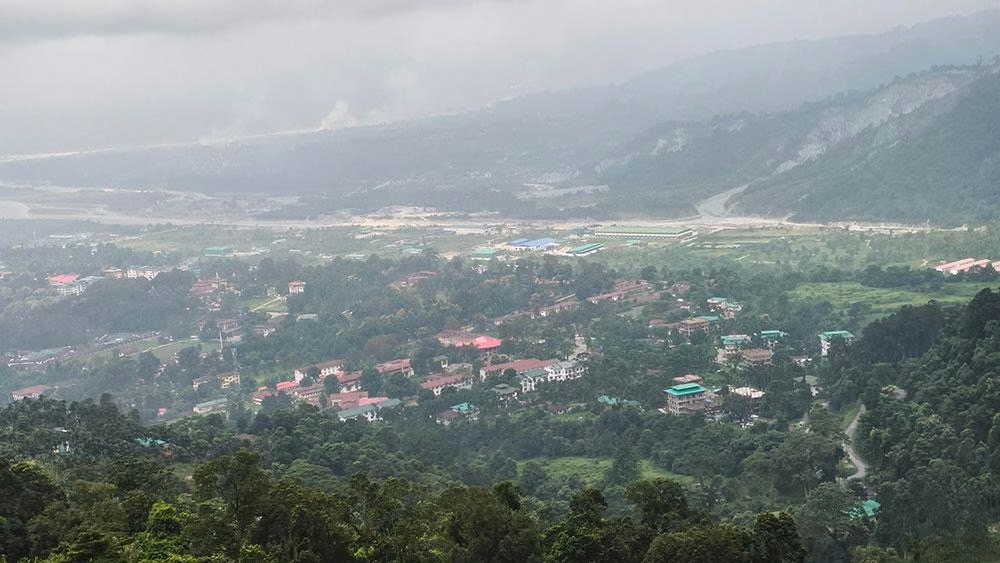
Samtse stands at a critical crossroads as rapid industrial expansion transforms the region's economic landscape. 🏭 The once-quiet town in southwestern Bhutan is experiencing unprecedented growth, but residents and local officials are increasingly concerned about whether the region's infrastructure—particularly housing—can accommodate the influx of workers expected in the coming years.
The Housing Crisis Looms 🏠
What was once considered an affordable alternative to overcrowded Phuentsholing is now facing similar pressures. Rental prices have surged dramatically as two major industrial parks expand their operations, attracting workers from across the country and beyond.
Current market rates tell a compelling story of supply-demand imbalance. A modest two-bedroom apartment now commands approximately Nu 12,000 monthly, while three-bedroom units reach up to Nu 16,000. Even semi-permanent single-storey houses with basic amenities cost around Nu 6,000 per month—prices that would have been unimaginable just a few years ago.
"With more industries coming in, they create more jobs and more work, which has outpaced the ongoing home construction," explains Jewan Gurung, a Dhamdhum resident witnessing the transformation firsthand. The gap between workforce growth and housing supply has become the defining challenge of Samtse's development trajectory.
Industrial Growth Accelerating Faster Than Expected ⚡
The two industrial parks driving this transformation—Dhamdhum and Norbugang—are still ramping up operations, yet they're already straining local resources. As of mid-2024, Dhamdhum Industrial Park hosts 68 allotted industries, with only 24 currently operational and generating approximately 195 jobs. The remaining facilities are at various construction and licensing stages, representing enormous future employment potential.
Norbugang Industrial Park, meanwhile, has 10 industrial units focused primarily on large-scale ferro-alloy production. Four are operational, generating around 1,434 employment opportunities, while six remain under construction. These numbers represent just the beginning of what's anticipated to be substantial industrial expansion.
The critical insight here is sobering: if housing demand is already this intense with most industries still offline, what happens when full operational capacity is reached? "If the pressure reaches this level even when most of the industries have not yet started operations, the housing crisis may worsen further once all the industries become operational," warns Tshering, a local shopkeeper observing the situation daily.
Construction Boom Signals Market Response 🏗️
Private developers are responding to market signals, though perhaps not quickly enough. The Samtse Dzongkhag has issued approximately 60 residential construction approvals, with 45 to 50 houses currently under construction. This represents a significant uptick compared to historical construction patterns.
Visible development clusters are emerging across the region:
- Gurung Basti area: Over 10 buildings under active construction during recent assessments
- Highway corridor: Significant activity along routes toward Norbugang Industrial Park
- Central Samtse: Scattered residential projects responding to localized demand
While this construction activity demonstrates market responsiveness, the pace must accelerate substantially to prevent acute housing shortages. Workers are already adopting coping mechanisms—sharing accommodation to manage costs—a sign that affordability pressures are mounting.
The Corporate Responsibility Question 🤝
The Ministry of Industry, Commerce and Employment has articulated a clear position: industries must assume responsibility for worker accommodation rather than expecting government intervention. This policy shift transfers housing provision burden from public institutions to private employers.
This directive creates three potential scenarios:
- Corporate housing provision: Industries construct or subsidize employee housing
- Shared facility arrangements: Companies coordinate bulk accommodation solutions
- Private market reliance: Workers independently secure rental housing
Each approach carries different implications for Samtse's housing market. Corporate-provided housing could stabilize prices by reducing private sector demand, while market-dependent solutions might intensify rental inflation. The actual outcome will likely involve a mixture of these approaches, depending on individual company policies and competitive pressures for talent.
Government Intervention: The Housing Development Initiative 🏛️
Recognizing the crisis potential, the National Housing and Development Corporation Limited, supported by Asian Development Bank funding, has recently awarded contracts for 64 new housing units in Samtse. This represents a meaningful intervention, though observers debate whether the scale matches anticipated demand.
The 64-unit project provides approximately 640 individuals with formal housing options—a positive step, but potentially insufficient if workforce growth accelerates as projected. Notably, Samtse possesses advantages that Phuentsholing lacked during its housing crisis: available land suitable for development. This geographic advantage creates opportunity for strategic expansion if authorities move decisively.
Infrastructure Strain Beyond Housing 💧
The housing challenge, while most visible, represents only one dimension of Samtse's infrastructure stress. Water supply systems designed for smaller populations are straining under increased demand from larger residential buildings accommodating more tenants.
"With bigger buildings that could accommodate more tenants, the water issue is also surfacing, as the old lines cannot meet the demand of the current population," notes a Khandothang resident. Local leadership has submitted proposals to strengthen water security, but implementation timelines remain uncertain.
This infrastructure bottleneck could become as critical as housing availability. Industrial operations typically demand significant water resources, while residential expansion compounds pressure on aging distribution networks. Simultaneous infrastructure upgrades—water systems, electrical grids, waste management—must accompany housing development to prevent compounding crises.
Learning From Phuentsholing's Experience 📚
Phuentsholing's transformation from small border town to overcrowded commercial hub offers cautionary lessons. Rapid industrial and commercial growth overwhelmed housing supply, creating affordability crises that persist today. Residents fear Samtse could replicate this trajectory unless deliberate planning intervenes.
Key differences exist, however. Samtse's larger available land provides opportunity for planned expansion rather than the constrained development patterns that characterized Phuentsholing. Strategic intervention now could prevent the housing affordability nightmare that plagues Bhutan's largest border town.
The Path Forward: Strategic Planning Essential 🎯
Samtse's future depends on coordinated action across multiple stakeholders:
Government authorities must accelerate housing development approvals and infrastructure investment, leveraging available land before speculation drives prices higher.
Private industries should implement employee housing programs, either through direct construction or shared facility arrangements, reducing pressure on local rental markets.
Private developers need market certainty and regulatory support to justify rapid residential expansion, knowing demand will sustain investments.
Municipal leadership must balance growth with livability, ensuring rapid expansion doesn't sacrifice Samtse's character or create the congestion that plagues Phuentsholing.
Conclusion: A Window of Opportunity ✨
Samtse faces a defining moment. The region possesses advantages—available land, growing economic opportunity, and advance warning from other regions' experiences—that could enable managed growth rather than crisis-driven scrambling.
However, this window of opportunity is rapidly closing. Within 18-24 months, as more industrial operations commence full employment, housing demand will likely intensify dramatically. Current rental inflation, while concerning, may appear moderate compared to future pressure if proactive measures aren't implemented now.
The question isn't whether Samtse can keep up with its growing workforce—it's whether stakeholders will act with sufficient urgency and coordination to ensure it does. The region's next chapter depends on decisions made in the present moment. 🌟
You May Also Like
News
Women Entrepreneurs Master AI and Digital Tools in Phuentsholing
September 1, 2026
News
Nepal Flood Exposes Critical Gaps in Bhutan's Early Warning Systems
August 29, 2026
News
High Court Overturns Acquittal: Doctor Sentenced to 10 Years for Child Sexual Abuse
August 29, 2026
News
Bhutan's Critical Engineer Shortage Threatens Megaproject Timeline
August 29, 2026