Category:
EconomyMatsutake Season: Genye's Growing Economy Beyond the Sale
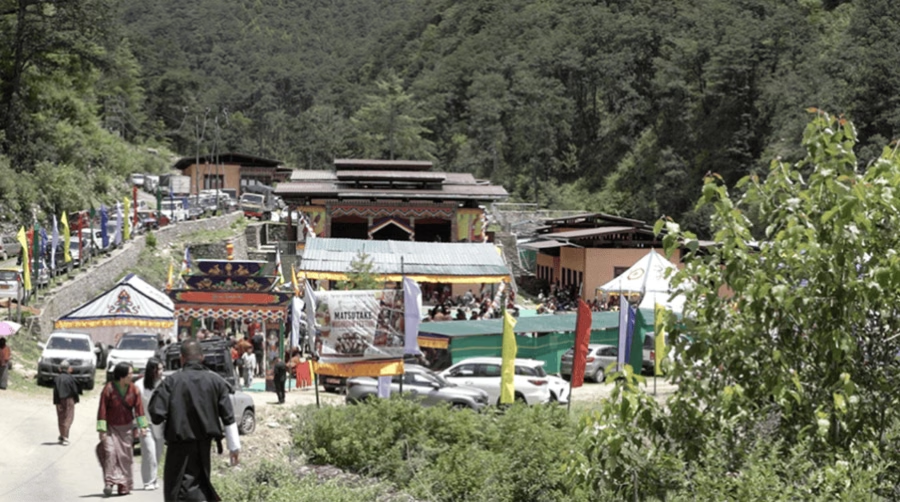
🍄 When a Wild Mushroom Transforms an Entire Community Economy
Every August, the quiet hillsides of Genye in Thimphu transform into a bustling economic hub—not because of traditional industries or commercial development, but because of a remarkable fungus that refuses to be cultivated. The matsutake season in Genye represents one of Bhutan's most compelling examples of how natural resources, when properly valued and managed, can catalyze broader economic growth far beyond the initial harvest.
What makes this story particularly fascinating is that the matsutake economy in Genye has evolved dramatically in recent years. The financial benefits that once stopped at the point of sale now ripple through the entire community, creating opportunities in tourism, hospitality, local commerce, and cultural preservation. This transformation offers valuable lessons about sustainable economic development in rural Bhutanese communities.
Understanding the Matsutake Phenomenon 🌲
Locally known as Sangay Shamu, the matsutake mushroom occupies a unique position in both global and local markets. Scientific research has consistently demonstrated that matsutake cultivation on farms remains extraordinarily difficult—the mushroom thrives only through a complex symbiotic relationship with specific forest tree species. This biological reality makes matsutake one of the world's most coveted wild mushrooms, commanding premium prices in international markets, particularly in Japan where it holds deep cultural significance.
The mushroom's rarity isn't a limitation in Genye; it's the foundation of an entire seasonal economy. Unlike agricultural products that require investment in seeds, fertilizers, and equipment, matsutake harvesting leverages Genye's existing forest ecosystems. Local residents have become expert foragers, developing generations of knowledge about where and when these prized mushrooms appear.

💰 Direct Income: The Foundation of Change
The financial impact of matsutake season on individual households is substantial. According to Kencho, the Gup (administrative head) of Genye Gewog, every villager earns a minimum of Nu 50,000 to 60,000 during the matsutake season—a significant sum in the context of rural Bhutanese incomes. More impressively, records indicate that top collectors and traders can exceed Nu 200,000 in seasonal earnings.
To contextualize this impact: for many Genye residents, matsutake season represents an annual income boost equivalent to several months of regular employment. This direct financial infusion provides households with capital for:
- Essential investments in education and healthcare
- Home improvements and maintenance
- Agricultural inputs for other crops
- Emergency financial reserves
- Community contributions and cultural celebrations
However, the truly revolutionary aspect of Genye's matsutake economy isn't the direct income—it's the economic multiplier effect that has begun to emerge.
🎉 The Genye Matsutake Festival: Catalyzing Broader Economic Activity
Recognizing the potential of their natural advantage, Genye's community leaders made a strategic decision: transform the matsutake season into a destination event. The Genye Matsutake Festival represents a deliberate effort to extend the economic benefits beyond mushroom collectors and into the broader tourism and hospitality sectors.
During the festival's two-day event, Genye's forests and fields became an open-air marketplace and cultural showcase. The programming reflected sophisticated understanding of experiential tourism and value-added services:
- Matsutake grading and tasting sessions that educated visitors about quality standards and flavor profiles
- Guided foraging experiences allowing tourists to participate in the harvest
- Treasure hunts that gamified the mushroom-hunting experience
- Forest bathing (shinrin-yoku) sessions—a wellness practice gaining international popularity—that invited visitors to engage mindfully with the natural environment
- Traditional food demonstrations showcasing how matsutake integrates into Bhutanese and Japanese cuisine
- Cultural performances and traditional games celebrating local heritage
The results exceeded expectations. According to Tandin Dorji, a farmer in Genye Gewog, the festival generated business activity levels previously unseen in the village. Visitors from multiple districts participated, with a notably increasing number of international tourists, particularly from Japan.
📈 Beyond Mushrooms: The Expanding Economy
What distinguishes Genye's matsutake economy from a simple commodity export is its cascading effect on other local enterprises. The influx of visitors during matsutake season has created demand for:
Hospitality Services: Homestays, guesthouses, and accommodation providers benefit from increased tourist arrivals. Families can generate additional income by hosting visitors interested in experiencing rural Bhutanese life.
Food and Beverage: Local restaurants and food vendors experience heightened demand. Entrepreneurs have opportunities to create specialized matsutake-based dishes, fusion cuisine, and traditional meals that appeal to both domestic and international visitors.
Transportation and Logistics: Vehicle rental services, guide services, and transportation providers see increased bookings during the festival period.
Retail and Crafts: Local artisans and craft producers have expanded markets for traditional goods, souvenirs, and cultural products.
Community Services: The increased economic activity generates funds for community development projects, cultural preservation initiatives, and infrastructure improvements.
🏪 The Formal Trade Evolution
The matsutake economy in Genye has also witnessed significant formalization and professionalization. The expansion of commercial infrastructure reflects growing confidence in the market's sustainability.
According to Tshering Wangchuk, Manager of Padma Gourmet and Foods, the exporter landscape has expanded dramatically. Last year, only three exporters operated in the region. This year, that number more than doubled to seven. This expansion indicates:
- Growing market confidence in matsutake's commercial viability
- Increased competition driving efficiency and quality standards
- Better market access for local collectors through multiple channels
- Employment creation in processing, grading, and logistics
The establishment of standardized grading systems—categorizing matsutake into Class A and B with fixed pricing—represents professionalization of the market. This standardization benefits all stakeholders:
- Collectors gain price transparency and fair valuation
- Exporters can manage quality consistency and buyer expectations
- International buyers receive reliable product standards
- The community benefits from reduced price manipulation
🌍 Global Demand Meets Local Supply
Genye's matsutake economy operates at the intersection of global market forces and local resource management. Japan's sustained demand for premium matsutake—driven by cultural preferences, culinary traditions, and limited domestic supply—creates reliable international market demand.
This global appetite for a locally available resource represents an unusual advantage. Unlike many rural communities that compete in commoditized global markets, Genye's matsutake offers genuine scarcity value. The mushroom cannot be mass-produced; it cannot be imported from cheaper sources; it cannot be synthesized or substituted. This creates a durable competitive advantage.
🌱 Sustainability Considerations and Forest Management
The matsutake economy's long-term viability depends on sustainable forest management. The symbiotic relationship between matsutake and specific tree species means that forest health directly impacts mushroom productivity. Genye's residents have demonstrated awareness of this connection, implementing traditional forest management practices that maintain ecosystem balance.
This sustainable approach contrasts with extractive economies that deplete natural resources. In Genye, the matsutake season incentivizes forest preservation and biodiversity protection—the community's economic interests align with environmental conservation.
📊 Economic Multiplier Effects and Community Development
The matsutake season's economic impact extends beyond individual earnings to community-level development. The concentrated seasonal income creates opportunities for:
Infrastructure Investment: Community funds from matsutake-related commerce can finance road improvements, water systems, and communication infrastructure.
Education Support: Families with seasonal matsutake income can better support children's education, potentially breaking cycles of poverty.
Healthcare Access: Improved household finances enable better access to healthcare services and preventive medicine.
Cultural Preservation: Increased tourism creates incentive and revenue for maintaining traditional practices, languages, and cultural knowledge.
Youth Retention: Economic opportunities in matsutake-related activities encourage younger generations to remain in rural communities rather than migrate to urban centers.
🔮 Future Prospects and Scalability
Genye's matsutake economy model offers replicable lessons for other Bhutanese communities with valuable natural resources. The key success factors include:
- Recognition of natural competitive advantages
- Community-level organization and coordination
- Investment in experiential tourism and value-added services
- Formalization of trading practices and quality standards
- Strategic marketing to international markets
- Integration of cultural and environmental elements
As global interest in sustainable, authentic experiences grows, rural communities with genuine natural and cultural assets like Genye occupy increasingly valuable market positions. The matsutake season demonstrates that economic development doesn't require industrialization or resource extraction—it requires recognizing and thoughtfully developing existing advantages.
🎯 Key Takeaways: Beyond the Simple Harvest
Genye's matsutake economy transcends the traditional commodity export model. What began as forest foragers collecting wild mushrooms has evolved into a sophisticated ecosystem encompassing:
✨ Direct collector income providing household financial security
✨ Tourism and hospitality services creating employment beyond harvesting
✨ Formalized trading infrastructure ensuring market efficiency and fairness
✨ Cultural preservation initiatives strengthening community identity
✨ Environmental stewardship aligning economic incentives with conservation
✨ Community development improving infrastructure and services
The matsutake season in Genye illustrates that sustainable economic growth emerges not from imposing external development models but from thoughtfully developing authentic local assets. As Genye continues to refine its matsutake-based economy, other rural communities—both within Bhutan and globally—can learn valuable lessons about building resilient, inclusive, and genuinely sustainable economic systems.
The quiet hillsides of Genye have become a case study in economic transformation—proving that sometimes the most powerful economic engines are found not in factories or offices, but in forests, where nature and human enterprise intersect.
You May Also Like
Economy
Bhutan's Bold Vision: Two USD 50M Enterprises by 2030
September 27, 2026
Economy
Mega Dry Port in Pasakha: Bhutan's Trade Revolution
September 25, 2026
Economy
Fixed Deposit Tax Withholding: What You Need to Know
September 13, 2026
Economy
DRC's QR Payment Innovation: Tracking Business Income
September 2, 2026