Category:
EconomyToyota Import Chaos: No-Objection Letter Dilemma
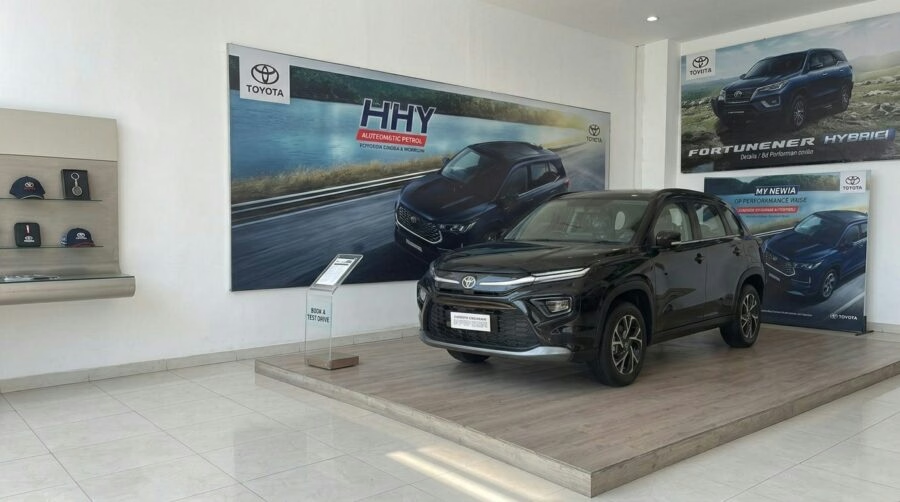
Understanding the Toyota Import Bottleneck 🚗
Bhutanese car buyers pursuing their dreams of owning a Toyota vehicle from Indian dealerships are encountering an unexpected roadblock. What should have been a straightforward transaction has transformed into a bureaucratic maze, leaving hundreds of potential owners in a state of uncertainty. The core issue revolves around a mysterious requirement: a "no-objection letter" that has become the centerpiece of an escalating dispute between buyers, dealers, regulatory authorities, and the country's authorized Toyota distributor.
The situation highlights a critical gap in how import regulations, manufacturer policies, and commercial agreements intersect in Bhutan's automotive market. Understanding this complex scenario requires examining the various stakeholders involved and their conflicting positions on what should be a simple consumer transaction.
The Urban Cruiser Hyryder Phenomenon 🌟
The Toyota Urban Cruiser Hyryder has become the focal point of this controversy. This particular model, which combines affordability with modern features, is not currently distributed through Bhutan's authorized Toyota dealer, the State Trading Corporation of Bhutan Limited (STCBL). Since January of this year alone, the Department of Trade has issued approximately 691 import approvals from India, with nearly 94 percent of these authorizations specifically designated for the Urban Cruiser Hyryder.
This unprecedented demand reflects a broader consumer trend in the region. Buyers recognize that purchasing directly from Indian dealers offers access to vehicle variants unavailable in the domestic market. The price differential and model availability have created a compelling economic incentive for cross-border purchases, transforming what was once a niche practice into a mainstream buying pattern.
When Dealers Draw a Line ⚠️
The complications began when Bhutanese buyers, having secured government import approval, approached Toyota dealerships in Siliguri, West Bengal. Their expectations were straightforward: complete the purchase and arrange for vehicle shipment. Instead, they encountered an unexpected demand from the dealers themselves.
Indian Toyota dealers informed buyers that they would need to produce a no-objection letter from STCBL before proceeding with the sale. This requirement caught many off guard, as it was not mentioned during initial discussions or in any official government documentation. One buyer, whose experience mirrors that of many others, described the moment of realization: "After making all the necessary arrangements to purchase the vehicles, we were informed that a complaint had been filed with Toyota Company from Bhutan. We were told that Toyota Company had instructed them not to sell the vehicles in Bhutan, and as a result, they would not be able to sell the vehicles to us."
This allegation—that Toyota had instructed dealers not to sell to Bhutanese customers—added another layer of concern to an already confusing situation.
STCBL's Surprising Declaration 📋
The State Trading Corporation of Bhutan Limited, which holds the exclusive dealership rights for Toyota vehicles in the country, recently issued an official notification addressing this controversy. Their statement was unambiguous: STCBL lacks the legal authority to issue no-objection letters for direct imports from external sources.
Dechen Wangdi, General Manager of STCBL's Toyota Division, explained the company's position clearly: "STCB is a trading company; we are not a regulatory authority. We have no authority to issue an objection or no-objection certificate, so most of the customer they deal directly with the Indian supplier. The Indian supplier has asked them to obtain a no-objection certificate from STCB, which was quite shocking, and we are not in a position to issue it as per our dealership agreement with Trade Japan."
This statement reveals a fundamental misalignment in expectations and responsibilities. While Indian dealers believe STCBL should provide clearance, STCBL argues that its role as a commercial trading entity does not extend to regulatory certification. Furthermore, STCBL denied having filed any complaints with Indian Toyota dealers or authorities to prevent sales to Bhutanese customers, directly contradicting the claims made by some buyers.
The Regulatory Perspective 🏛️
The Department of Trade, Bhutan's primary authority overseeing import regulations, has taken a distinctly different stance on this matter. According to their official position, the no-objection letter is entirely unnecessary for completing a vehicle import transaction.
Rinchen Lhazom, Chief Trade Officer at the Internal Trade Promotion and Facilitation Division, Ministry of Industry, Commerce and Employment (MoICE), articulated the government's view: "We have proactively reached out via email to the company's officials, even inquiring whether they have any objections to supplying these particular variants, which are not supplied or distributed by our Bhutanese dealers in the Bhutanese market, by the authorised legitimate dealers and distributors based outside Bhutan. And we are still awaiting the response from the company, and as soon as we receive the responses via email, we will be able to update."
The Department's official written response clarifies that import authorization from their office is the only governmental requirement necessary. Once a vehicle receives approval and meets all customs, tax, and registration obligations, no additional clearance should be required. The decision to supply or withhold vehicles rests exclusively with the manufacturer or principal company, not with the authorized local distributor.
The Three-Way Contradiction 🔄
This situation presents a classic case of regulatory confusion where three major stakeholders hold contradictory positions:
- Indian Dealers: Require a no-objection letter from STCBL before completing sales
- STCBL: Claims it has no authority to issue such letters and denies filing complaints
- Department of Trade: Maintains that no-objection letters are not required at all
This triangular deadlock leaves buyers in an untenable position. They possess government approval but cannot complete purchases without a document that the authorized distributor claims it cannot legally provide.
Impact on Consumer Confidence 📊
The prolonged uncertainty has created significant anxiety among hundreds of Bhutanese consumers. Many have already invested time, money, and effort in arranging financing, securing approvals, and negotiating with dealers. The sudden introduction of an additional requirement—one that appears to exist in no official documentation—has eroded confidence in the entire import process.
Industry observers note that this situation reflects broader challenges in cross-border commerce in South Asia. As consumers increasingly leverage digital connectivity and regional market access to find better deals and product variety, regulatory frameworks and manufacturer policies have not kept pace. The result is friction points like the one currently affecting Toyota buyers in Bhutan.
Partial Relief for Some Buyers ✅
A glimmer of hope exists for buyers who have already received tax invoices from Indian dealers. According to information shared with media outlets, dealers are considering fulfilling orders for customers who hold official tax documentation. These buyers may eventually receive their vehicles, though timelines remain uncertain due to inventory constraints.
However, this partial solution only addresses a fraction of the affected buyers. Those with only import approval letters face a much dimmer prospect. Their ability to complete purchases depends entirely on responses that government officials are still awaiting from Toyota's corporate representatives.
The Waiting Game 🕐
As of now, the Department of Trade continues its outreach to Toyota's corporate officials, seeking clarity on whether the manufacturer has any objections to these direct imports. This single email exchange has become the linchpin upon which hundreds of vehicle purchases may depend. The speed and nature of the company's response could fundamentally alter the situation for waiting buyers.
The delay in receiving this response underscores a broader challenge in modern commerce: the intersection of global corporate policies, national regulatory frameworks, and consumer expectations. When these systems fail to communicate clearly, consumers bear the cost of the confusion.
What This Means for Bhutanese Consumers 💡
This situation serves as a cautionary tale for anyone considering cross-border vehicle purchases. While import approval from the government represents a necessary first step, it may not be sufficient to guarantee transaction completion. Buyers must now navigate an additional layer of complexity involving manufacturer policies and distributor relationships that exist beyond the formal regulatory framework.
The lack of clear communication between all stakeholders—dealers, manufacturers, authorized distributors, and government agencies—has created a vacuum filled with speculation, uncertainty, and frustration. Moving forward, clearer protocols and explicit communication channels will be essential to prevent similar situations from recurring.
Looking Ahead 🔮
The resolution of this issue will likely require coordinated action from multiple parties. The Department of Trade's engagement with Toyota represents a positive step toward clarification. However, lasting solutions will demand that all stakeholders—including manufacturers, authorized distributors, and regulatory bodies—establish clear, written guidelines governing direct imports of vehicle variants not available through official channels.
For the hundreds of Bhutanese currently caught in this limbo, the path forward remains uncertain. Their situation highlights the importance of transparent communication, clearly defined responsibilities, and proactive problem-solving in the automotive import sector. Until these elements are firmly established, consumers pursuing cross-border vehicle purchases will continue to face unpredictable obstacles and delays that could have been prevented through better coordination and clearer policies.
You May Also Like
Economy
Bhutan's Bold Vision: Two USD 50M Enterprises by 2030
September 27, 2026
Economy
Mega Dry Port in Pasakha: Bhutan's Trade Revolution
September 25, 2026

Economy
Fixed Deposit Tax Withholding: What You Need to Know
September 13, 2026
Economy
DRC's QR Payment Innovation: Tracking Business Income
September 2, 2026