Category:
NewsLaya Road Damage: Tongchudra Bridge Collapse Crisis
Infrastructure Crisis in Remote Bhutan 🌊
Bhutan's remote northwestern region faces a severe infrastructure emergency following devastating flood damage that has isolated communities and disrupted essential services. The Laya Gewog Centre road has sustained catastrophic damage, with the iconic Tongchudra bridge completely washed away, leaving officials and tourists stranded in one of the kingdom's most inaccessible areas.
The scale of destruction along this critical mountain corridor has prompted immediate government intervention and emergency response operations. What began as seasonal water flow has transformed into a major infrastructure challenge that threatens connectivity to Laya, one of Bhutan's most isolated gewogs.
Assessing the Laya Road Damage 📋
On November 1, Gasa Dzongda Jigme Namgyel led a comprehensive assessment mission to evaluate the extent of destruction along the severely damaged Laya road. The inspection revealed extensive deterioration across multiple critical sections between Koina and Tongchudra, with the road formation compromised at three major locations.
The damage assessment identified the following key problem areas:
- Three major road sections completely washed away from their foundations
- Tongchudra vicinity experiencing the most severe destruction, with the entire road base swept away
- Road stretch beyond the bridge towards Laya completely obliterated
- Steep terrain making restoration efforts exceptionally challenging
- Dense forest coverage limiting access and complicating repair operations
The Tongchudra bridge collapse represents the most visible symbol of the disaster. This vital crossing point, which served as the lifeline for communities on both sides of the river, now lies in ruins. The complete destruction of this structure has effectively severed the primary transportation route to Laya, one of Bhutan's most remote and culturally significant regions.
Emergency Response and Rescue Operations 🚨
Government officials mobilized quickly to address the crisis. The Dzongda's team included Desuups and other administrative personnel who navigated treacherous conditions to deliver essential supplies to project officials stranded at Tongchudra. This mission demonstrated the commitment of Bhutanese authorities to support isolated communities during natural disasters.
The rescue operation employed innovative solutions to overcome geographical obstacles. Royal Bhutan Police teams utilized specialized rappelling equipment to assist officials in safely traversing the first damaged section, where vertical drops and unstable terrain created life-threatening hazards.
At subsequent problem areas, personnel climbed the hillside manually and cleared temporary pathways to establish a safe passage to Tongchudra. These emergency measures showcased the resourcefulness and bravery of response teams operating in extremely challenging mountain conditions.
Temporary Bridge Construction and Evacuation 🌉
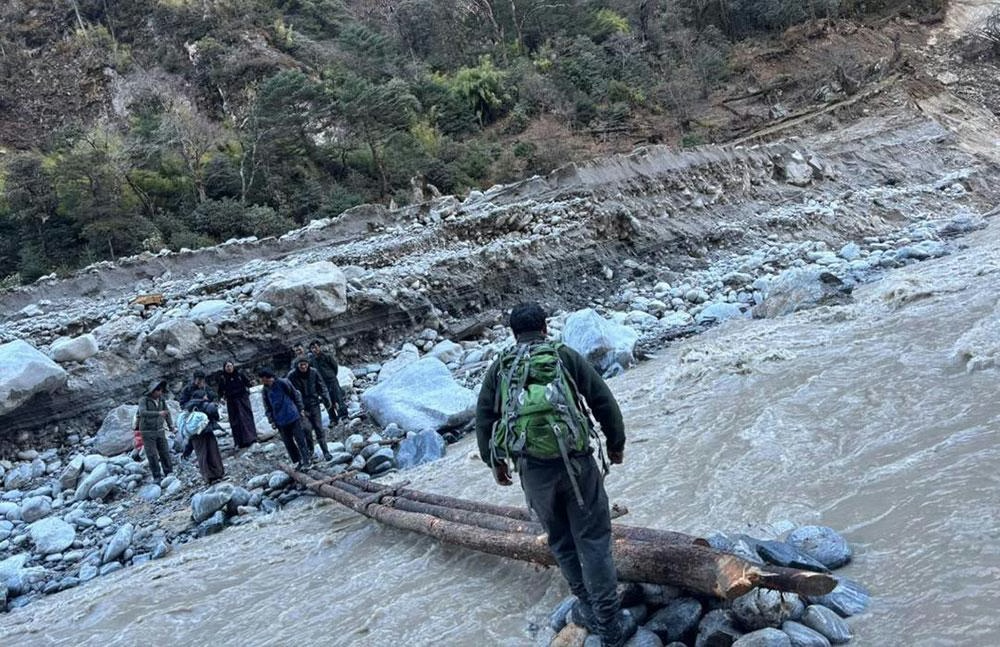
In a critical development, authorities constructed a temporary bridge at Tongchudra, enabling nine stranded individuals to cross safely. This emergency structure, while essential for immediate evacuation, remains fragile and unsuitable for regular public use.
The Dzongda emphasized important safety concerns regarding this temporary solution: "The structure is not safe for regular commuters or public use and could be washed away if the river discharge increases." This cautionary statement underscores the precarious nature of current conditions in the Laya road corridor.
The temporary bridge has proven instrumental in facilitating evacuations. The Snowman Trek team, which had been stranded in Laya, successfully crossed the temporary structure and reached Tongchudra. However, their journey to safety remained incomplete, requiring additional challenging segments.
These trekkers faced a demanding evacuation route: a 1.5-kilometer walk along cliff edges, belongings transfer, ropeway crossing, and additional hiking before reaching Laya. The dzongkhag subsequently arranged three private vehicles to transport the team from Laya to Punakha, completing their emergency evacuation.
Telecommunications and Essential Services Disruption 📡
Beyond road infrastructure, the flooding has disrupted critical telecommunications services vital to the region. The Telecom Manager traveled to Laya to restore connectivity, navigating the same treacherous conditions faced by other officials.
The restoration efforts encountered significant obstacles. Insufficient sunlight prevented solar batteries from achieving full charge capacity, limiting the scope of network restoration. A temporary connection was eventually established, though service reliability remains compromised.
This telecommunications vulnerability highlights the fragility of essential services in remote mountain communities. The solar-dependent system creates additional complications during monsoon seasons when cloud cover and reduced sunlight are prevalent. Service interruptions could impact emergency communications, medical consultations, and administrative functions.
Geological and Hydrological Concerns 🏔️
Beyond the immediate road damage, the flooding has created an artificially formed lake in the region. Officials conducted careful monitoring of this new water body to assess potential risks to surrounding communities.
Current hydrological assessments indicate relatively stable conditions. The water level remains consistent, with no significant accumulation or dangerous elevation increases. Water continues flowing through an outlet, preventing dangerous pooling. The surrounding terrain consists of relatively open and flat areas, which officials assess as presenting low immediate risk.
However, the Dzongda cautioned that conditions could change rapidly with increased precipitation or upstream water flow. The temporary nature of these assessments reflects the dynamic and unpredictable character of mountain hydrology during flood seasons.
Broader Context: Mountain Infrastructure Challenges in Bhutan 🏛️
The Laya road disaster reflects broader challenges facing Bhutan's mountain infrastructure. The kingdom's commitment to preserving pristine natural environments while developing remote communities creates inherent tensions. Roads in areas like Laya must navigate through steep terrain, dense forests, and unstable geological formations.
Bhutan's infrastructure development strategy emphasizes sustainable practices, which sometimes limits the scale and robustness of construction projects. Mountain roads must balance environmental protection with functional durability, a challenging equation during extreme weather events.
Historically, Bhutanese communities in remote areas have developed remarkable resilience and self-sufficiency. Traditional knowledge systems and community networks have enabled survival in isolated regions for centuries. Modern infrastructure development builds upon these foundations while introducing contemporary challenges.
Long-term Restoration Challenges ⚙️
The extent of damage to the Laya road poses significant challenges for restoration efforts. The Dzongda acknowledged that "the extent of the damage poses significant challenges to restoring road connectivity to Laya, and the temporary arrangements remain vulnerable to rising river flow."
Full restoration will likely require substantial resources and extended timelines. Engineers must address multiple damaged sections simultaneously while managing geographical constraints. The steep cliffs and dense forest that make the region beautiful also complicate reconstruction efforts.
Restoration priorities likely include:
- Stabilizing road formations at three critical locations
- Reconstructing or reinforcing bridge structures
- Installing improved drainage systems
- Establishing more resilient emergency pathways
- Implementing early warning systems for future flood events
Community Impact and Resilience 💪
The Laya road damage affects not only infrastructure but also the lives and livelihoods of remote communities. Connectivity disruptions impact access to medical services, educational opportunities, market access, and administrative services.
Yet Bhutanese communities have demonstrated extraordinary adaptability. The successful evacuation of stranded trekkers and the rapid implementation of temporary solutions reflect the problem-solving capabilities of local officials and communities. Traditional mountain knowledge combines with modern emergency management techniques to address crises.
Looking Forward: Lessons and Preparations 🔮
This disaster provides valuable lessons for Bhutan's infrastructure planning. Climate change may increase the frequency and intensity of extreme weather events, necessitating more resilient infrastructure design.
Future considerations include:
- Enhanced drainage infrastructure on mountain roads
- Improved early warning systems for flood events
- Strategic placement of emergency shelter and supply caches
- Regular maintenance protocols adapted to climate realities
- Community training in emergency response procedures
The Laya road situation underscores the importance of continued investment in remote area infrastructure while respecting environmental constraints. Bhutan's unique development philosophy, which prioritizes Gross National Happiness over Gross Domestic Product, must encompass resilient infrastructure that serves communities without compromising environmental integrity.
Conclusion: Resilience in the Mountains 🏔️
The severe damage to the Laya road and destruction of the Tongchudra bridge represent a significant challenge for Bhutan's remote communities. Yet the swift response, innovative emergency solutions, and successful evacuation of stranded individuals demonstrate the capability and commitment of government officials and local communities.
Temporary measures provide immediate relief while permanent restoration solutions are developed. The road to recovery will be long, but Bhutanese resilience and resourcefulness provide confidence that connectivity will be restored. This crisis, while serious, also highlights the remarkable determination of communities and officials working together in one of the world's most challenging mountain environments.
As Bhutan continues balancing development with environmental preservation, the Laya road situation offers important insights for future infrastructure planning in remote mountain regions.