Category:
NewsBhutan Rewrites Its National Story with 108 Chortens
A Moment That Changed Everything 🌟
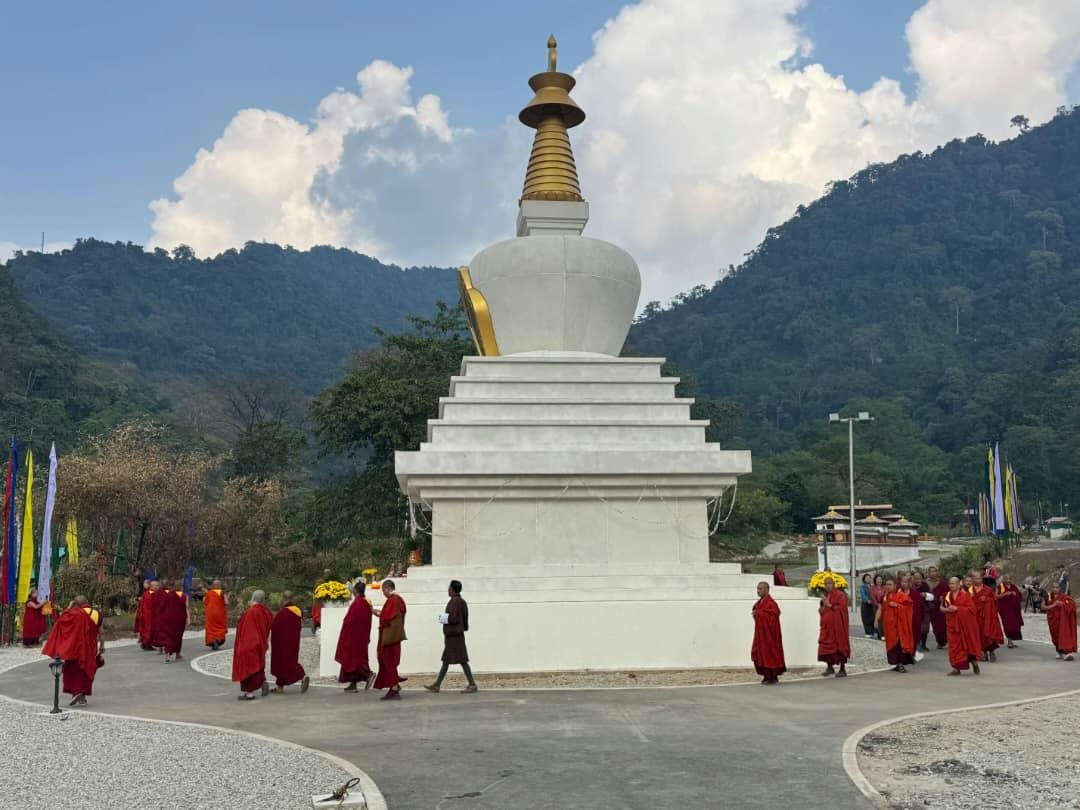
On November 1st, Bhutan accomplished something that seemed impossible just ten months earlier. What began as an audacious vision transformed into a breathtaking reality when approximately 200,000 Bhutanese citizens—roughly one-quarter of the nation's entire population—gathered along the Mau Chhu River in Gelephu Mindfulness City (GMC) to witness history unfold. In just nine hours, 108 sacred Jangchub Chortens rose from the earth in a coordinated display of national unity and spiritual devotion that has captivated the world's attention.
This wasn't merely an engineering achievement or a construction milestone. It was a profound reimagining of what a small nation could accomplish when united by shared purpose and guided by visionary leadership. The event marked a transformative moment for Bhutan, one that extends far beyond the physical structures now gracing the landscape.
Understanding the Jangchub Chorten 🙏
To comprehend the significance of Project 108, one must first understand the spiritual and cultural weight of the Jangchub Chorten itself. In Buddhist tradition, this architectural form represents far more than aesthetic beauty or religious symbolism. The Jangchub Chorten embodies the enlightened mind in physical manifestation—a sacred geometry that sanctifies the ground upon which it stands and radiates spiritual energy across the surrounding landscape.
The number 108 itself carries profound meaning in Buddhist philosophy, appearing repeatedly throughout sacred texts and practices. It represents completion, wholeness, and the journey toward enlightenment. By raising 108 chortens simultaneously, Bhutan wasn't simply constructing buildings; the nation was performing an act of consecration at a civilizational scale, laying spiritual foundations for a city designed to balance modernity with mindfulness.
Gelephu Mindfulness City itself represents a revolutionary approach to urban development. Unlike conventional cities that prioritize concrete infrastructure and economic metrics, GMC was conceived as a place that refuses the traditional bargain between prosperity and principle. Here, growth and progress are deliberately balanced with sustainability, harmony, and value-based development principles that honor Bhutanese cultural traditions.
The Journey to November 1st 📅
When His Majesty The King announced the ambitious Project 108 initiative a decade ago, skepticism rippled through the nation and beyond. Critics questioned whether such an undertaking was logistically feasible, culturally appropriate, or economically justified. The announcement had an almost mythical quality—something that belonged to legend rather than reality. Even among Bhutanese citizens, doubt crept in during those ten months of preparation.
Yet the King's unwavering confidence never wavered. His vision extended beyond the immediate project to encompass a broader narrative about national capability and collective potential. This wasn't about proving something to the world; it was about Bhutanese people proving something to themselves.
The convergence of dates amplified the day's spiritual significance. November 1st aligned with three momentous occasions: the 18th anniversary of His Majesty's coronation, the Descending Day of Lord Buddha, and the completion of Project 108. Such alignment in the Bhutanese lunar calendar wasn't coincidental—it represented a harmonious convergence of temporal and spiritual dimensions that deepened the event's meaning.
A Nation United 🇧🇹
The logistics of assembling 200,000 people in a single location presented extraordinary challenges. Citizens traveled from every corner of the nation, many undertaking journeys spanning multiple days. Some departed weeks in advance to secure favorable positions. They navigated unusually congested roads, slept in temporary accommodations, and endured uncomfortable conditions—all voluntarily, all without coercion or incentive beyond the profound honor of witnessing history.
This spontaneous mobilization revealed something essential about the Bhutanese character. No government mandate compelled attendance. No economic incentive motivated the journey. Instead, citizens responded to an intangible call—a shared belief in collective purpose and a desire to participate in something transcendent. This freely given devotion represents a form of national wealth that conventional economic measurements cannot capture.
The diversity of participants reflected Bhutan's multicultural fabric. Buddhists and members of other faith traditions stood together. Urban professionals and rural farmers worked side by side. Young people and elders collaborated in unprecedented harmony. The project became a national conversation, a shared endeavor that temporarily suspended ordinary divisions and reminded citizens of their fundamental unity.
Dismantling the Myth of Smallness 💪
Bhutan has long occupied an unusual position in global consciousness. With fewer than one million inhabitants and modest territorial dimensions, the nation might easily be dismissed by conventional metrics of power and influence. International observers frequently categorize Bhutan as small, peripheral, or marginal—labels that can subtly undermine national confidence and ambition.
Project 108 shattered this limiting narrative. No other nation with a population under one million has accomplished anything comparable. This distinction matters profoundly because it reframes how Bhutanese citizens perceive their collective capabilities. Historical precedent now exists—proof that smallness need not constrain ambition or limit achievement.
The world typically measures national strength through population density, territorial size, and GDP rankings. By these conventional standards, Bhutan will always appear modest. Yet Project 108 demonstrated that true national strength derives from different sources: the resilience of the Bhutanese spirit, the depth of shared values and virtues, and the compassion that binds citizens to one another and to all sentient beings.
This reframing carries implications extending far beyond construction projects. When citizens witness their nation accomplishing something deemed impossible by external observers, confidence permeates every subsequent endeavor. Future generations will approach challenges with the knowledge that their predecessors overcame seemingly insurmountable obstacles through collective will and coordinated action.
Rewriting the National Narrative 📖
Perhaps the most significant outcome of Project 108 transcends physical accomplishment. On November 1st, Bhutan fundamentally rewrote the story it tells about itself—to its citizens, to future generations, and to the world. This narrative shift carries profound implications because the stories nations tell about themselves become the realities they inhabit.
A people who believe themselves limited will behave accordingly, making conservative choices and accepting restricted horizons. Conversely, a people who have witnessed 108 sacred structures rise from the earth in a single day will reject artificial constraints on their ambitions. They will approach future challenges with the confidence that comes from proven capability.
The King's achievement transcended the execution of a complex logistical feat. His Majesty demonstrated how vision, strategy, and coordinated action converge to transform the impossible into the inevitable. This model—the integration of clear purpose, meticulous planning, and unified execution—now exists as a template for future national initiatives. Citizens have witnessed this methodology succeed at unprecedented scale, providing both inspiration and practical framework for subsequent endeavors.
The Long Journey Ahead 🛤️
Yet triumph must not obscure ongoing challenges. His Majesty was explicit in acknowledging that November 1st represented a milestone, not a destination. The nation faces a thousand such tasks in coming years, each demanding sustained effort, strategic thinking, and collective commitment. Some will prove easier than Project 108; others will test national resolve in unprecedented ways.
The seasons of doubt will inevitably return. When they do, the memory of 108 chortens rising in nine hours should serve as an anchor—a reminder of what becomes possible when a nation believes in itself and acts with unified purpose. In moments of difficulty or uncertainty, this achievement should inspire rather than intimidate, motivate rather than paralyze.
The immediate challenge facing Bhutan involves securing genuine prosperity for future generations while maintaining the cultural values and environmental principles that define the nation's character. This requires tireless work across multiple domains: education, healthcare, economic development, environmental stewardship, and cultural preservation. None of these objectives will be simple, yet the precedent of Project 108 suggests that ambitious goals become achievable when approached with proper vision and collective commitment.
A Story of Hope and Capability ✨
The narrative that emerges from Project 108 is fundamentally one of hope. It speaks to human capability, to the power of collective action, and to the possibility of achieving extraordinary things when vision aligns with execution and individual effort merges into national purpose.
This story should guide Bhutan forward through challenges yet to come. When doubt arises, citizens can recall the image of 108 chortens standing together along the Mau Chhu River. When obstacles seem insurmountable, the memory of 200,000 people working in harmony should kindle confidence. When external observers suggest limitations based on national size or economic metrics, the precedent of Project 108 provides irrefutable counterevidence.
Bhutan has made history. Now the nation must continue making more—not through singular dramatic gestures, but through sustained commitment to the principles demonstrated on November 1st: shared purpose, collective action, and unwavering belief in national capability. The chortens stand as silent witnesses to what a people can accomplish when they believe in themselves and their vision for the future.
The story has been rewritten. Now comes the most important chapter: the one Bhutanese citizens will write together in the years ahead.