Category:
EducationCLCS Renamed: Trongsa College Embraces New Academic Direction
🎓 A Strategic Transformation in Bhutanese Higher Education
Bhutan's higher education landscape is witnessing a significant transformation as institutions adapt to meet contemporary workforce demands while safeguarding cultural heritage. The College of Language and Culture Studies in Trongsa has undergone a comprehensive restructuring, emerging with a fresh identity and innovative academic programmes designed to address the evolving needs of the nation and global employment markets.
This institutional evolution represents more than a simple rebranding exercise—it reflects a deliberate strategic pivot toward sustainability and relevance in an increasingly competitive educational environment. The college's journey from enrollment challenges to renewed purpose offers valuable insights into how educational institutions can balance tradition with modernization.
📊 Understanding the Context: Why Change Was Necessary
The institution faced significant headwinds in recent years. In 2023, the College of Language and Culture Studies made the difficult decision to suspend new admissions, triggering widespread concern about its viability and future trajectory. This suspension served as a critical wake-up call for stakeholders, signaling that incremental adjustments would no longer suffice.
Recognizing the urgency of the situation, the Royal University of Bhutan initiated a comprehensive review process that extended far beyond internal discussions. The university engaged with a diverse spectrum of stakeholders including academic experts, government agencies, private sector leaders, and community representatives. This inclusive consultation process ensured that the restructuring would reflect both practical employment realities and Bhutan's commitment to preserving its unique cultural identity.
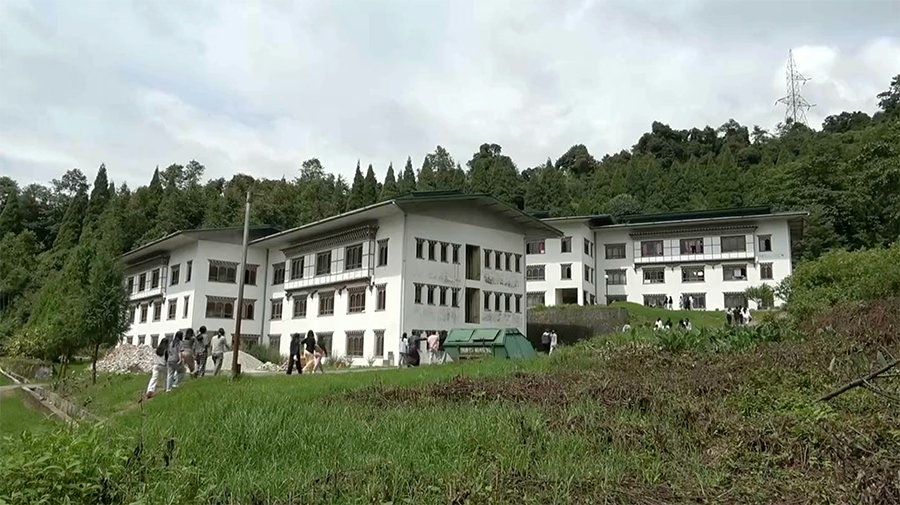
✨ The New Identity: Trongsa College of Heritage and Contemporary Studies
The renaming to Trongsa College of Heritage and Contemporary Studies symbolizes the institution's dual commitment: honoring Bhutan's rich heritage while embracing contemporary academic rigor. This nomenclature shift clarifies the college's positioning as a bridge between traditional knowledge systems and modern scholarly inquiry.
The new name encapsulates a philosophy that recognizes heritage not as a static artifact to be preserved in amber, but as a living, evolving dimension of Bhutanese identity that can inform contemporary solutions. This perspective aligns with global trends in higher education, where institutions increasingly recognize the value of indigenous knowledge systems and cultural studies in addressing modern challenges.
🎯 Five Innovative Academic Programmes
The college has introduced five carefully designed four-year undergraduate programmes that collectively represent a sophisticated response to identified market demands and national priorities:
Language and Heritage Studies
This programme combines linguistic analysis with cultural preservation, preparing graduates to document, analyze, and promote Bhutanese languages and cultural practices. Graduates find opportunities in education, cultural documentation, and heritage management sectors.
History and Global Affairs
Offering a geopolitical perspective grounded in Bhutanese and Asian historical contexts, this programme equips students to engage with international relations, diplomacy, and policy analysis. The curriculum emphasizes how historical understanding informs contemporary global challenges.
Cultural Innovation and Entrepreneurship
This forward-thinking programme recognizes that cultural heritage can generate economic value. Students learn to develop sustainable enterprises that leverage Bhutanese cultural assets, from tourism to creative industries, creating employment while preserving traditions.
Buddhist Psychology and Mindfulness
Drawing on Bhutan's spiritual traditions while incorporating contemporary psychological science, this programme addresses growing global interest in mental health, wellness, and contemplative practices. Graduates pursue careers in mental health services, corporate wellness, and international development organizations.
Bhutan Studies and Global Perspectives
This interdisciplinary programme positions Bhutan within global contexts, examining how the nation's unique development philosophy, environmental policies, and social systems offer lessons for international audiences. Graduates develop expertise valuable for diplomacy, international development, and comparative policy analysis.
💼 Career Pathways and Employment Prospects
The college's strategic repositioning directly addresses employment realities. The five new programmes create pathways into diverse professional sectors:
- Diplomacy and Public Service: Graduates equipped for Ministry of Foreign Affairs, international organizations, and diplomatic missions
- Education and Academia: Qualified educators and researchers for schools, universities, and research institutions
- Journalism and Media: Content creators and analysts for national and international media organizations
- Cultural Tourism: Professionals managing heritage sites, cultural experiences, and sustainable tourism initiatives
- Entrepreneurship: Business founders leveraging cultural and contemporary knowledge
- Mental Health and Wellness: Practitioners in psychological services and international development
- International Development: Specialists working with NGOs and multilateral organizations
🌍 Global Engagement and International Opportunities
Dean of Academic Affairs Pema Wangchuk emphasized a crucial dimension of the new academic direction: international engagement. Students will have opportunities to participate in conferences, seminars, and collaborative research initiatives outside Bhutan. This exposure serves dual purposes—it enhances students' professional development while positioning them as cultural ambassadors.
When Bhutanese graduates work internationally, they carry with them authentic knowledge of Bhutanese culture, values, and perspectives. This soft cultural diplomacy proves increasingly valuable in an interconnected world where cross-cultural understanding remains essential. Employers globally recognize the unique perspectives that Bhutanese professionals bring to international teams.
📈 Early Indicators of Success
The college enrolled 125 students in the current academic year, demonstrating renewed institutional confidence and student interest. While this represents a modest starting point, the figure signals that the repositioning strategy resonates with prospective students and their families. This enrollment recovery, following the 2023 suspension, suggests that the college has successfully communicated its renewed value proposition.
🔮 The Path Forward: Challenges and Opportunities
While the restructuring represents a promising development, questions remain about long-term sustainability and graduate employment outcomes. The true measure of success will emerge over the coming years as graduates enter the workforce and demonstrate the practical value of their education.
Several factors will influence the college's trajectory:
Curriculum Relevance: Programmes must evolve continuously to reflect changing employer needs and technological advancement. Regular engagement with industry partners ensures curricula remain current.
Faculty Development: Attracting and retaining qualified academics capable of teaching at international standards remains crucial. Investment in professional development and competitive compensation packages will be essential.
Graduate Tracking: Systematic monitoring of graduate employment and career progression will provide data for programme refinement and demonstrate institutional effectiveness to stakeholders.
Infrastructure and Resources: Modern facilities, technology access, and research opportunities will determine whether the college can deliver world-class education.
Student Support Services: Counseling, career guidance, and academic support systems ensure students succeed academically and professionally.
🌟 Broader Implications for Bhutanese Education
The Trongsa College's transformation offers lessons for Bhutanese higher education more broadly. The experience demonstrates that institutional renewal requires:
- Stakeholder engagement across sectors and perspectives
- Willingness to reimagine traditional institutional identities
- Balance between preservation and innovation
- Responsiveness to employment market realities
- Commitment to both national and global engagement
As Bhutan continues modernizing while maintaining its distinctive cultural values, educational institutions play a vital role in developing citizens who can navigate both worlds effectively. The Trongsa College of Heritage and Contemporary Studies exemplifies this delicate balancing act.
🎓 Looking Ahead
The renaming and academic restructuring of the College of Language and Culture Studies represents a decisive moment for the institution. By introducing contemporary programmes while maintaining heritage focus, the college has positioned itself to serve both immediate employment needs and Bhutan's long-term cultural preservation goals.
The coming years will reveal whether this strategic repositioning successfully attracts students, produces employable graduates, and achieves sustainable growth. Early enrollment figures suggest promising momentum, but sustained success requires continued commitment to academic excellence, student support, and stakeholder engagement.
For prospective students, employers, and policymakers, the Trongsa College of Heritage and Contemporary Studies now represents a distinctive educational option—one that honors Bhutanese identity while preparing graduates for meaningful engagement with the contemporary world. This balance, increasingly rare in higher education, may prove to be the institution's greatest competitive advantage.
You May Also Like
Education
Two Students Transform Library System Into Digital Solution
September 16, 2026
Education
Strengthening School Support for Students Unable to Afford Tuition
September 13, 2026
Education
Student Citizen Journalism: Breaking Silence on Bullying
September 12, 2026
Education
Tashithang ECCD Centre: Nurturing Young Learners in Rural Bhutan
September 6, 2026