Category:
EconomyBhutan's Agricultural Future: Why Economics Must Drive Food Security
The Critical Intersection of Agriculture and National Economics 🌾
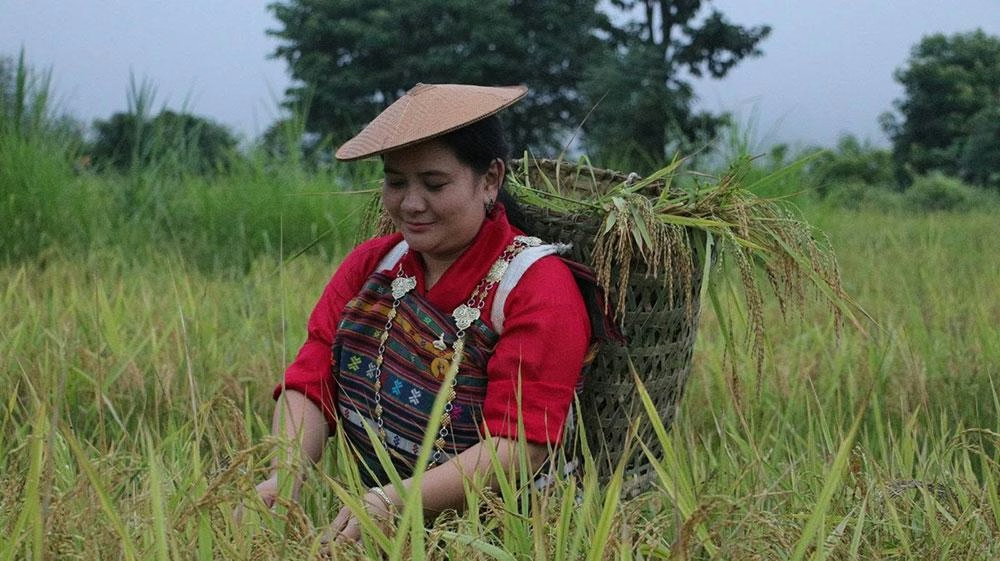
Bhutan stands at a crossroads. While the nation has built its identity on sustainability and cultural preservation, a quieter crisis threatens its foundation: the steady decline of agricultural productivity and rural engagement. The challenge isn't merely about farming traditions—it's fundamentally an economic imperative that demands immediate, strategic attention from policymakers, business leaders, and consumers alike.
The disconnect between Bhutan's agricultural potential and its current trajectory has become impossible to ignore. Young people are leaving rural communities in search of urban opportunities, imported food products increasingly dominate retail shelves, and the nation's self-reliance in food production continues to erode. Yet this trend isn't inevitable. It reflects a systemic undervaluation of agriculture as an economic sector rather than an insurmountable cultural shift.
Understanding the Root Cause: Why Young Farmers Are Leaving 📊
The exodus of young people from agricultural pursuits stems primarily from economic realities rather than philosophical disillusionment. Farming communities across Bhutan face a painful truth: those who work the land earn the least from the food value chain. A young person capable of contributing to agricultural advancement looks at the income potential and sees insufficient incentive to build a future in farming.
This isn't a matter of cultural values shifting—it's a rational economic decision. When alternative employment in urban centers offers higher wages, greater stability, and clearer career progression, the choice becomes straightforward. The problem lies not in the abandonment of farming itself, but in how agricultural work is economically structured and valued within the broader national economy.
To reverse this trend, Bhutan must fundamentally reframe agriculture from a cultural heritage practice into a competitive, profit-generating economic sector. This transformation requires:
- Market access guarantees for farmers to reduce uncertainty
- Price stability mechanisms that reward quality production
- Value-added processing opportunities that keep profits within rural communities
- Modern farming techniques that increase productivity and reduce labor intensity
- Technology integration that makes farming more efficient and appealing to younger generations
The Food Security Vulnerability: A National Risk Assessment ⚠️
Bhutan's growing dependence on imported food represents a strategic vulnerability that extends far beyond economics. A nation reliant on external food sources faces multiple interconnected risks:
Global supply chain disruptions can rapidly destabilize domestic food availability. Recent international events have demonstrated how quickly supply chains can fracture, creating shortages and price spikes that disproportionately affect smaller economies.
Currency fluctuations directly impact import costs. As the global economy experiences volatility, Bhutan's purchasing power for food imports becomes increasingly uncertain, straining government budgets and household finances.
Loss of agricultural knowledge represents an irreversible cultural and practical loss. Traditional farming techniques, crop varieties adapted to Bhutanese geography, and generational expertise disappear when young people abandon farming. Once lost, this knowledge becomes extraordinarily difficult to recover.
Economic sovereignty becomes compromised when a nation cannot feed itself. Food security directly influences geopolitical positioning, trade negotiations, and long-term national independence.
The mathematics are straightforward: a country that cannot produce sufficient food for its population surrenders a fundamental lever of self-determination. In an increasingly unpredictable global environment, this vulnerability poses existential risks to Bhutan's development goals.
Transforming Agriculture into a Competitive Economic Sector 💼
Successful agricultural transformation requires treating farming not as a nostalgic cultural practice but as a modernizable, scalable economic enterprise. This mindset shift has profound implications for policy, investment, and market development.
Entrepreneurs within Bhutan have already begun demonstrating this model. By building businesses that connect farmers directly to consumers while maintaining fair pricing structures, they've proven that agriculture can simultaneously generate profit, strengthen rural livelihoods, and advance national food security. These enterprises operate at the intersection of commercial viability and social responsibility.
The business model demonstrates that sourcing domestically—while requiring higher costs and managing seasonal supply challenges—creates long-term resilience for both the enterprise and the nation. This approach rejects the false choice between profitability and purpose, instead recognizing that sustainable business success requires strengthening the entire value chain.
The Consumer's Role: Building Demand for Local Food 🛒
Food security cannot be achieved through farmer and business efforts alone. Consumers bear direct responsibility for creating the market conditions that make domestic agriculture economically viable.
Every purchase decision carries economic weight. When Bhutanese consumers choose locally-produced food, they accomplish multiple objectives simultaneously:
- Support rural employment and keep farming families economically viable
- Strengthen domestic businesses that create additional jobs and economic activity
- Reduce import dependency and preserve foreign currency reserves
- Improve food safety by maintaining visibility over production standards
- Preserve agricultural knowledge by maintaining active farming communities
- Build economic resilience by diversifying the nation's productive capacity
This isn't simply a purchasing preference—it represents an investment in Bhutan's long-term economic independence and stability. Consumer behavior directly influences whether young people perceive agriculture as a viable career path.
Policy Framework: What Government Must Prioritize 🏛️
While entrepreneurial innovation and consumer behavior matter enormously, government policy provides the foundational framework that enables agricultural transformation. Effective policy must address:
Agricultural subsidies and support mechanisms that make farming economically competitive with alternative employment. This might include direct income support, input cost assistance, or guaranteed purchase programs that reduce farmer risk.
Infrastructure investment in rural areas—transportation networks, storage facilities, processing centers, and market infrastructure—that enable farmers to efficiently bring products to market.
Educational programs that teach modern agricultural techniques, business management, and value-added processing to both current and prospective farmers.
Research and development focused on crop varieties suited to Bhutanese geography, sustainable farming practices, and productivity improvements.
Market development initiatives that connect domestic producers with institutional buyers, exporters, and retail networks.
Without deliberate policy support, market forces alone will continue pushing young people away from farming toward urban employment. Government intervention isn't about inefficiency—it's about correcting market failures that undervalue agriculture despite its critical importance to national development.
The Legacy Question: Building Bhutan's Food Future 🌱
Bhutan's agricultural trajectory over the next two decades will largely determine the nation's economic resilience, food security, and rural vitality. The choices made today—by policymakers, businesses, and consumers—will reverberate through generations.
The alternative to intentional agricultural transformation is passive decline: continued rural depopulation, increasing food import dependency, loss of traditional farming knowledge, and reduced economic self-determination. This path offers no advantages and creates numerous vulnerabilities.
Conversely, treating agriculture as an explicit economic mandate creates multiple positive outcomes. A thriving agricultural sector generates rural employment, produces food for domestic consumption, creates opportunities for value-added processing and export, maintains cultural knowledge, and strengthens national resilience.
This transformation isn't about romanticizing farming or expecting young people to work the land for cultural reasons. It's about creating economic conditions where agriculture becomes an attractive, profitable career path that offers genuine opportunity and security.
Moving Forward: Concrete Steps for Agricultural Renaissance 🚀
Bhutan possesses the foundational elements necessary for agricultural revitalization: arable land, favorable geography, a small population that can be efficiently served by domestic production, and growing consumer awareness of food security importance.
What remains is the political will and strategic commitment to treat agriculture as a central economic priority rather than a peripheral cultural concern. This requires:
- Explicit government commitment to agricultural development as a national economic strategy
- Substantial public investment in rural infrastructure, research, and farmer support programs
- Business model innovation that creates profitable opportunities connecting farmers to markets
- Consumer education about the economic and strategic importance of food sovereignty
- Institutional procurement policies that prioritize domestic agricultural products
Bhutan's food future depends not on nostalgia for traditional farming but on creating modern, economically viable agricultural opportunities that appeal to current and future generations. The nation has the capacity to achieve food security while generating rural prosperity. What's required is the strategic commitment to make agriculture an economic mandate rather than a cultural aspiration.
You May Also Like
Economy
Bhutan's Bold Vision: Two USD 50M Enterprises by 2030
September 27, 2026
Economy
Mega Dry Port in Pasakha: Bhutan's Trade Revolution
September 25, 2026

Economy
Fixed Deposit Tax Withholding: What You Need to Know
September 13, 2026
Economy
DRC's QR Payment Innovation: Tracking Business Income
September 2, 2026