Category:
SportsBhutanese Judokas Win Four Medals at SPARDHA Tournament
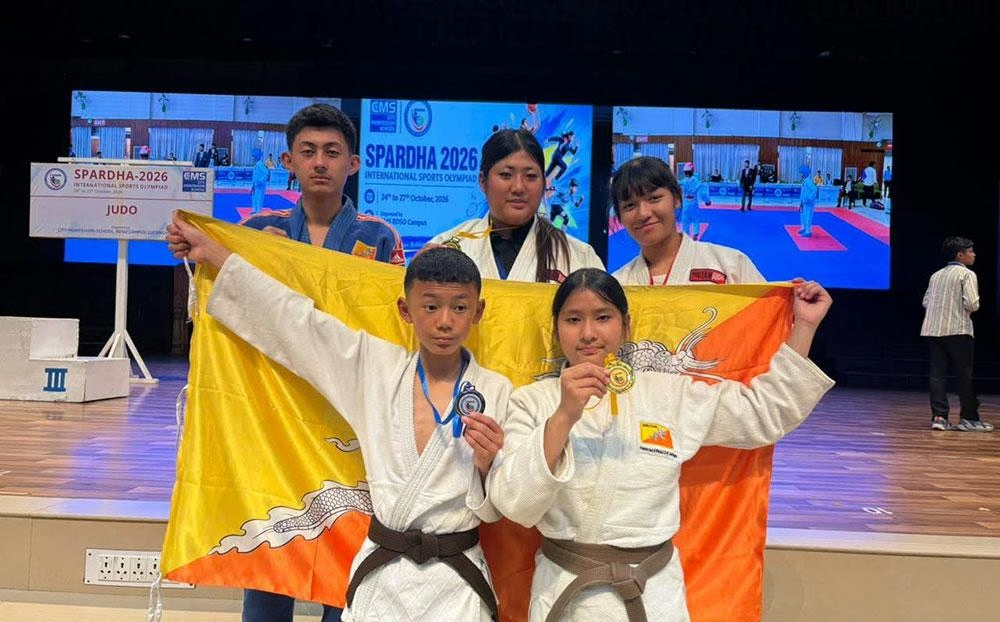
A Breakthrough Performance for Bhutanese Judo 🥇
Bhutan's judo contingent returned home with remarkable success from the second edition of the SPARDHA sports tournament in Lucknow, India. The delegation secured an impressive four-medal haul—two gold, one silver, and one bronze—demonstrating the growing competitive caliber of the nation's judokas on the international stage. This achievement marks a significant milestone for a small nation working to establish itself in the global judo community.
The tournament, held at the City Montessori School's Research Designs and Standards Organisation (RDSO) Campus, brought together thousands of student-athletes from across the region, creating a highly competitive environment. For Bhutanese judokas, participation in such large-scale international competitions provides invaluable exposure and the opportunity to test their skills against unfamiliar opponents from diverse backgrounds.
Medal Winners Shine in Their Categories ⭐
Tandin Dorji Wangmo, competing for Zilnoen Lower Secondary School, captured gold in the women's under-57kg category, showcasing exceptional technique and mental fortitude. Her victory demonstrates the depth of emerging talent within Bhutan's secondary school system.
Kinzang Deki delivered an outstanding performance by winning gold in the women's over-78kg category. Her achievement is particularly noteworthy given her status as a school dropout, highlighting how individual determination and athletic passion can transcend educational circumstances.
On the podium alongside his teammates, Jigme Kuenzang Yoezer earned a silver medal in the under-40kg category, adding to Bhutan's overall medal count. Meanwhile, Pema Yangtshog, representing Pelkhil School, secured bronze in the women's under-57kg category, rounding out the delegation's impressive performance.
The Bhutanese team comprised athletes from judo clubs and schools based in Thimphu and Gelephu, representing the nation's primary judo development centers. This geographic representation reflects ongoing efforts to build a more distributed competitive judo infrastructure across the country.
Overcoming Preparation Challenges 💪
Coach Bikash Tamang revealed that the path to this success was far from straightforward. The invitation to participate arrived only approximately six weeks before the tournament commenced, arriving during a period when other training programmes were already in full swing. This compressed timeline required strategic decision-making and efficient resource allocation.
Despite the limited preparation window, the coaching team orchestrated focused training sessions that addressed multiple dimensions of athletic development:
- Physical conditioning to build endurance and strength
- Technical refinement of judo fundamentals and specialized techniques
- Tactical preparation for match strategy and opponent analysis
- Mental readiness for competitive pressure and decision-making
The coach attributed the four-medal achievement to the exceptional discipline and commitment demonstrated by the athletes, combined with their accumulated competitive experience from previous tournaments. This foundation proved crucial when facing unfamiliar opponents in an international setting.
Navigating Tournament Disruptions 🎯
The Bhutanese delegation encountered unexpected obstacles during the competition itself. Inconsistent match schedules and coordination challenges among tournament organizers disrupted the athletes' carefully planned preparation routines. These logistical issues created uncertainty regarding warm-up timing and match readiness.
Coach Tamang emphasized that despite these external disruptions, the athletes demonstrated remarkable adaptability. Their ability to quickly adjust to changing circumstances while maintaining competitive focus proved instrumental in their medal success. "The experience taught them valuable lessons, strengthened their confidence, and helped them develop greater resilience and adaptability," he noted.
This capacity for improvisation under pressure represents a critical competitive skill, particularly for athletes from smaller nations who must frequently compete in unfamiliar environments with varying levels of organizational support.
The Broader Challenge: Sustaining Competitive Judo in Bhutan 🌍
While the SPARDHA tournament results celebrate individual achievement, they also illuminate a fundamental challenge facing Bhutanese judo development. According to the Bhutan Judo Association (BJA), sports in Bhutan remain predominantly viewed as recreational pursuits rather than viable professional careers or economic sectors.
Football stands as the notable exception, commanding significant institutional support and public investment. Other sporting disciplines, including judo, struggle to offer athletes realistic pathways to sustainable livelihoods. This creates a critical talent retention problem that threatens long-term competitive development.
The Talent Retention Crisis ⚠️
Many promising Bhutanese athletes abandon competitive training after completing secondary education, particularly when pursuing higher education or formal employment. This pattern proves especially detrimental because athletic peak performance typically occurs in the mid-to-late twenties—precisely when many Bhutanese judokas have already left the sport.
The consequences are substantial:
- Lost potential: Promising young athletes discontinue training before reaching their full competitive capabilities
- Reduced international competitiveness: Fewer athletes reaching senior-level expertise
- Weakened talent pipeline: Limited progression from junior to elite competitive levels
- Economic inefficiency: Investment in youth development yields incomplete returns
This cycle represents a systemic vulnerability in Bhutan's sports infrastructure, one that requires strategic intervention at multiple levels.
Strategic Vision: Grassroots Development Initiative 🚀
Recognizing these challenges, the Bhutan Judo Association has formulated an ambitious three-to-five-year grassroots development programme. The initiative targets the establishment of approximately six additional judo clubs distributed throughout the country, expanding beyond the current concentration in Thimphu and Gelephu.
This expansion will proceed through collaborative partnership with:
- Bhutan Olympic Committee: Providing governance and international coordination
- Ministry of Education and Skills Development: Integrating judo into educational frameworks
- Local communities: Building institutional support and athlete recruitment
The programme aims to create a more robust competitive pathway, enabling young judokas to progress systematically from recreational participation through junior competitive levels to senior elite performance. By establishing multiple development centers, the BJA seeks to identify and nurture talent across diverse geographic regions.
Building Sustainable Systems 🏗️
The strategic expansion reflects understanding that international success requires domestic infrastructure. By increasing the number of training facilities and coaching opportunities, Bhutan can:
- Broaden talent identification: Reach potential athletes in underserved regions
- Improve coaching quality: Distribute experienced instructors across more centers
- Enhance training intensity: Create competitive environments that push athletes to higher levels
- Establish career pathways: Demonstrate that judo can lead to meaningful professional opportunities
International exposure through tournaments like SPARDHA provides crucial competitive experience, but sustainable success ultimately depends on domestic development infrastructure. The medals won in Lucknow represent immediate achievement; the grassroots programme represents long-term vision.
Looking Forward: International Exposure Meets Domestic Development 🌟
The path forward requires balanced investment in both international competition participation and domestic programme development. Continued participation in regional and international tournaments will maintain competitive edge and provide motivation for young athletes. Simultaneously, expanded grassroots programmes will create the talent pipeline necessary to sustain such international participation.
The SPARDHA tournament results demonstrate that Bhutanese judokas possess the technical capability and competitive spirit to succeed on larger stages. What remains is building the institutional infrastructure and career incentives necessary to retain this talent and develop it to its full potential.
As the Bhutan Judo Association pursues its expansion plans, the four medals won in Lucknow serve as both celebration and catalyst—recognition of current achievement combined with motivation for ambitious future development. The next chapter in Bhutanese judo will be written not just by individual athletes winning medals, but by systemic investments that enable successive generations to reach competitive excellence.
You May Also Like
Sports
Snowman Race Begins: 17 Athletes Challenge 185km Himalayan Route
October 24, 2026
Sports
Bhutan's Historic FIFA U-15 World Cup Debut in Azerbaijan
October 24, 2026
Sports
Bhutan's Para-Sports Gap: Lessons from Asian Para Games
October 23, 2026
Sports
FIFA's $25 Million Investment in Bhutan's Football Future
October 21, 2026