Category:
PoliticsWomen in Politics: Breaking Through Barriers Before Election Day
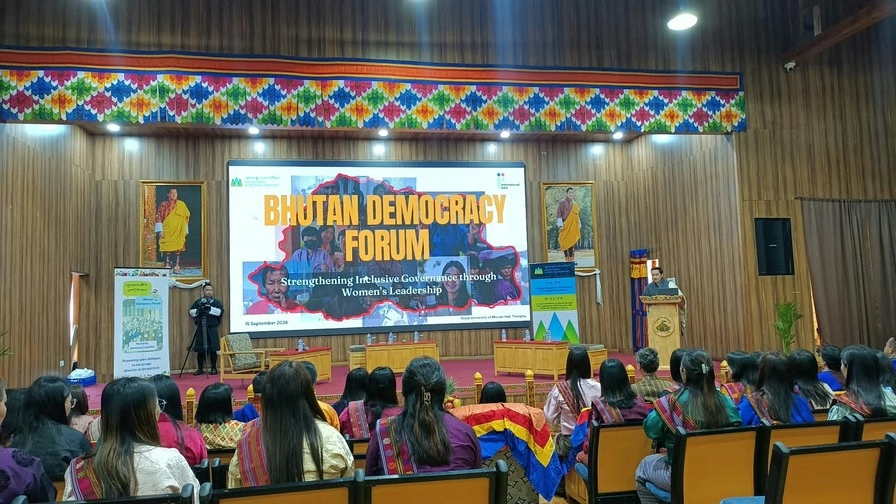
The path to political office for women extends far beyond casting a ballot or winning votes on election day. 🗳️ Long before candidates step into the spotlight, they face a complex web of obstacles that fundamentally shape whether they can even enter the race. Recent research has illuminated these hidden challenges, revealing that the barriers women encounter in politics are multifaceted and deeply systemic.
While discussions about women in politics often focus on societal attitudes and cultural norms, the reality is far more complicated. Financial constraints, logistical challenges, family responsibilities, and social pressures create a perfect storm that discourages many qualified women from pursuing political careers. Understanding these barriers is essential for anyone interested in building a more inclusive and representative political system. 💪
The Financial Barrier: Campaign Costs and Economic Dependence 💰
One of the most significant obstacles women face when considering political candidacy is the sheer cost of running a campaign. For local government elections, aspiring candidates must establish a dedicated bank account and deposit substantial funds—up to 70,000 ngultrum in some cases—before the campaign even begins. This financial requirement creates an immediate barrier for women who may lack personal savings or access to capital.
The financial burden extends beyond initial deposits. Campaign activities, transportation, promotional materials, and community engagement all require significant investment. For women who have limited independent income or face economic dependence on spouses or family members, this financial hurdle can be insurmountable.
Research examining women's political participation has consistently identified campaign financing as a critical challenge. Women candidates often report difficulty securing funding compared to their male counterparts, partly due to historical patterns of investment in male candidates and partly due to perceptions about women's viability as political contenders.
Mobility, Safety, and the Logistics of Campaigning 🚗
Campaigning requires constant movement—traveling between communities, attending evening events, and being visible throughout a constituency. Yet for many women, safe mobility remains a genuine concern. Late-night campaign activities, traveling to remote areas, and the demands of being visible in public spaces create safety and practical challenges that male candidates may not face to the same degree.
Beyond personal safety, transportation logistics intertwine with family responsibilities. Women who manage household duties cannot simply disappear for extended campaign tours. The expectation that they maintain their domestic responsibilities while simultaneously campaigning creates a time management crisis that few male candidates encounter.
Access to reliable transportation, the ability to travel without supervision or concern, and the freedom to be away from home during unconventional hours all represent practical barriers that disproportionately affect women candidates. These logistical challenges are not merely inconveniences—they fundamentally limit a woman's capacity to conduct an effective campaign.
Childcare: The Hidden Constraint 👶
Childcare emerges as one of the most practical yet overlooked barriers to women's political participation. While men may have partners who manage childcare responsibilities, women typically cannot assume the same support system. Even when childcare arrangements exist, the emotional and mental burden of being away from children during intensive campaign periods weighs heavily on many women.
The lack of accessible, affordable childcare infrastructure means that women must either make private arrangements or compromise their campaign efforts. This constraint is particularly acute in rural and semi-rural areas where formal childcare services may not exist. Some women choose not to contest elections specifically because they cannot adequately address childcare needs while maintaining an effective campaign presence.
This barrier intersects with broader questions about work-life balance and societal expectations. While society increasingly expects women to participate in public life and politics, it has not yet created the infrastructure or shifted the cultural norms necessary to support this participation alongside caregiving responsibilities.
Social and Cultural Expectations 🌍
Family support plays a crucial role in determining whether women contest elections. Spousal endorsement, family encouragement, and social acceptance from respected community figures significantly influence a woman's decision to enter politics. When family members discourage political participation or view it as incompatible with a woman's "proper role," the barriers become personal and deeply challenging to overcome.
Public scrutiny and rumor mills operate differently for women candidates than for men. Women face heightened scrutiny regarding their appearance, family situation, marital status, and personal choices. Gossip and speculation about a woman's motivations, character, or personal life can undermine her candidacy in ways that rarely affect male candidates.
The political environment itself can feel hostile or unwelcoming to women, even in contexts where legal frameworks provide equal opportunity to contest. Cultural narratives about women's capabilities, appropriate roles, and political suitability create an intangible but powerful deterrent to political participation.
Structural and System-Level Barriers 🏛️
Beyond individual challenges, structural barriers embedded in political systems themselves limit women's participation. Political parties may not actively recruit or support women candidates. Campaign infrastructure, mentorship networks, and resource allocation within parties often favor men. Women may lack access to the informal networks and power structures that facilitate political advancement.
The absence of women in higher political positions means fewer role models and mentors for aspiring women candidates. This creates a self-perpetuating cycle where the underrepresentation of women in politics discourages further women's participation. Without visible examples of successful women politicians, potential candidates struggle to envision themselves in these roles.
Additionally, the timing and structure of political activities may not accommodate women's realities. Meeting schedules, campaign calendars, and party activities may be designed without consideration for women's multiple responsibilities and constraints.
The Intersection of Barriers: How Challenges Compound ⚡
These barriers do not exist in isolation—they interact and compound each other. A woman with childcare responsibilities faces not only the practical challenge of arranging care but also the financial burden of campaign costs and the logistical challenges of traveling for campaign events. Financial dependence on a spouse may be exacerbated by lack of family support for political ambitions.
Women from lower-income backgrounds face particularly acute challenges, as they may simultaneously contend with financial constraints, limited access to transportation, fewer social networks, and less family flexibility around caregiving. Women from marginalized communities may face additional discrimination layered on top of gender-based barriers.
Understanding these compounding barriers is essential for developing effective solutions. Addressing only one barrier—such as legal provisions for equal candidacy—will not remove the practical obstacles women face.
Capacity Building and Skill Development 📚
Many aspiring women leaders identify public speaking and political communication as areas where they need development. Access to training programs, mentorship, and capacity-building initiatives can significantly enhance women's confidence and effectiveness as candidates. Organizations providing training in public speaking, campaign strategy, policy development, and political communication report that women participants experience marked increases in confidence and political efficacy.
These capacity-building efforts are not luxuries—they are essential investments in enabling women to compete effectively in the political arena. When women receive proper training and support, they demonstrate the same capabilities as their male counterparts and often bring fresh perspectives and community-focused approaches to politics.
Service Delivery and Community Needs 🏘️
Women's political participation is deeply connected to community service delivery and quality of life issues. Women, who often spend more time in their communities and bear primary responsibility for household needs, directly experience gaps in services like water supply, road infrastructure, and healthcare. These lived experiences inform women's political priorities and policy perspectives.
When women participate in local government, they often prioritize issues that directly affect daily community life—infrastructure, water access, education, and healthcare. This perspective enriches political decision-making and ensures that governance addresses the needs of entire communities, not just certain segments.
Moving Forward: What Needs to Change 🔮
Addressing barriers to women's political participation requires multifaceted solutions. Temporary special measures such as reserved seats, campaign finance support for women candidates, and subsidized childcare during campaign periods can level the playing field. Greater representation of women within political parties ensures that recruitment, support, and resource allocation actively include women.
However, rule changes alone are insufficient. Genuine progress requires:
- Financial support mechanisms for women candidates, including campaign finance assistance and reduced deposit requirements
- Childcare infrastructure that enables women to participate in campaigns and political activities
- Safety and mobility provisions that ensure women can campaign effectively without compromising personal security
- Capacity-building programs that develop women's political skills and confidence
- Cultural shift initiatives that challenge limiting narratives about women's political roles
- Party-level reforms that actively recruit, mentor, and support women candidates
- Community engagement that builds family and social support for women's political participation
The Path to Political Inclusion 🌟
Women's political participation is not simply a matter of individual choice or willingness to contest. It is fundamentally about whether society creates the conditions—financial, logistical, social, and cultural—that enable women to compete on equal terms. The barriers that exist long before election day are systemic and require systemic solutions.
As local government elections approach, the question becomes not whether women are willing to enter politics, but whether communities, parties, and governments are willing to remove the obstacles that prevent them from doing so. Creating space for women in politics means addressing the practical realities of women's lives, supporting their ambitions, and valuing the unique perspectives they bring to political leadership.
The journey toward truly inclusive and representative politics requires commitment at every level—from family support and community attitudes to party policies and government infrastructure. When these barriers are addressed, women will not just participate in politics; they will transform it, bringing new priorities, perspectives, and solutions that benefit entire communities. 💫
You May Also Like
Politics
Women Leaders Training: Preparing for 2027 Local Elections
August 31, 2026
Politics
Speaker Election: Constitutional Duty Over Party Loyalty
August 29, 2026
Politics
Noise in the Quietest Democracy: Bhutan's Political Crisis
August 29, 2026
Politics
Election Pledges Gone Unfulfilled: Who Bears the Responsibility?
August 29, 2026