Category:
EconomyWhy Agricultural Investment Alone Won't Revive Farming in Bhutan
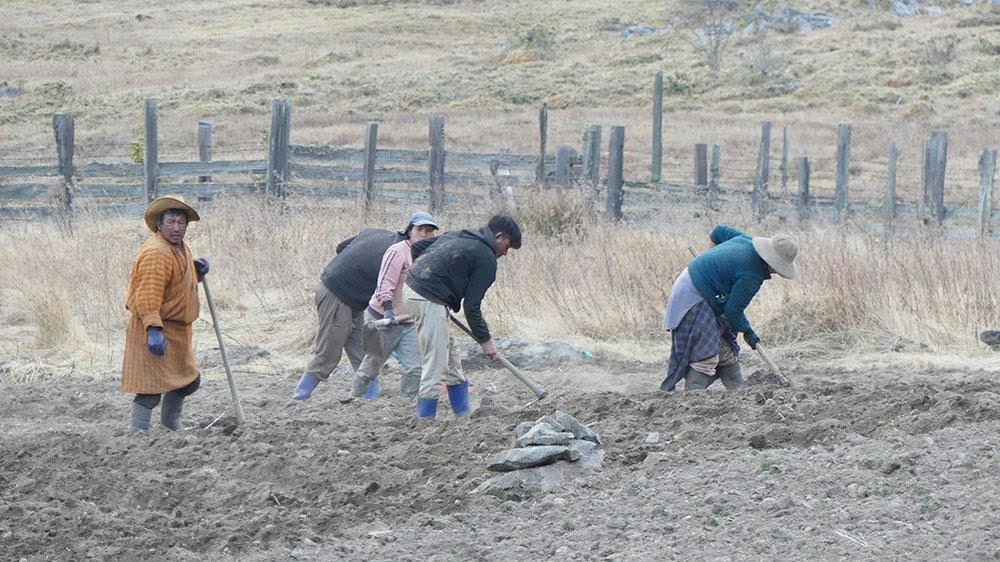
The Paradox of Rising Investment and Declining Farm Viability 🌾
Bhutan faces a peculiar agricultural crisis that defies conventional economic logic. Despite pouring billions of ngultrum into the farming sector, fewer citizens are choosing agriculture as a sustainable livelihood. The government's substantial commitment to agricultural development through the 13th Plan has not translated into the thriving, commercially viable farming enterprises policymakers envisioned.
This disconnect between spending and outcomes reveals a fundamental misalignment in how agricultural resources are allocated and deployed across the kingdom. The issue transcends simple budget mathematics—it speaks to systemic challenges in market infrastructure, farmer economics, and the fundamental attractiveness of rural livelihoods in a modernizing nation.
Understanding the Scale of Agricultural Investment 💰
The Ministry of Agriculture and Livestock commands the fourth-highest budget allocation among all central government agencies under the current planning cycle. With Nu 15 billion earmarked specifically for agricultural development, this represents one of the government's most substantial sectoral commitments. When combined with approximately Nu 2 billion from the Economic Stimulus Programme and an additional Nu 5.08 billion from departmental sources—including Nu 3.68 billion in project-tied assistance from India—the total agricultural investment ecosystem reaches unprecedented levels.
Yet these impressive figures mask a troubling reality: farming income remains stagnant and unattractive. Agricultural workers earn a mean monthly income of just Nu 12,945, representing less than half the earnings of industrial workers and approximately two-fifths of what service sector employees command. This substantial income gap persists despite government efforts to bolster agricultural productivity and profitability.
The Farmer Income Challenge 📊
The most striking revelation concerns the nature of agricultural production in Bhutan. According to the Integrated Agriculture and Livestock Census 2025, the nation maintains 70,278 farming households. However, only 9.38 percent of these households produce primarily for commercial sale. Even more concerning, merely 0.93 percent—just 618 households—engage in farming exclusively for market sales rather than subsistence.
This means approximately one in ten farming households operates on a commercial basis. The remaining majority—36.67 percent—grow solely for their own consumption, treating agriculture as a survival mechanism rather than an income-generating enterprise. This subsistence-oriented approach fundamentally limits the sector's contribution to national economic growth and individual farmer prosperity.
The disparity between production capacity and commercial orientation reveals that higher agricultural spending has not catalyzed the transition from subsistence to market-driven farming that development economists consider essential for rural prosperity.
The Aging Workforce Crisis 👴
Demographic trends paint an increasingly urgent picture. Agricultural employment has declined significantly from 65.3 percent of the national workforce in 2009 to 43.6 percent in 2025. While the sector still employs approximately 166,450 people, the composition of this workforce has shifted dramatically toward older workers.
The sector is increasingly sustained by workers aged 55 and above, indicating that farming is becoming "an occupation of necessity rather than choice" for aging populations unable to transition to other sectors. Younger Bhutanese are systematically leaving agriculture, viewing it as economically unviable despite government investments aimed at modernization and income enhancement.
This generational exodus threatens the sector's long-term viability and suggests that investment alone cannot reverse the fundamental perception that farming offers limited economic opportunity for ambitious young people.
Underutilized Agricultural Land 🌱
A striking inefficiency undermines productivity gains: approximately 26 percent of Bhutan's farmland—representing 66,120 acres—lies fallow. This idle land represents both a lost economic opportunity and evidence that investment in agricultural inputs has outpaced farmers' capacity or willingness to utilize available resources.
Mechanization remains limited, with only 13,032 power tillers available nationwide. Fifty-five percent of farming households continue relying on animal power for cultivation, reflecting both the capital constraints facing small-scale farmers and the insufficient penetration of modern agricultural technology despite government support programs.
These statistics suggest that infrastructure and equipment investments, while necessary, have not achieved sufficient scale or accessibility to transform farming practices at the household level.
The Marketing Infrastructure Gap 🏪
One of the most significant findings from recent agricultural sector reviews concerns the disconnect between production capability and market access. Bhutan has successfully helped farmers increase production volumes without simultaneously building the commercial infrastructure necessary to connect this output to reliable buyers.
This represents a critical strategic failure in agricultural policy implementation. A farmer who doubles production without access to functioning market channels faces not opportunity but burden—surplus produce that cannot be sold represents wasted inputs, spoilage, and economic loss rather than income enhancement.
The agricultural marketing system operates at what experts describe as "a relatively rudimentary stage," inadequate for a modernizing economy seeking to commercialize its farming sector. Government allocations for farmers' groups and cooperatives, farm shops, and market infrastructure have not generated proportionate improvements in actual produce volumes reaching buyers or measurable increases in farmer incomes.
The Potato Crisis: A Cautionary Tale 🥔
Potato production exemplifies the challenges facing Bhutanese agriculture. Despite substantial investments in potato farming—including greenhouse technology, improved seed varieties, and cooperative support—the sector remains vulnerable to market fluctuations and export demand shocks.
Farmers face unsold inventory, volatile pricing, and heavy dependence on Indian export markets that fluctuate unpredictably. When Indian demand contracts or prices collapse, Bhutanese potato farmers absorb the losses directly, with limited government mechanisms to stabilize incomes or guarantee minimum prices for production.
This vulnerability exposes a fundamental weakness: commercial farming without robust market infrastructure and price stabilization mechanisms cannot provide the income security necessary to attract and retain farmers. The potato sector's challenges illustrate how production-focused investments fail without complementary market development.
Irrigation Coverage Limitations 💧
While assured irrigation represents a critical input for agricultural productivity, current coverage remains insufficient. Approximately 29 percent of agricultural land—about 67,955 of 234,328 acres—benefits from assured irrigation systems. Completing all 24 central irrigation schemes under development would increase this to only 31.1 percent.
This limitation means that nearly 70 percent of farmland remains dependent on rainfall patterns, creating vulnerability to climate variability and constraining the intensity and reliability of production. The dzongkhags (districts) have proposed 474 irrigation schemes, but only 24 received central government prioritization, reflecting resource constraints and competing development priorities.
The irrigation gap represents a fundamental infrastructure deficit that no amount of current-level spending can quickly resolve, yet it constrains the productivity potential of vast agricultural areas.
Wildlife Fencing and Land Use Conflicts 🚧
Chain-link fencing constitutes the largest single Department of Agriculture intervention, consuming Nu 5.1 billion of its Nu 9.14 billion total budget. Of the 3,400 kilometer target, 1,475 kilometers have been completed across 269 schemes, protecting approximately 40,000 acres.
However, this massive investment has generated unintended consequences. Fencing concentrates wildlife pressure onto unfenced neighboring lands, creating conflicts between wildlife conservation and agricultural protection. More problematically, fencing land that remains uncultivated provides no productive benefit—it protects neither production nor income.
This represents a significant misallocation of scarce resources. Future fencing schemes should prioritize land under active cultivation rather than protecting idle acreage, ensuring that infrastructure investments directly support productive farming rather than land speculation or abandoned agricultural plots.
The Food Corporation Challenge 🏢
The Food Corporation of Bhutan Limited (FCBL) occupies a central role in agricultural marketing and export facilitation, yet operates under severe financial constraints. Despite responsibility for produce buying, farmer payment processing, storage, grading, and cross-border transportation, the corporation receives no dedicated working capital allocation.
This structural contradiction forces FCBL to operate as a transaction facilitator between farmers and private Indian traders rather than as an active marketing agent capable of aggregating production, stabilizing prices, and developing export channels. The corporation's role remains "largely confined to facilitating transactions" rather than actively developing markets.
Establishing a capitalized revolving fund for FCBL would enable the corporation to purchase produce directly from farmers, pay competitive prices promptly, and invest in value-added processing and export development. Without this financial autonomy, FCBL cannot fulfill its intended function as a market development engine.
Policy Recommendations for Systemic Reform 🎯
Recent comprehensive reviews of Bhutan's agricultural investment ecosystem have identified critical areas requiring policy adjustment:
- Revise cost-sharing guidelines to exempt essential inputs such as frozen semen and breeding bulls, reducing farmer capital requirements for productivity-enhancing investments
- Establish income support mechanisms for vulnerable households, recognizing that market-based solutions alone cannot address poverty in subsistence farming communities
- Consolidate export systems into a single facilitation window within 12 months, reducing bureaucratic complexity and transaction costs for cross-border agricultural trade
- Create state-level India-Bhutan joint facilitation committees to address cross-border agricultural trade challenges that individual farmers cannot navigate independently
- Expand the Price Guarantee Scheme to cover additional commodities, providing income stability that encourages commercial farming commitment
- Strengthen concessional credit mechanisms that have successfully disbursed Nu 709.04 million across 1,866 loans at favorable interest rates
The Strategic Reorientation Imperative 🔄
Bhutan's agricultural challenge cannot be solved through budget increases alone. The fundamental question facing policymakers transcends "how much we invest"—it requires rigorous examination of where investments occur, how implementation proceeds, and whether capital deployment creates genuinely viable commercial farming enterprises.
The current approach risks perpetuating a cycle where production increases without corresponding market development, farmer incomes stagnate despite infrastructure investments, and younger generations continue abandoning agriculture for urban employment. Breaking this cycle requires strategic reorientation from production-focused investments toward comprehensive market development, farmer income stabilization, and commercial enterprise building.
Bhutan's agricultural future depends not on spending more, but on spending smarter—aligning investments with market realities, farmer capabilities, and the commercial viability requirements that make farming an attractive choice for the next generation of Bhutanese citizens.
Looking Forward: The Path to Agricultural Transformation 🌟
The 13th Plan aspires to increase agriculture's GDP contribution from Nu 31 billion in 2023 to Nu 50 billion by 2029. Achieving this ambitious target requires fundamental shifts in how agricultural resources are deployed and how success is measured.
Success should be evaluated not by the number of farmer groups established or kilometers of fencing completed, but by tangible outcomes: volumes of produce reaching markets, farmer incomes approaching parity with other sectors, and the proportion of households choosing farming as a preferred livelihood rather than accepting it as necessity.
Bhutan possesses the financial resources, policy commitment, and technical capacity to transform its agricultural sector. What remains to be demonstrated is the strategic will to redirect investments from infrastructure-heavy projects toward market development, farmer income support, and the commercial ecosystem that makes farming genuinely attractive to Bhutanese citizens seeking viable livelihoods in an increasingly competitive economy.
You May Also Like

Economy
Civil Service Pay Hike: Widening the Public-Private Wage Gap
November 21, 2026
Economy
India's Historic Poverty Reduction: A World Bank Success Story
November 21, 2026
Economy
TER Token Hits All-Time Low at Nu 107 Amid Global Gold Price Decline
November 20, 2026
Economy
Government Tackles Potato Farming Crisis with Strategic Reforms
November 19, 2026