Category:
HealthTelemedicine: Bhutan's Answer to Healthcare Access
Bridging the Healthcare Gap 🏥
Bhutan's healthcare system faces a persistent challenge that no amount of traditional planning can easily solve: how to ensure every remote community has access to specialist medical expertise. When the government made its ambitious pledge to station a doctor in every gewog, few anticipated the complexities that would emerge. Today, as that promise proves logistically difficult, a technological innovation is stepping in to fill the void.
Telemedicine represents far more than a convenient alternative—it's becoming a lifeline for patients in distant regions who would otherwise endure grueling journeys to reach specialized care. The solution addresses one of healthcare's most enduring obstacles: the unequal distribution of medical expertise across geography.
Understanding the Original Promise ⚖️
The "One Gewog, One Doctor" initiative reflected genuine ambition within Bhutan's health ministry. The concept was straightforward: ensure that every administrative subdivision had its own physician, bringing healthcare closer to underserved populations. However, reality proved more complex than policy documents suggested.
During a March press briefing, the Health Minister acknowledged the initiative's limitations. Deploying physicians to every gewog wasn't feasible given Bhutan's terrain, population distribution, and the challenges of attracting medical professionals to remote locations. Instead, the ministry pivoted toward investing in 29 mobile medical units as an interim solution.
Yet even this approach has constraints. Mobile units require fuel, maintenance, and driver availability. They operate on schedules that may not align with urgent patient needs. What patients truly require is access to specialist expertise when needed—not according to a rotating schedule.
The Telemedicine Revolution 🚀
Telemedicine transcends the simple video call many people imagine. It represents the complete delivery of healthcare services through information and communication technology, fundamentally transforming how medical expertise travels across distances.
Unlike traditional teleconsultation, modern telemedicine encompasses multiple dimensions:
- Remote patient monitoring for chronic disease management
- Specialist case discussions between healthcare providers
- Virtual multidisciplinary meetings for complex cases
- Tele-ICU support for critically ill patients
- Continuing medical education for frontline healthcare workers
- Advanced diagnostic imaging review by distant specialists
Equipped with high-definition cameras, digital stethoscopes, and secure medical platforms, specialists can examine patients, review medical images, and assess vital parameters from hundreds of kilometers away. The technology doesn't replace hospitals or healthcare workers—it extends their reach exponentially.
A Real-World Success Story 💙
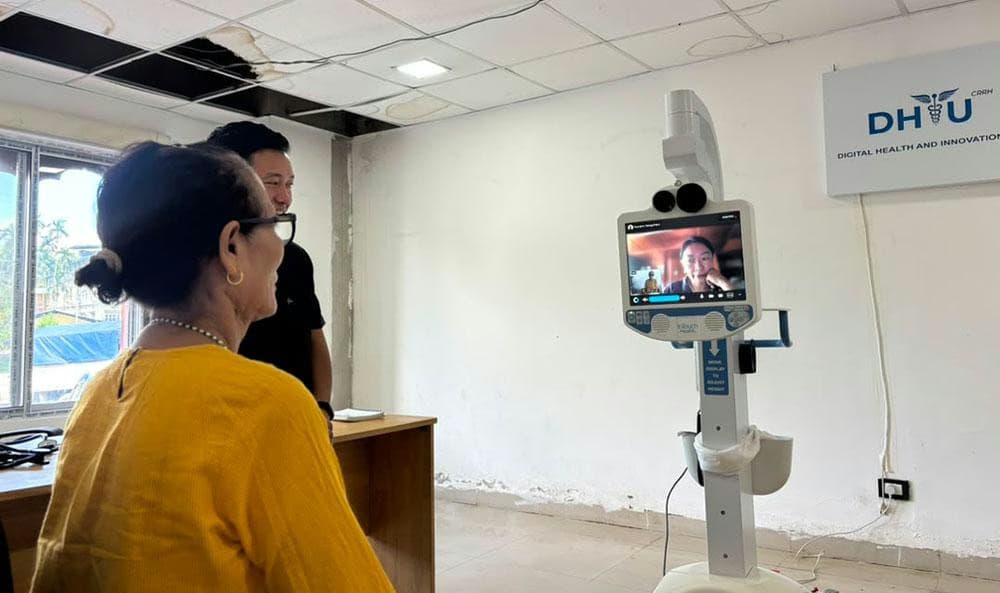
In Gelephu's Central Regional Referral Hospital, a 64-year-old patient named Lilly Maya Gurung sat before a camera for a consultation that would have previously required a grueling 200-kilometer journey to Thimphu. On the screen appeared Bhutan's only rheumatologist, reviewing her swollen joints and adjusting her medications in real-time.
Rheumatoid arthritis, an autoimmune condition where the body's immune system attacks healthy joints, demands regular specialist oversight. Without treatment, it causes permanent joint damage and severely compromises quality of life. For Gurung, the teleconsultation meant receiving expert care without abandoning her home community.
"I am relieved," she said after the appointment, no longer facing the prospect of costly travel, accommodation expenses, and time away from daily responsibilities.
Another patient—a schoolgirl managing an autoimmune condition—experienced equally transformative benefits. Previously, specialist appointments meant missing school days, falling behind academically, and enduring the stress of long-distance travel. Through telemedicine, she received expert care and returned directly to her classroom.
Addressing Bhutan's Healthcare Workforce Reality 📊
Bhutan's healthcare system has experienced measurable growth. Between 2020 and 2024, the physician workforce expanded from 336 to 411 doctors, raising the doctor-to-population ratio from 4.62 to 5.29 per 10,000 residents. This represents genuine progress in a developing healthcare system.
However, the distribution remains profoundly unequal. The country currently employs:
- 177 specialists and sub-specialists
- 173 medical officers serving frontline communities
- 59 hospitals across the nation
- 193 primary health centres
- 555 outreach clinics
Yet most specialist expertise concentrates in Thimphu. Certain specialties—rheumatology being a prominent example—have only one or two practitioners serving the entire nation. Patients from eastern districts like Gelephu, Samdrupjongkhar, or Trashigang face days of travel for routine specialist appointments, incurring substantial accommodation costs and missing work or school.
How Telemedicine Functions in Practice ⚙️
The rheumatology teleconsultation service launched in Gelephu on May 21, 2024, utilizing equipment donated by the World Tele Initiative, a US-based nonprofit organization. Within two months, the hospital recorded over 40 teleconsultation sessions involving approximately seven patients requiring ongoing chronic disease management.
The process is remarkably straightforward:
- Patient preparation at the remote health facility
- Specialist connection via secure digital platform
- Real-time examination using specialized equipment
- Medical decision-making by the distant specialist
- Prescription management coordinated through national systems
- Follow-up scheduling without requiring patient travel
According to the Central Regional Referral Hospital's Medical Superintendent, benefits emerged immediately. Patients avoided costly journeys, eliminated lengthy waiting room hours, and received prescriptions for unavailable medicines that could be obtained through the national referral hospital without additional travel.
Chronic Disease Management Benefits 🩺
Telemedicine proves particularly valuable for chronic conditions requiring regular monitoring rather than surgical intervention. Patients with rheumatoid arthritis, diabetes, hypertension, heart disease, and autoimmune disorders benefit substantially from remote specialist oversight.
These conditions demand:
- Regular medication adjustments based on patient response
- Periodic clinical assessment to monitor disease progression
- Preventive intervention to avoid complications
- Patient education about lifestyle modifications
Traditional healthcare models force patients to choose between regular specialist care (requiring repeated travel) or managing conditions with limited local expertise. Telemedicine eliminates this false choice.
Expanding Beyond Rheumatology 🔬
Gelephu's success with rheumatology has prompted broader expansion plans. The hospital established a Digital Health Innovation Unit specifically to scale teleconsultation across additional specialties. Collaboration with the Eastern Regional Referral Hospital in Mongar aims to create a network where specialist expertise flows seamlessly across eastern Bhutan.
Potential specialties for telemedicine expansion include:
- Cardiology for heart disease management
- Oncology for cancer treatment coordination
- Neurology for neurological disorders
- Pediatric specialties for complex childhood conditions
- Mental health services for psychiatric consultations
- Dermatology for skin conditions requiring specialist assessment
The Complementary Healthcare Model 🤝
A Ministry of Health official emphasized that telemedicine isn't designed to replace face-to-face healthcare or community-based doctors. Rather, it functions as a complementary service connecting patients and frontline providers with scarce specialist expertise, particularly in remote areas.
This distinction matters profoundly. Frontline health workers—nurses, medical officers, and health assistants—remain essential. They provide continuity of care, manage routine health issues, and identify patients requiring specialist input. Telemedicine amplifies their capabilities rather than diminishing their role.
The model recognizes that not every patient needs a specialist in their community. Instead, specialist knowledge travels to where it's needed through technology, while community healthcare workers maintain ongoing relationships with patients.
Overcoming Distance: Healthcare's Oldest Challenge 🌍
Distance has challenged healthcare delivery since medicine's inception. Geography determined whether patients received expert care or made do with local practitioners' limited knowledge. Telemedicine fundamentally alters this equation.
For Bhutan specifically, geography presents extraordinary challenges. The nation's mountainous terrain, scattered population centers, and limited transportation infrastructure make traditional healthcare distribution extremely difficult. Telemedicine leverages existing infrastructure—hospitals in major cities—to serve patients across the country.
This approach proves particularly cost-effective. Rather than duplicating specialist positions across multiple locations, Bhutan can concentrate specialists in regional hubs and extend their expertise through technology.
Industry Trends Supporting Telemedicine Growth 📈
Globally, telemedicine adoption accelerated dramatically post-2020, with healthcare systems worldwide recognizing its value. Bhutan's embrace of teleconsultation aligns with international trends showing:
- Increased patient satisfaction with remote consultations for appropriate cases
- Improved health outcomes through better specialist access
- Reduced healthcare costs by eliminating unnecessary travel
- Enhanced healthcare worker retention in remote areas
- Stronger chronic disease management through regular monitoring
Countries ranging from India to Southeast Asian nations have successfully implemented telemedicine networks, providing proven models Bhutan can adapt to its unique context.
Looking Forward: The Future of Bhutanese Healthcare 🔮
The "One Gewog, One Doctor" promise reflected genuine commitment to healthcare equity. Telemedicine doesn't abandon that vision—it reimagines how to achieve it. Rather than stationing individual doctors in every location, Bhutan can ensure every community accesses specialist expertise through technology.
This approach offers several advantages:
- Flexibility to expand services as technology improves
- Scalability to reach new specialties without massive infrastructure investment
- Sustainability through efficient use of limited specialist resources
- Equity by ensuring remote patients receive equivalent care to urban residents
- Efficiency by allowing specialists to serve more patients
The Central Regional Referral Hospital's Digital Health Innovation Unit represents just the beginning. As Bhutan's telemedicine network expands, more patients will experience what Lilly Maya Gurung discovered: world-class specialist care without abandoning their communities, their livelihoods, or their daily lives.
Key Takeaways 🎯
Telemedicine emerges as Bhutan's pragmatic response to healthcare's geographic challenges. While the original promise of stationing doctors in every gewog proved logistically difficult, technology offers a superior alternative: bringing specialist expertise to patients rather than requiring patients to travel for expertise.
The early success in Gelephu demonstrates that telemedicine works in Bhutan's context. Patients benefit from reduced travel burden, lower costs, and consistent specialist oversight. Healthcare workers gain access to specialist consultation for complex cases. The health system optimizes limited specialist resources.
As Bhutan's telemedicine network expands across specialties and regions, the nation moves closer to healthcare equity—not through traditional deployment models, but through intelligent use of technology that honors both the original promise and the realities of implementation.
You May Also Like
Health
Mental Health: A Shared National Responsibility
August 29, 2026
Health
Mongar Mother and Child Hospital Handover: Ending Years of Healthcare Delays
August 26, 2026
Health
Behind Every Statistic: Understanding Human Impact in Health
August 26, 2026
Health
Breaking the Cycle: Understanding Relapse in Recovery
August 22, 2026