Category:
EconomySangay Shamu Foraging: Bhutan's Precious Matsutake Economy
The Hidden Treasure of Bhutanese Forests 🌲
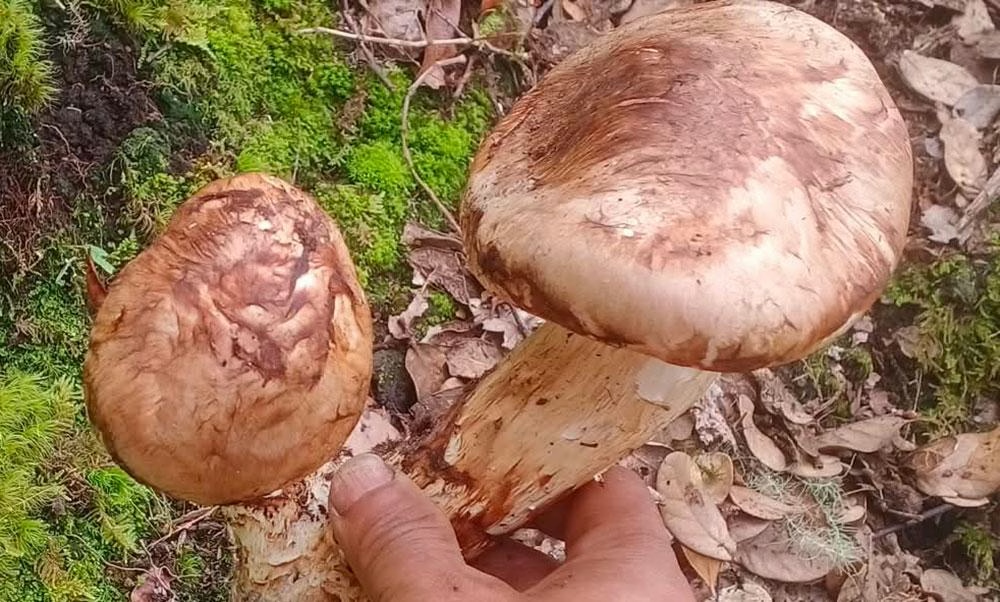
Before dawn breaks over the Geney Gewog region south of Thimphu, dedicated foragers are already moving through darkness with purpose. The matsutake mushroom—known locally as Sangay Shamu—represents far more than a culinary delicacy; it embodies an economic lifeline for rural Bhutanese communities and a complex ecological story that deserves serious attention.
This prized fungus has sustained families in the region for over three decades, generating substantial income that supports local development and cultural preservation. Yet today, collectors face mounting challenges that threaten both their livelihoods and the future availability of this remarkable resource.
Understanding Sangay Shamu: Nature's Delicate Prize ✨
Sangay Shamu occupies a unique position in both Bhutanese culture and the international gourmet market. The matsutake mushroom grows exclusively in specific forest conditions within Bhutan's carefully managed ecosystems, where it develops a distinctive flavor profile that commands premium prices worldwide.
What makes this fungus particularly challenging to harvest is its elusive nature. The mushrooms hide beneath layers of fallen oak leaves—locally called jishing—and blend seamlessly with the forest floor. Experienced collectors describe the difficulty as requiring almost meditative focus; an untrained eye cannot distinguish the mushroom from surrounding vegetation.
The quality hierarchy adds another layer of complexity. Matsutake specimens developing in soft, moist soil with unopened caps represent grade-A specimens commanding the highest prices. Those forced to mature in hard, compacted earth fetch considerably less, creating economic incentives for collectors to seek optimal growing locations.
The Pre-Dawn Ritual: A Collector's Day Begins 🌙
Foragers like Tandin Dorji, who has dedicated 14 years to Sangay Shamu collection, follow rituals refined through countless seasons. The work begins at 3:30 AM, with preparation that seems almost ceremonial in its precision.
Clothing selection carries strategic importance beyond comfort. Collectors deliberately wear black and green garments designed to blend with forest foliage—a practical necessity rooted in competitive dynamics. Red or white clothing would make collectors visible to competitors who might follow them to productive foraging grounds. This camouflage strategy reflects the economic stakes involved; each collector protects their discovered locations with determination.
The journey to foraging sites typically requires nearly an hour of walking through darkness. Groups travel together initially, then disperse silently into different forest sections, maintaining complete separation until the designated meeting point hours later. This coordinated yet independent approach maximizes coverage while respecting territorial boundaries within the community.
Harvesting itself demands exceptional technique. Collectors bend low and gently part leaves with sturdy sticks, treating each potential mushroom with care. Rough handling damages the delicate fungus before extraction. After removal, collectors meticulously cover the small holes left behind, maintaining forest integrity and potentially supporting future growth cycles.
The Economic Reality: Declining Yields, Rising Concerns 📊
The matsutake economy in Geney Gewog represents a significant component of local and national revenue. In 2024, collectors gathered 7,478.896 kilograms across 857.5 hectares of reserved forest, generating royalties of Nu 149,757.90 for the gewog. This translates to direct community earnings ranging between Nu 100,000 and Nu 300,000 each season.
Nationally, Bhutan exported nine metric tonnes of matsutake last year, earning approximately Nu 57 million in export revenue. Japan remains the primary market, where matsutake commands exceptional prices due to cultural significance and culinary prestige.
However, troubling trends have emerged. Current pricing stands at Nu 2,000 per kilogram for grade-A specimens and Nu 1,800 for grade-B mushrooms—representing price increases that might initially seem positive. Yet this price appreciation masks a concerning reality: production has collapsed dramatically.
Historically, collectors filled three Bolero truckloads daily during peak season. Today, they struggle to fill a single truck. Production has plummeted from historical levels of 20 to 30 tonnes to approximately one tonne—a decline that specialists describe as drastic. The 2025 harvest fell slightly to around 6,960 kilograms, continuing a downward trajectory that alarms both collectors and government officials.
The Harsh Realities: Bears, Drought, and Danger 🐻
Foraging Sangay Shamu involves genuine physical peril. Bear encounters represent an ever-present threat in the forests where matsutake thrives. Tandin Dorji reports that annually, one to two collectors suffer bear attacks—incidents that have occasionally been severe enough to deter other foragers from entering the forest.
This danger explains why collectors never venture into the forest without sturdy sticks—tools serving dual purposes as walking aids and defensive implements. The psychological weight of this constant threat adds stress to an already demanding occupation.
Weather patterns dramatically influence harvests in ways that extend beyond simple preference. Unlike many mushroom varieties that almost anyone can gather, Sangay Shamu requires specific moisture conditions. Rain directly correlates with mushroom availability; dry seasons produce minimal harvests regardless of collector effort or expertise.
Tandin Dorji's personal experience illustrates the volatility. His best single day yielded five kilograms—a record achieved during a season when bear attacks kept many competitors at home. His most productive year generated 60 kilograms and earned Nu 114,000. This season, after months of effort, he has gathered only 12 to 13 kilograms, earning Nu 25,000—a 78% reduction in income despite increased dedication.
Climate and Environmental Factors Reshaping the Landscape 🌡️
Dawa Penjor, a mushroom specialist at Bhutan's Ministry of Agriculture and Livestock, acknowledges that formal research into decline causes remains limited. However, specialists recognize clear patterns: yields fall significantly when temperatures rise and rainfall becomes scarce, drying the forest floor and creating inhospitable conditions for fungal development.
Climate variability has intensified, with recent years showing concerning patterns of insufficient precipitation during critical growing periods. This environmental stress compounds existing collection pressures, creating a convergence of challenges that threaten sustainability.
The ministry has developed comprehensive management protocols addressing these concerns. Guidelines discourage collection of immature mushrooms and destruction of growing areas, promoting basket usage over plastic bags to minimize environmental damage. These conservation measures represent thoughtful approaches to balancing economic needs with ecological preservation.
The Sangay Shamu Festival and Community Concerns 🎉
The annual Sangay Shamu Festival in Geney Gewog celebrates the mushroom's cultural and economic significance while providing marketplace opportunities. This year's event concluded with mushrooms commanding premium prices, yet the atmosphere reflected underlying anxiety rather than pure celebration.
Collectors and farmers expressed shared concerns about long-term sustainability. One farmer articulated the prevailing worry: "The price of the mushroom is increasing, but production is decreasing. We are worried that one day the mushroom will vanish."
Phub Tshering, another local farmer, exemplifies these concerns. He collected 50 kilograms last year, earning Nu 80,000, and hoped to exceed that performance this year. Recent rainfall deficiencies have left him anxious about whether the forest will produce sufficient matsutake to meet his economic expectations.
Economic Sustainability and Future Outlook 💭
The matsutake economy presents a paradox: rising prices amid falling production creates short-term income volatility while signaling long-term vulnerability. Higher per-kilogram prices cannot indefinitely compensate for dramatically reduced yields.
Foragers face a difficult reality. Even experienced collectors rarely gather more than one kilogram daily under optimal conditions. The scarcity that keeps prices elevated also limits income growth potential. Collectors cannot simply work harder to compensate for declining availability; the mushrooms either exist in the forest or they do not.
The gewog's dependence on Sangay Shamu revenue makes this decline particularly consequential. With limited alternative income sources in rural areas, reduced matsutake availability directly impacts family incomes, educational opportunities, and community development initiatives.
Conservation Efforts and Research Needs 🔬
The Ministry of Agriculture and Livestock has recognized the urgency of addressing matsutake sustainability. The developed management plan represents important progress, yet questions remain about implementation effectiveness and whether current measures sufficiently address underlying environmental pressures.
Formal research into decline causes would provide valuable insights for targeted interventions. Understanding whether climate change, soil degradation, over-harvesting, or other factors primarily drive production losses could enable more strategic conservation responses.
International cooperation might offer additional perspectives. Japan, as the primary market for Bhutanese matsutake, has centuries of experience managing wild mushroom resources. Knowledge exchange could inform Bhutanese conservation strategies while strengthening bilateral relationships.
What Lies Ahead: Challenges and Possibilities 🔮
The Sangay Shamu story represents a microcosm of broader challenges facing rural economies dependent on natural resource extraction. As climate patterns shift and environmental pressures intensify, communities worldwide face similar questions about balancing immediate economic needs with long-term sustainability.
For Geney Gewog and other matsutake-dependent communities, the path forward requires integrated approaches combining conservation, research, climate adaptation, and potentially economic diversification. Price increases provide temporary relief but cannot substitute for actual mushroom availability.
The collectors rising before dawn to search forest floors deserve recognition for their dedication and skill. Yet their efforts increasingly occur within constraints they cannot control—environmental conditions that grow less favorable with each passing season. Whether Sangay Shamu remains a viable livelihood source depends on decisions made today regarding forest management, climate adaptation, and sustainable harvesting practices.
The prized matsutake mushroom has sustained Bhutanese communities for generations. Ensuring it remains available for future generations requires urgent attention to the interconnected ecological, economic, and social factors shaping its future.
You May Also Like
Economy
Bhutan's Bold Vision: Two USD 50M Enterprises by 2030
September 27, 2026
Economy
Mega Dry Port in Pasakha: Bhutan's Trade Revolution
September 25, 2026
Economy
Fixed Deposit Tax Withholding: What You Need to Know
September 13, 2026
Economy
DRC's QR Payment Innovation: Tracking Business Income
September 2, 2026