Category:
NewsSamtse Awaits Dzongkhag Thromde Status Eight Years Later
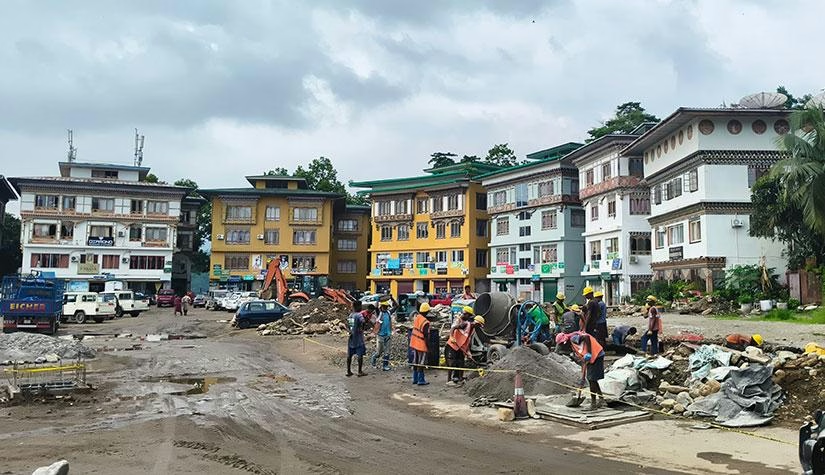
The Long Wait for Urban Recognition 🏛️
Samtse stands at a critical juncture. Once a modest border town, it has transformed into a thriving economic hub that local leaders argue deserves formal recognition through dzongkhag thromde status. Yet after eight years of waiting since the initial announcement following the 111th National Day celebrations in 2018, the promise remains unfulfilled, leaving residents and officials in a state of uncertainty about the town's future governance structure.
The disconnect between Samtse's rapid economic expansion and its administrative classification has become increasingly apparent. What was once considered a peripheral settlement has evolved into a strategic regional center, yet it continues to operate under governance structures designed for a smaller, less economically dynamic community. This mismatch raises important questions about how Bhutan plans to manage urban development in its emerging economic centers.
Economic Growth Outpacing Administrative Framework 📈
Samtse's transformation over the past decade tells a compelling story of economic dynamism. The town has emerged as a crucial industrial hub, hosting two established industrial areas that attract businesses and entrepreneurs from across the region. This industrial presence has fundamentally altered the town's economic profile, positioning it as more than just a residential settlement.
The population figures tell an equally striking narrative. In 2019, Samtse had approximately 7,500 residents. By the present day, this figure has nearly doubled to around 15,000, including the mobile population—a growth rate that reflects the town's increasing attractiveness as a place to live and work. Covering roughly 4.8 square kilometers, the town now faces the challenge of accommodating this rapid expansion within existing infrastructure.
Local leaders emphasize that the circumstances justifying the original proposal have fundamentally changed. "It has been about eight years since the plan to declare Samtse as the fifth dzongkhag thromde was announced, but we are yet to see it happening," noted local officials, highlighting the frustration with the prolonged delay. The argument is no longer about whether Samtse meets basic criteria—it clearly does—but rather about whether the government will act on what many consider an obvious administrative necessity.
Major Infrastructure Projects Reshaping the Region 🚀
Several transformative projects are expected to further accelerate Samtse's development trajectory. The proposed Banarhat-Samtse railway connectivity represents a game-changing infrastructure investment that would integrate the town into a broader regional transportation network. This rail link could fundamentally reshape trade patterns and economic activity in the eastern Bhutan region.
The planned airport at Yoeseltse adds another dimension to Samtse's strategic importance. Air connectivity would position the town as a gateway for regional commerce and tourism, potentially attracting investment and visitors that would further strain existing urban services and infrastructure.
The Gyalsung Academy at Jamtsholing brings educational significance to the region, likely attracting families and creating demand for residential and commercial services. Meanwhile, the planned upgrade of Samtse hospital to a regional referral hospital will increase healthcare capacity but simultaneously create pressure for expanded urban housing and service infrastructure.
These projects represent more than isolated developments—they constitute a comprehensive economic transformation that demands corresponding administrative and governance structures.
The Administrative Disconnect 🤔
The core concern articulated by local leaders centers on the absence of a clear urban development framework to guide this growth. Samtse Gewog Gup Wangchuk Lepcha expressed frustration with the lack of transparency: "It has been a long time since the announcement was made, but we have not heard any word about the status of the plan from the relevant agencies or the government."
This communication gap has created uncertainty that extends beyond administrative classification. Without clear guidance on Samtse's future status, investors face ambiguity about long-term infrastructure planning. Residents struggle with questions about service provision and urban amenities. Business leaders cannot confidently plan expansions without knowing whether the town will receive the administrative attention and resources that thromde status would bring.
The current town infrastructure, while functional, reflects its previous status. Samtse currently operates approximately 18 formal buildings, and while local officials note adequate land for expansion, the pace of growth threatens to outstrip planning capacity.
A Policy Caught Between Shifting Priorities 🔄
Understanding why the dzongkhag thromde proposal remains unresolved requires examining how government priorities have shifted across successive administrations. In March 2020, former Prime Minister Dr Lotay Tshering confirmed that the plan remained active but identified a significant procedural hurdle: thromde delimitations established by the Election Commission of Bhutan in 2015 would require parliamentary modification to accommodate Samtse.
This parliamentary requirement emerged from the original 2015 decision to establish dzongkhag thromdes and yenlag thromdes across all 20 dzongkhags. However, a subsequent Supreme Court writ directed the Election Commission to defer thromde elections in 16 dzongkhags, effectively pausing the entire delimitation process. This legal complication transformed what might have been a straightforward administrative upgrade into a more complex constitutional matter.
The Covid-19 pandemic introduced another constraint. By November 2020, the government cited fiscal limitations, with Dr Lotay Tshering explaining that the recurring expenditure associated with establishing a new thromde could not be accommodated within the government's reduced revenue base. The proposal shifted from active implementation to a holding pattern, with the government continuing planning work while postponing concrete action.
The situation evolved again in 2023, when then Infrastructure and Transport Minister Dorji Tshering told Parliament that Samtse and Mongar represented logical candidates for dzongkhag thromde status based on population and economic metrics. This statement suggested renewed momentum, yet subsequent government actions have not matched this rhetorical support.
The Current Government's Approach 💼
The current administration has articulated a notably different philosophy. In May 2025, Prime Minister Tshering Tobgay stated during a Meet-the-Press session that the government would prioritize equitable development across all towns rather than concentrating resources on individual urban centers. He emphasized that no dzongkhag should receive preferential treatment based on political weight or population size.
"There should be no distinction between dzongkhags. Policies must reflect ground realities," the Prime Minister stated, signaling a commitment to inclusive development across Bhutan's urban network. While this philosophy reflects admirable principles of equity, it raises questions about how Samtse's specific circumstances—its exceptional economic growth, strategic location, and infrastructure projects—will be addressed within this broader framework.
This policy position suggests that the government may not prioritize Samtse's dzongkhag thromde status in the near term, despite the town's apparent readiness. The focus appears to have shifted from individual town upgrades to a more systematic approach to urban development across the country.
What Samtse Needs Now 🎯
Local leaders argue that the issue extends beyond administrative prestige. The fundamental need is for a clear urban development framework that can guide growth and ensure adequate infrastructure provision. Samtse Dzongdag Melam Zangpo noted that development has already commenced and will continue according to localized plans, but the absence of formal thromde status complicates long-term planning.
The town requires:
- Clear governance structure aligned with its economic significance and population size
- Comprehensive urban planning that anticipates infrastructure needs from upcoming projects
- Adequate service delivery mechanisms to handle increased demand for water, sanitation, waste management, and transportation
- Investment in municipal capacity to manage rapid urbanization
- Transparent communication from national authorities about the town's administrative future
Looking Forward 🌟
Samtse's situation reflects broader challenges facing Bhutan's urban development strategy. As the country experiences economic growth concentrated in specific regional centers, administrative structures must evolve to match economic realities. The town's eight-year wait for formal recognition highlights the gap between policy announcements and implementation, between stated priorities and budgetary realities.
The convergence of major infrastructure projects—railway connectivity, airport development, hospital upgrades, and educational institutions—creates a window of opportunity. If Samtse can secure dzongkhag thromde status now, it can establish governance frameworks and service delivery systems that will accommodate future growth efficiently. Delay risks creating infrastructure deficits that become increasingly costly to remedy.
For residents, business owners, and local officials, the uncertainty remains frustrating. Yet the town's continued economic momentum suggests that Samtse's development will proceed regardless of administrative classification. The question is whether the government will provide the governance tools and resources that responsible urban development demands, or whether Samtse will continue growing without adequate administrative support—a scenario that serves neither the town nor Bhutan's broader development objectives.
You May Also Like
News
Women Entrepreneurs Master AI and Digital Tools in Phuentsholing
September 1, 2026
News
Can Samtse Keep Up With Its Growing Workforce?
August 29, 2026
News
Nepal Flood Exposes Critical Gaps in Bhutan's Early Warning Systems
August 29, 2026
News
High Court Overturns Acquittal: Doctor Sentenced to 10 Years for Child Sexual Abuse
August 29, 2026