Category:
CultureSacred Kanjur Scriptures: Preserving Buddhist Heritage
A Spiritual Milestone for Bhutan's Monastic Communities 🙏
Bhutan has long been recognized as a beacon of Buddhist tradition in the modern world, where spirituality remains interwoven into the fabric of daily life. Recently, the nation witnessed a remarkable convergence of religious devotion and cultural preservation when sacred Kanjur scriptures were ceremonially offered to monastic communities across the country. This significant initiative represents far more than a simple distribution of religious texts—it embodies centuries of spiritual commitment and intellectual tradition.
The timing of this momentous occasion was particularly auspicious, coinciding with the historic raising of 108 enlightened stupas at Gelephu Mindfulness City on November 1st. This dual celebration underscored Bhutan's unwavering dedication to upholding Buddhist teachings while advancing its visionary development projects.
Understanding the Kanjur: Buddhism's Most Revered Collection 📚
The Kanjur, literally translating to "Translated Words of the Buddha," stands as one of Tibetan Buddhism's most treasured scriptural collections. This comprehensive compilation encompasses the Sutras (teachings), Vinaya (monastic discipline), and Tantras (esoteric practices), creating a complete foundation for Buddhist study, contemplation, and spiritual advancement.
For practitioners and scholars alike, the Kanjur represents an authoritative resource that has guided Buddhist communities for centuries. Its significance extends beyond academic interest—the scriptures serve as living teachings intended to illuminate the path toward enlightenment and benefit all sentient beings. In Bhutanese Buddhist culture specifically, the Kanjur holds profound spiritual and cultural importance, representing both religious instruction and national heritage.
The act of offering these scriptures carries deep spiritual merit in Buddhist tradition. Known as making a "tendrel," or auspicious offering, the distribution transforms the physical act of giving into a meritorious religious practice designed to uphold the Buddha Dharma and advance spiritual welfare across the nation.
The Royal Kanjur Project: Bringing Sacred Teachings to Every Corner 🌍
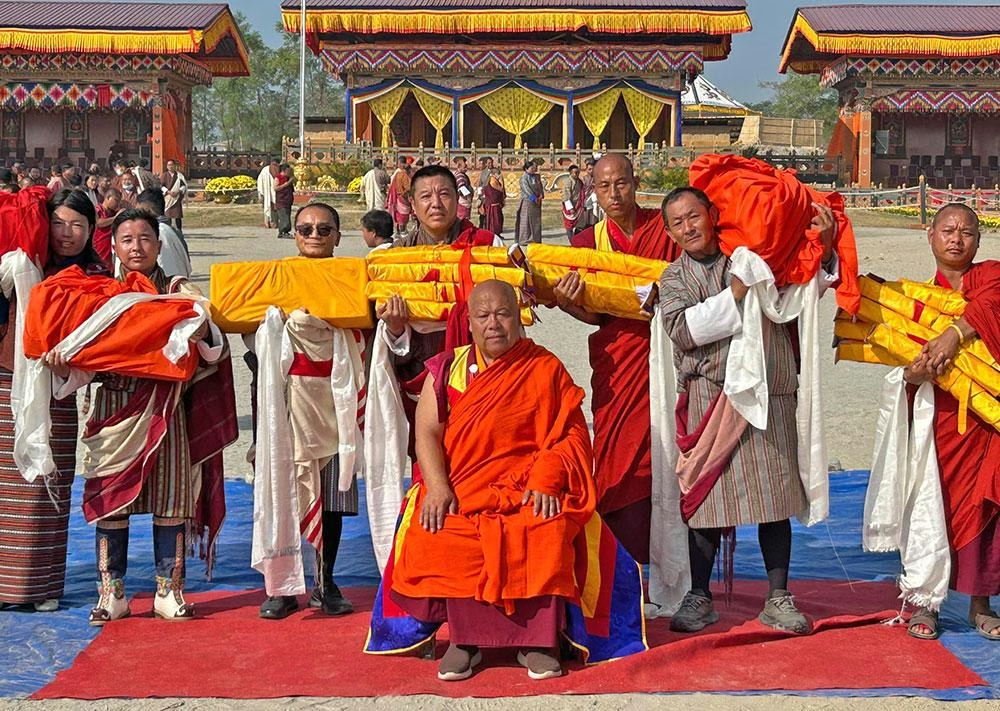
Coordinated by the Office of the Gyalpoi Zimpon, the Royal Kanjur Project represents an ambitious undertaking to strengthen Buddhist education and practice throughout Bhutan. The initiative distributed 21 volumes each of the Kanjur Text to Rabdey Dratshangs in all 20 dzongkhags (districts) and 205 gewogs (administrative subdivisions), with the ceremonial handover occurring at Zeeray Thang in Gelephu Mindfulness City.
Former Tsugla Lopon Samten Dorji, serving as chairman of the Royal Kanjur Project, personally presented the sacred scriptures to religious institutions, emphasizing the spiritual significance of the moment. According to Lam Kezang Chhoephel, the project's secretary, this distribution represents merely the beginning of a larger vision for scriptural preservation and dissemination.
The Deeper Purpose Beyond Physical Distribution
While the distribution of 21 volumes to monastic communities across Bhutan marks an important achievement, project leaders emphasize that the true significance lies in how these teachings are received, studied, and practiced. As Lam Kezang Chhoephel articulated, "The greater significance of Kanjur Text lies not merely in possessing the sacred scriptures, but in upholding, practising and transmitting the enlightened teachings of Lord Buddha for the lasting benefit of all sentient beings."
This philosophy reflects a nuanced understanding of cultural and spiritual preservation. In contemporary discussions about heritage conservation, experts increasingly recognize that merely archiving cultural artifacts provides incomplete protection. True preservation occurs when communities actively engage with and transmit traditions to future generations. The Kanjur distribution initiative exemplifies this approach by placing scriptures directly into monastic communities where they will be studied, debated, and practiced daily.
A Handwritten Legacy: The Ninth Je Khenpo's Contribution 🖊️
The Kanjur texts being distributed trace their lineage to an extraordinary manuscript tradition dating back to 18th-century Bhutan. The 103-volume handwritten Kanjur preserved at Phajoding Goenpa represents the devoted work of the Ninth Je Khenpo, Gyelwa Shakya Rinchen (1710–1759), who served as Bhutan's chief monastic authority from 1744 to 1755.
Born in Rubesa, Wangduephodrang, Gyelwa Shakya Rinchen dedicated his life to Buddhist scholarship and spiritual advancement. Beyond his administrative role as Je Khenpo, he established meditation retreat centers and fostered an environment of rigorous religious study. His most enduring contribution, however, remains the handwritten Kanjur collection, a testament to his commitment to preserving Buddha's teachings for posterity.
The Craftsmanship Behind Sacred Manuscripts
The creation of the Phajoding Kanjur involved far more than calligraphic skill—it represented the convergence of multiple traditional crafts and disciplines. The manuscripts were prepared using handmade paper produced by Bhutanese artisans, with distinctive indigo-black paper forming part of the traditional production process. This choice of materials was not merely aesthetic; it reflected deep knowledge of paper longevity and the spiritual significance of using locally-crafted materials for sacred texts.
The ink itself carried special significance, reportedly made from soot collected from blue pine smoke traditionally used for lighting. This detail exemplifies how Bhutanese craftspeople integrated available natural resources into their artistic and religious practices, creating materials that were simultaneously functional and spiritually appropriate.
The calligraphy was undertaken by a group of devoted disciples working under the Ninth Je Khenpo's direct guidance over approximately three years. Among these distinguished scribes were Drukdra Namgyel, Shakya Tendzin, Jigme Sengge, Kunga Gyatso, Yonten Thaye, and Tenzin Namgyel—figures whose names are remembered as carriers of Bhutan's religious tradition.
The Discipline of Manuscript Creation
Creating 103 volumes of hand-calligraphed scripture demanded extraordinary patience, discipline, and specialized knowledge. Each character required precise brushwork; each page demanded consistent quality; each volume necessitated unwavering focus. The process brought together paper-makers who prepared materials, calligraphers who inscribed texts, and religious scholars who ensured doctrinal accuracy.
This collaborative process reflected Bhutanese values emphasizing collective spiritual effort and the interdependence of different skilled practitioners. No single individual could have created these manuscripts alone; success required the coordinated dedication of an entire community united by religious purpose.
Expanding Access: The 103-Volume Collection Initiative 🔄
While the distribution of 21-volume Kanjur sets marked a significant milestone, the Royal Kanjur Project envisions even broader dissemination. The 103-volume handwritten Kanjur collection, scanned and reproduced in print from the original Phajoding manuscripts, is planned for wider distribution to Rabdeys, gewogs, and monasteries over the coming years.
This phased approach reflects practical considerations regarding production capacity and distribution logistics while maintaining the sacred nature of the offering. By gradually expanding access to these comprehensive scriptures, the project ensures that monastic communities throughout Bhutan can deepen their engagement with Buddhist teachings.
Supporting Monastic Education and Practice
For Bhutan's monastic communities, access to complete Kanjur collections directly supports the continued study and practice of Buddhist teachings. Monasteries and religious institutions serve as centers of learning where monks engage in rigorous textual study, philosophical debate, and meditative practice. The availability of authoritative scriptural sources enables these communities to maintain educational standards and transmit authentic teachings to younger generations.
Beyond the monastic sphere, the preservation and distribution of such collections safeguards an important dimension of Bhutan's historical memory, artistic heritage, and spiritual identity. In an era of rapid globalization and cultural homogenization, maintaining access to traditional Buddhist scriptures represents a deliberate choice to honor ancestral wisdom and maintain cultural continuity.
The Broader Context: Buddhism in Modern Bhutan 🏔️
Bhutan's approach to preserving Buddhist heritage reflects the nation's distinctive development philosophy. Unlike many countries that have experienced secularization or marginalization of religious traditions, Bhutan has deliberately integrated Buddhist values into its national identity and governance structures. The concept of Gross National Happiness, adopted as a development metric alongside economic indicators, explicitly incorporates Buddhist principles emphasizing spiritual wellbeing and collective harmony.
The Royal Kanjur Project aligns with this broader commitment to cultural and spiritual preservation. By ensuring that monastic communities have access to authoritative scriptural sources, the initiative strengthens the religious foundation upon which Bhutanese society rests.
Connecting Ancient Wisdom to Contemporary Challenges
In contemporary discussions about cultural preservation, experts increasingly recognize that traditional knowledge systems offer valuable insights for addressing modern challenges. Buddhist teachings on interdependence, compassion, and mindfulness have gained international recognition as relevant to contemporary concerns including mental health, environmental sustainability, and social cohesion.
By preserving and disseminating the Kanjur, Bhutan ensures that these teachings remain accessible not only to monastics but potentially to broader audiences seeking wisdom from Buddhist philosophy. This approach positions Bhutan as a custodian of important intellectual and spiritual traditions with relevance extending far beyond its borders.
Cultural Heritage as Living Tradition 🌸
The significance of the Kanjur distribution initiative extends beyond the immediate practical benefits of providing religious texts to monasteries. It represents a philosophical stance regarding how cultural heritage survives and thrives across generations.
Cultural traditions do not persist through passive preservation alone. They endure through active engagement, continuous study, and committed practice by successive generations. The handwritten Kanjur created in the 18th century by the Ninth Je Khenpo and his disciples survives today not merely as an artifact in an archive, but as a living teaching transmitted through monastic communities and now made more widely accessible through this distribution initiative.
The devotion of religious masters, the craftsmanship of artisans, and the dedication of disciples across centuries have collectively carried these teachings forward. Each generation adds its own layer of engagement and understanding, ensuring that ancient wisdom remains relevant and vital.
Looking Forward: Sustaining Buddhist Education 🎯
As the Royal Kanjur Project continues its phased distribution of the 103-volume collection, Bhutan demonstrates sustained commitment to Buddhist education and heritage preservation. The project's success will ultimately be measured not by the number of volumes distributed, but by whether the teachings they contain continue to be studied, understood, and practiced by monastic communities and beyond.
The initiative also raises important questions about cultural preservation in the digital age. While the Kanjur texts have been scanned and reproduced in print for distribution, the original handwritten manuscripts remain preserved, honoring both traditional materials and modern accessibility needs. This balanced approach respects the historical significance of the original manuscripts while ensuring that the teachings they contain reach wider audiences.
For Bhutan and the broader Buddhist world, the Sacred Kanjur scriptures offered to monastic communities represent more than religious texts—they embody centuries of spiritual aspiration, intellectual achievement, and artistic craftsmanship. By ensuring their continued preservation and active engagement, Bhutan honors its past while investing in the spiritual welfare of future generations.
You May Also Like

Culture
108 Jangchub Chortens: Bhutan's Historic Guinness World Record
November 4, 2026
Culture
Walking Through the Night for Blessings
November 4, 2026

Culture
108 Chortens Rise at GMC: Prayer Chants Echo Across Bhutan
November 2, 2026
Culture
108 Jangchub Chortens: A Night of Faith and History
November 2, 2026