Category:
PoliticsKanglung Education Centre Plan Stalled for Over a Decade
A Decade of Delays: Kanglung's Education Centre Dream Remains Unfulfilled 🏫
When the government first announced plans to transform Kanglung in Trashigang into a thriving education centre back in 2014, local residents envisioned a brighter future. The vision promised economic revitalization, employment opportunities, and enhanced livelihoods for the community. However, more than a decade later, what was meant to be a transformative initiative has become a cautionary tale of bureaucratic stagnation and unfulfilled political promises.
The Kanglung education centre development plan has effectively stalled despite comprehensive groundwork completed in 2017. Survey, zoning, and documentation work were finished years ago, yet the project remains confined to paper with virtually no physical progress. This prolonged delay raises critical questions about government accountability and the implementation of electoral pledges.
The Original Vision: Why Kanglung Was Chosen 🌟
The selection of Kanglung as an education hub wasn't arbitrary. When Education Minister Norbu Wangchuk first introduced the concept, the rationale was compelling: the district already hosted several established educational institutions, benefited from favorable climatic conditions, and enjoyed strategic proximity to a domestic airport. This combination of factors positioned Kanglung as an ideal location for educational expansion.
The existing educational infrastructure in the area is substantial. Sherubtse College, two monastic institutes, Early Childhood Care and Development Centres, the recently established Yarabling Higher Secondary School, and a vocational training centre for people with disabilities collectively create a robust educational ecosystem. These institutions should have formed the foundation for a comprehensive education centre that would consolidate and expand Kanglung's role as a regional learning hub.
Infrastructure Investment Without Implementation 🔧
In preparation for the anticipated development, the Trashigang District Administration demonstrated its commitment by constructing a water supply project and establishing drinking water infrastructure for residents. This investment reflected genuine optimism about the project's imminent launch. However, this preparatory infrastructure now stands as a monument to unfulfilled promises rather than a foundation for progress.
The contrast is striking: while the government invested in supporting infrastructure, it simultaneously failed to allocate resources for the actual education centre development. This disconnect between preparation and implementation reveals systemic challenges in project management and political follow-through.
Community Frustration: Residents Speak Out 😟
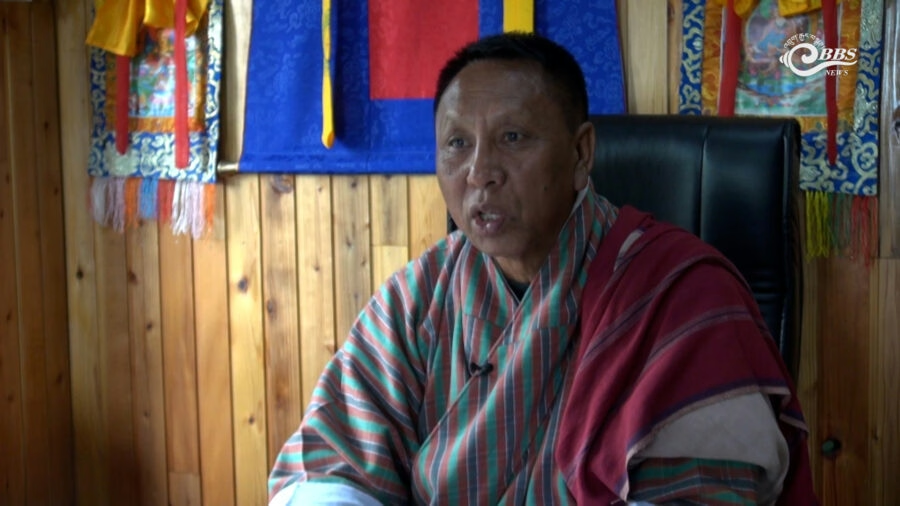
Kanglung Gup Kinzang Dorji articulated the growing anxiety within the community with particular clarity. He noted that the area has undergone significant demographic changes, with Thram holders increasing from approximately 500 to around 1,800. People have been purchasing land and constructing homes based on the assumption that the education centre project would proceed as planned.
"We already have the map and design for the centre," Kinzang Dorji explained, highlighting the concern that if structures are eventually built, they may encroach on privately owned land. This uncertainty has created a precarious situation where residents cannot make informed decisions about property development and investment.
The temporal dimension of this delay cannot be overstated. As the Gup emphasized, "Right now, it is not too early. Rather, it is already too late to start the education centre." This sentiment captures the cumulative frustration of a community watching opportunities slip away while their lives remain in limbo.
Economic Consequences for Local Businesses 💼
The stalled project has had tangible negative effects on Kanglung's local economy. Tenzin Mendrel, a businessman operating in the area, provided insight into the economic deterioration. Sherubtse College's reduction in student intake and course offerings has directly impacted the local business ecosystem. The college's downsizing has left many residential properties vacant as students and staff have relocated to urban centers.
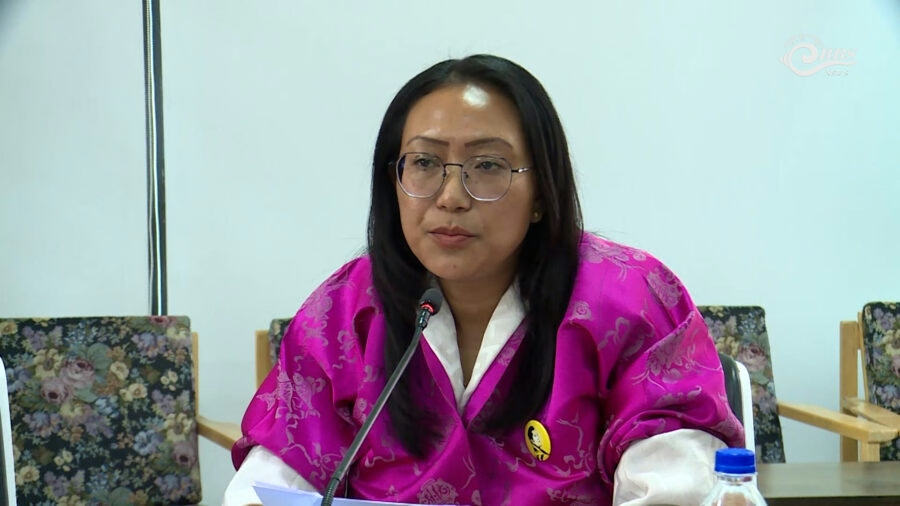
Mendrel articulated the potential benefits that a functioning education centre could provide: increased visitor traffic from outside the region, expanded employment opportunities for local youth, enhanced business activities, and increased tax revenue for the government. These aren't speculative advantages—they represent tangible economic multiplier effects that education centres typically generate in communities where they're successfully implemented.
The departure of business staff members symbolizes a broader trend of outmigration, leaving Kanglung increasingly quiet and economically stagnant. This reversal of fortune is particularly acute given that the community had positioned itself to benefit from educational sector growth.
Property Development Uncertainties 🏗️
Ugyen Dorji from Kanglung articulated another critical issue: the ambiguity surrounding Kanglung's official designation has created construction restrictions that constrain property development. In designated towns, building codes typically allow structures within 50 feet of roads, providing greater development flexibility. However, because Kanglung's status as an education centre remains unresolved, these zoning regulations remain unclear.
This regulatory uncertainty has created a chilling effect on property development. Residents contemplating construction investments face difficult decisions: proceed with development plans based on current regulations, or wait for potential changes that might follow the education centre designation. Many have chosen to defer decisions, effectively freezing economic activity in the sector.
Political Pledges and Implementation Gaps 🗳️
The education centre plan represents more than just a stalled infrastructure project—it embodies a broader pattern of unfulfilled political commitments. The initiative was pledged during both terms of the ruling government and was subsequently included in the People's Democratic Party's parliamentary election platform. These weren't peripheral campaign promises; they were central to the government's development vision for eastern Bhutan.
Yet despite this political backing, the project failed to secure inclusion in the 13th Five-Year Plan's priority list. During a recent Meet the Press session, Education and Skills Development Minister Yeezang De Thapa acknowledged this reality, stating that while the government remains committed to establishing Kanglung as an education centre, competing priorities within the ministry prevented its inclusion in the current planning cycle.
The Broader Context: Development Planning Challenges 📊
Bhutan's Five-Year Plan system represents a comprehensive approach to national development, requiring careful prioritization of competing initiatives across multiple sectors. The education ministry faces legitimate demands from numerous quarters: infrastructure development, curriculum modernization, teacher training, and institutional expansion all compete for limited resources.
However, the decade-long delay of the Kanglung project raises questions about planning mechanisms and accountability structures. When projects advance from initial conceptualization through survey and documentation phases, they typically carry implicit commitments regarding implementation timelines. A gap of this magnitude suggests either inadequate initial planning or changing governmental priorities that weren't transparently communicated to affected communities.
Lessons from Regional Education Hub Development 🌍
Globally, successful education hubs demonstrate specific characteristics: strategic location, existing institutional presence, adequate infrastructure, and sustained governmental commitment. Kanglung possesses most of these elements. What remains absent is the final critical component—unwavering implementation commitment backed by adequate resource allocation.
Comparable education development initiatives in other regions have succeeded through:
- Clear timelines: Specific implementation schedules communicated to stakeholders
- Dedicated funding: Ring-fenced budget allocations ensuring resource availability
- Transparent governance: Regular progress reporting and stakeholder engagement
- Institutional coordination: Cross-sector collaboration among educational institutions
- Community involvement: Local participation in planning and implementation
The Kanglung initiative appears to have faltered in several of these dimensions.
Looking Forward: Uncertain Prospects ⏳
Residents of Kanglung currently find themselves in a state of suspended uncertainty. The infrastructure exists, the planning documents are complete, the educational institutions are positioned, yet the project remains dormant. Property owners cannot confidently make investment decisions, businesses cannot plan for growth, and young people continue to migrate toward more economically vibrant urban centers.
The minister's acknowledgment that the project couldn't be prioritized in the current Five-Year Plan leaves open the possibility of future inclusion, but provides no concrete timeline or commitment. For a community that has waited a decade, such vague assurances offer little comfort.
Conclusion: Time for Decisive Action 🔑
The stalled Kanglung education centre plan represents a critical test of governmental accountability and implementation capacity. What began as a visionary initiative to revitalize an eastern district has become a symbol of bureaucratic inertia and unfulfilled promises.
The path forward requires decisive action: concrete timelines must be established, resources must be allocated, and transparent communication must flow to the affected community. Kanglung possesses all the prerequisites for becoming a thriving regional education hub. What remains is the political will and administrative commitment to transform plans into reality.
For the residents of Kanglung, the question is no longer whether the education centre will be built, but when. The community has waited long enough. The time for action is now.
You May Also Like
Politics
Bhutan Launches Four Voter Participation Initiatives for LG Elections
September 16, 2026
Politics
Women in Politics: Breaking Through Barriers Before Election Day
September 15, 2026

Politics
Women Leaders Training: Preparing for 2027 Local Elections
August 31, 2026
Politics
Speaker Election: Constitutional Duty Over Party Loyalty
August 29, 2026