Category:
EconomyInformal Trade Undercuts Formal Businesses in Phuentsholing
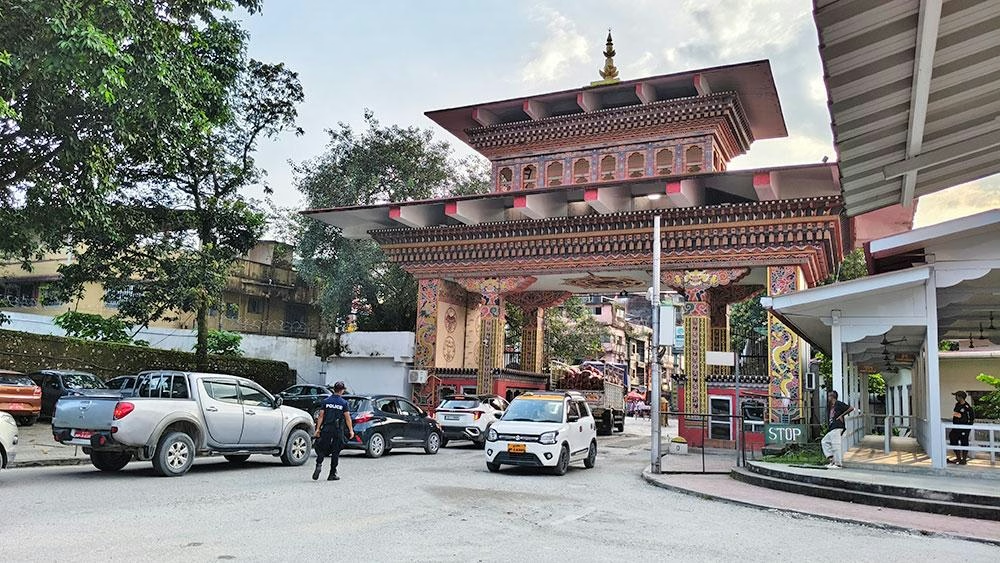
The Growing Challenge of Unregulated Commerce 📊
Phuentsholing, Bhutan's primary commercial hub, faces a mounting economic challenge that threatens the viability of legitimate businesses. The increasingly sophisticated movement of commercial goods through informal channels—disguised as personal imports in private vehicles—has created an uneven playing field where compliant traders struggle to compete against those operating outside regulatory frameworks.
This phenomenon represents more than a simple customs issue; it reflects a structural weakness in how border commerce is monitored and controlled, with far-reaching implications for Bhutan's formal retail sector and government revenue.
Understanding the Informal Trade Mechanism 🚗
The mechanics of informal trade in Phuentsholing operate deceptively simply. Traders bring goods across the border in small consignments via private vehicles, declaring them as personal imports even when the intended purpose is commercial resale. This practice exploits the ambiguous distinction between what constitutes legitimate personal belongings and what should be classified as commercial merchandise.
What makes this approach particularly effective is its distributed nature. Rather than large shipments that would trigger scrutiny, goods move in numerous small batches, each appearing innocent in isolation. When examined cumulatively across multiple border crossings, however, these movements constitute organized commercial activity.
The Cost Disadvantage for Formal Businesses 💰
Legitimate importers operating through formal channels bear substantial costs that informal traders successfully avoid:
- Customs duties on all imported goods
- Import taxes and value-added charges
- Business registration and licensing fees
- Customs clearance procedures and associated documentation
- Transportation costs through official channels
- Regulatory compliance expenses
These cumulative costs typically represent 20-35% of the product's wholesale price for formal businesses. Informal traders, by circumventing these requirements, can undercut legitimate competitors by significant margins—sometimes offering prices 30-50% lower than registered retailers.
This creates an impossible situation for compliant businesses: either reduce margins to unsustainable levels or lose market share to competitors operating without regulatory obligations.
The Distribution Network: From Border to Doorstep 🌐
Informal goods don't simply accumulate at the border—they've developed sophisticated distribution channels that reach every corner of Bhutan. These networks utilize multiple transportation methods and digital platforms to move products from Jaigaon across the country.
Traditional Transport Routes
Public transportation serves as the primary distribution mechanism. Bus terminals in Phuentsholing have become informal distribution hubs, where non-Bhutanese traders routinely send consignments through long-distance buses to customers throughout the country. A morning visit to Phuentsholing's bus terminal reveals the scale of this activity: multiple traders dispatching packages disguised as passenger luggage on buses heading to Thimphu, Paro, Punakha, and other major towns.
Taxis and private vehicles amplify this effect. Drivers have become informal couriers, transporting goods alongside regular passengers, further obscuring the commercial nature of the activity.
Digital Distribution: The Social Media Revolution 📱
Online platforms have fundamentally transformed informal trade dynamics. Sellers now advertise products on TikTok, Facebook, WhatsApp, and other social media channels, receive orders, and arrange deliveries without ever establishing a registered retail outlet or importing goods through official commercial channels.
This digital approach presents particular enforcement challenges. Traditional monitoring focused on physical goods at borders and retail locations; social media-based commerce operates largely invisible to conventional regulatory oversight. Transactions leave minimal paper trails, payments occur through informal channels, and delivery arrangements bypass formal logistics networks.
Notably, some established Bhutanese social media influencers actively promote products that have entered the country without paying taxes, inadvertently or intentionally legitimizing the practice among younger consumers.
The Enforcement Dilemma 🔍
Authorities face a genuine paradox in addressing informal trade. The fundamental challenge lies in distinguishing between legitimate personal imports and disguised commercial activity.
Why Current Enforcement Falls Short
Border security personnel carry primary responsibility for immigration and security checks. Determining whether goods carried by passengers are genuinely for personal use requires additional assessment capacity that currently doesn't exist. A single small consignment crossing the border appears indistinguishable from personal shopping; only when examining patterns across multiple crossings does commercial activity become apparent.
The absence of clear quantitative thresholds compounds this problem. Without defined daily or weekly limits for goods carried in private vehicles, enforcement decisions become subjective and inconsistently applied. This inconsistency actually encourages informal trade—traders recognize that enforcement is unpredictable and often ineffective.
Additionally, informal payment arrangements and private delivery networks mean authorities lack basic information about the volume, value, and destination of goods entering the market. This intelligence gap prevents effective policy development and targeted interventions.
Impact on Phuentsholing's Business Community 🏪
Local business owners describe the situation with palpable frustration. Restaurant owners observe competitors offering free delivery to distant cities—an economically impossible proposition if taxes were being paid. Shopkeepers watch as their carefully planned inventory investments become less competitive against tax-free alternatives.
The Competition and Consumer Affairs Authority (CCAA) has formally identified informal goods movement as a source of unfair competition in its business report on Phuentsholing, acknowledging what traders already know: the current system disadvantages compliant businesses.
This competitive distortion threatens not just individual businesses but the entire formal retail ecosystem. When legitimate traders cannot compete on price against unregulated competitors, investment in Bhutanese retail decreases, employment opportunities diminish, and government revenue declines.
Proposed Solutions: Finding Balance ⚖️
Addressing informal trade requires distinguishing between organized commercial activity and legitimate personal imports. Blanket restrictions on passengers carrying household goods would burden genuine travelers while doing little to address organized informal traders.
Enforcement Recommendations
The CCAA has proposed specific, implementable measures:
1. Establish Clear Thresholds
- Define daily or weekly limits for goods carried in private vehicles
- Consignments exceeding prescribed limits would be classified as commercial imports
- Apply applicable customs and tax requirements to excess quantities
2. Implement Risk-Based Monitoring
- Focus enhanced scrutiny on vehicles making frequent border crossings
- Target shipments inconsistent with personal use patterns
- Track repeat crossers carrying similar product categories
3. Develop Digital Tracking
- Create systems to monitor patterns across multiple crossings
- Distinguish between occasional personal imports and habitual commercial activity
- Share intelligence between border security and tax authorities
4. Address Digital Commerce
- Establish protocols for monitoring social media-based sales
- Require digital platform registration for sellers operating across borders
- Implement payment tracking for cross-border transactions
Broader Economic Implications 📈
Informal trade represents a significant revenue loss for Bhutan's government. Estimated tax and customs revenue forgone through informal channels likely exceeds Nu. 50-100 million annually—funds that could support education, healthcare, and infrastructure development.
Beyond revenue considerations, informal trade creates broader economic distortions. It discourages legitimate business investment, reduces employment in formal retail sectors, and undermines the rule of law by rewarding those who circumvent regulations.
For Bhutan's long-term economic development, particularly as the country seeks to diversify beyond hydropower, a functioning formal business environment is essential. This requires fair competition, predictable regulations, and consistent enforcement.
Looking Forward: The Path to Compliance 🛣️
Effective solutions require cooperation across multiple stakeholders. Border security, tax authorities, the CCAA, and the business community must align on clear standards and consistent enforcement.
Successful implementation would likely involve:
- Training programs for border personnel on distinguishing personal from commercial imports
- Technology investments in tracking systems and digital monitoring
- Clear communication of new thresholds and enforcement approaches to traders
- Graduated implementation allowing businesses time to adapt to new requirements
The goal isn't to eliminate cross-border commerce but to ensure it occurs within a framework that protects legitimate businesses and generates appropriate government revenue.
Conclusion: Restoring Fair Competition 🎯
Phuentsholing's informal trade challenge reflects a common development issue: regulatory frameworks struggle to keep pace with evolving commerce methods. As traders increasingly leverage digital platforms and distributed logistics networks, traditional border-focused enforcement becomes insufficient.
Addressing this requires acknowledging that informal trade isn't simply a customs problem—it's a competitive fairness issue affecting Bhutan's entire retail sector. By implementing clear thresholds, risk-based enforcement, and digital monitoring systems, authorities can distinguish legitimate personal imports from organized commercial activity.
The stakes extend beyond individual businesses. A formal retail environment that functions fairly attracts investment, creates employment, and generates revenue for public services. Conversely, an environment where informal traders operate with impunity discourages compliance and undermines economic development.
Phuentsholing's path forward requires balancing legitimate border commerce with fair competition principles—ensuring that traders who follow rules aren't systematically disadvantaged by those who don't. This balance is essential not just for individual business owners but for Bhutan's broader economic health and development trajectory.
You May Also Like
Economy
Bhutan's Bold Vision: Two USD 50M Enterprises by 2030
September 27, 2026
Economy
Mega Dry Port in Pasakha: Bhutan's Trade Revolution
September 25, 2026

Economy
Fixed Deposit Tax Withholding: What You Need to Know
September 13, 2026
Economy
DRC's QR Payment Innovation: Tracking Business Income
September 2, 2026