Category:
EconomyIndian Banks Slow to Adopt Bhutanese UPI Payments

The Digital Payment Challenge Between Bhutan and India 💳
Bhutanese travelers venturing across the border to India are encountering a frustrating reality: their mobile banking applications aren't universally accepted at merchants' point-of-sale terminals. Despite the promising launch of the Unified Payments Interface (UPI) linkage between the two nations, the rollout has revealed significant gaps in infrastructure integration that continue to hamper seamless cross-border digital transactions.
The vision of hassle-free digital payments using Bhutanese banking apps in India remains partially unrealized, with users frequently encountering error messages and failed transactions when attempting to scan QR codes at Indian merchants. This technical bottleneck represents a critical challenge in the broader initiative to strengthen financial connectivity between the two neighboring countries.
Understanding the UPI Integration Roadblock 🚧
The core issue lies in the phased approach to integrating Bhutanese banking platforms with Indian merchant banking infrastructure. Currently, only six Indian banks have been enabled to accept payments originating from Bhutanese mobile banking applications. This limited acceptance network creates a fragmented experience where transaction success depends largely on which specific bank operates the merchant's payment terminal.
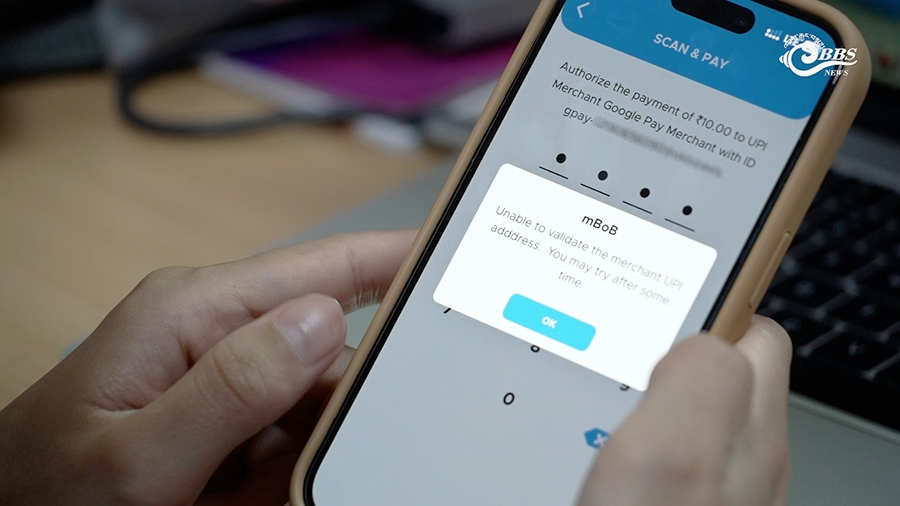
When Bhutanese users attempt to complete payments at merchants whose banking institutions remain unintegrated, the system returns an error indicating that the merchant's UPI address cannot be validated. This technical rejection effectively prevents the transaction from proceeding, leaving consumers unable to complete their purchases despite having sufficient funds and functional banking credentials.
The Second Phase Launch and Early Performance 📊
The second phase of UPI linkage commenced on September 17 following a visit by India's External Affairs Minister to Bhutan, marking a significant milestone in bilateral financial cooperation. During the initial 20-day period following launch, the integrated system successfully processed over 8,600 transactions, demonstrating genuine demand for cross-border digital payment capabilities among Bhutanese citizens and residents.
However, this transaction volume, while encouraging, represents only a fraction of the potential market given India's massive merchant ecosystem. Approximately 65 million merchants throughout India accept UPI QR payments, yet the vast majority remain unable to process transactions from Bhutanese banking applications.
Which Indian Banks Currently Support Bhutanese Payments? 🏦
The six Indian banks presently enabled for Bhutanese UPI transactions form a limited but growing network:
- State Bank of India - India's largest public sector bank (pending full integration)
- HDFC Bank - Major private sector player
- ICICI Bank - Leading private banking institution
- Axis Bank - Prominent private bank
- Kotak Mahindra Bank - Mid-sized private lender (pending integration)
- Union Bank of India - Public sector bank (pending integration)
These institutions represent approximately 20 percent of India's UPI acceptance infrastructure. The remaining 80 percent of merchants continue operating through banks and payment platforms that have yet to complete integration protocols with Bhutanese counterparts.
The Integration Pipeline: What's Coming Next? 🔄
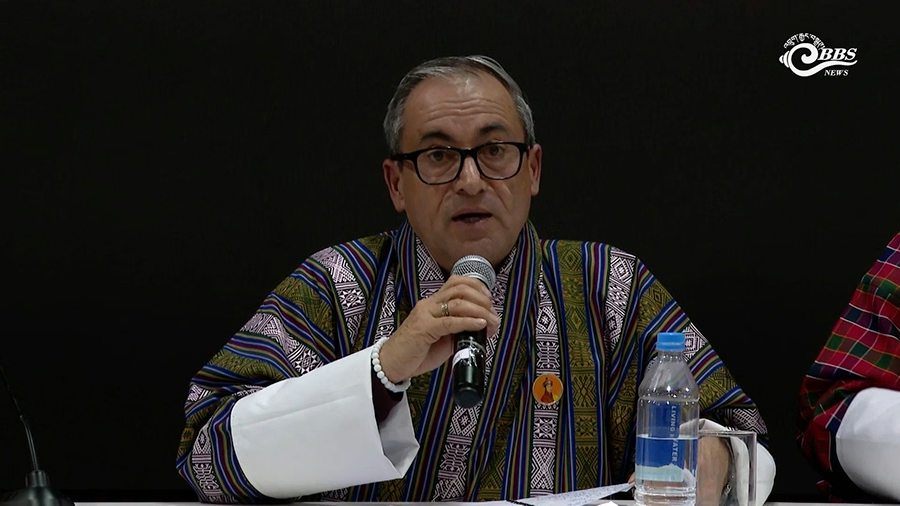
According to Bhutan's Foreign Affairs and External Trade Minister, several major financial players are currently navigating various stages of integration:
Major Banks in Integration Phase:
- State Bank of India (SBI)
- SDF FC Bank
- Kotak Mahindra Bank
- Union Bank of India
Leading Third-Party Payment Platforms:
- PhonePe
- Google Pay
- Paytm
Once these institutions and platforms complete their integration processes, acceptance coverage could expand to approximately 80 percent of India's UPI payment infrastructure. This represents a transformative shift that would fundamentally change the digital payment experience for Bhutanese travelers and remote workers operating in India.
Why Integration Takes Time: Technical and Operational Considerations ⚙️
The integration process between banking systems across national borders involves complex technical, regulatory, and operational challenges:
Technical Requirements:
- Harmonizing different payment gateway architectures
- Establishing secure encryption protocols for cross-border transactions
- Testing interoperability between disparate banking software systems
- Creating redundant systems to ensure transaction reliability
Regulatory and Compliance Factors:
- Coordinating with financial regulators in both nations
- Establishing anti-money laundering (AML) protocols
- Implementing Know Your Customer (KYC) verification standards
- Creating audit trails for regulatory compliance
Operational Considerations:
- Training merchant banking staff on new payment acceptance procedures
- Updating point-of-sale terminal software
- Establishing dispute resolution mechanisms
- Creating customer support infrastructure
Collaborative Efforts to Accelerate Integration 🤝
The Royal Monetary Authority (RMA) of Bhutan is actively collaborating with its Indian counterparts to expedite the integration timeline. This partnership focuses on three critical areas:
-
Accelerating Integration Timelines - Working directly with Indian banking institutions to prioritize Bhutanese payment system compatibility
-
Monitoring Transaction Performance - Continuously tracking successful and failed transactions to identify bottlenecks and system vulnerabilities
-
Addressing Technical Issues - Rapidly diagnosing and resolving technical and operational problems that emerge during real-world transaction processing
This coordinated approach reflects the commitment both nations have demonstrated toward strengthening financial integration as part of their broader bilateral relationship.
The Merchant Experience and Consumer Impact 💰
For Bhutanese consumers, the current situation creates unpredictability in their payment experience. A traveler cannot reliably predict whether their Bhutanese banking app will function at a particular merchant location without prior knowledge of that merchant's banking relationships.
This uncertainty discourages digital payment adoption and encourages continued reliance on cash transactions, which carry security risks and logistical challenges. The fragmented acceptance network essentially creates a two-tier merchant system: those equipped to accept Bhutanese UPI payments and those that remain unable to process them.
The Broader Context: Regional Digital Payment Evolution 🌏
The Bhutan-India UPI linkage represents part of a larger trend toward regional digital payment integration in South Asia. As countries increasingly recognize the economic and convenience benefits of seamless cross-border transactions, bilateral and multilateral payment system agreements are becoming more common.
India's UPI system, which processes over 700 million transactions monthly domestically, serves as a model for other nations seeking to modernize their payment infrastructure. The expansion of UPI acceptance beyond India's borders signals growing confidence in the system's security and reliability.
What's Next for Bhutanese Digital Travelers? 🚀
The trajectory suggests meaningful improvement in the coming months as major banks and payment platforms complete their integration processes. However, consumers should remain aware that transaction success may depend on merchant banking relationships during this transition period.
Recommendations for Bhutanese Users:
- Carry backup payment methods when traveling in India
- Test transactions at smaller amounts initially
- Keep digital records of all transactions for dispute resolution
- Report failed transactions to your Bhutanese bank for troubleshooting
- Monitor updates from the Royal Monetary Authority regarding expanded acceptance
The Path Forward: Toward 80 Percent Acceptance 📈
The achievement of 80 percent UPI acceptance coverage represents an ambitious but achievable goal. Once major banks like State Bank of India, Union Bank of India, and leading payment platforms complete integration, the Bhutanese user experience will transform dramatically.
This expanded acceptance would position Bhutanese travelers with payment capabilities comparable to domestic Indian users, fundamentally changing the dynamics of cross-border commerce and travel between the two nations. The current challenges, while frustrating, represent growing pains in an important financial integration initiative.
Conclusion: Patience and Progress 🎯
The integration of Bhutanese banking applications with Indian UPI infrastructure remains a work in progress, but the momentum is clearly positive. With six banks already operational and several major institutions actively completing integration, the landscape is rapidly evolving.
Bhutanese travelers and businesses should view the current limitations as temporary obstacles rather than permanent barriers. The collaborative efforts between the Royal Monetary Authority and Indian financial regulators demonstrate serious commitment to resolving technical and operational challenges.
As integration expands toward the target 80 percent acceptance coverage, Bhutanese users can expect increasingly seamless digital payment experiences in India. The foundation has been laid; the infrastructure is being constructed. The promise of hassle-free cross-border digital payments is not distant—it's approaching with each completed bank integration and platform upgrade.
You May Also Like
Economy
Government Addresses 400+ Business Issues to Boost Economy
October 10, 2026
Economy
Bhutan's Bold Vision: Two USD 50M Enterprises by 2030
September 27, 2026
Economy
Mega Dry Port in Pasakha: Bhutan's Trade Revolution
September 25, 2026

Economy
Fixed Deposit Tax Withholding: What You Need to Know
September 13, 2026