Category:
NewsGerman-Bhutan Society Backs Gelephu Mindfulness City
A Landmark Partnership Promoting Bhutan's Vision Globally 🌍
For four decades, a dedicated community of Europeans has maintained an unwavering commitment to Bhutan, fostering cultural exchange and supporting development initiatives across the Himalayan kingdom. Now, this long-standing relationship is entering an exciting new chapter as the German-Bhutan Himalaya Society (DBHG) positions itself as a key advocate for one of Bhutan's most ambitious contemporary projects: Gelephu Mindfulness City.
The organization's recent decision to dedicate its 2027 annual conference to promoting this transformative initiative signals a significant evolution in how international partnerships can amplify Bhutan's innovative approach to sustainable development. This convergence of decades-long friendship and cutting-edge urban planning represents a compelling model for how nations can collaborate on projects that transcend traditional economic frameworks.
Understanding Gelephu Mindfulness City 🏙️
Gelephu Mindfulness City (GMC) represents a visionary reimagining of what modern development can achieve when guided by principles of sustainability, innovation, and cultural integrity. Envisioned by His Majesty The King as a Special Administrative Region, this ambitious project aims to create a thriving hub that balances economic growth with mindfulness and social responsibility.
The city's conceptual framework extends far beyond conventional urban development models. Rather than prioritizing rapid expansion and profit maximization, GMC is designed to attract international investment and talent while remaining deeply rooted in Bhutanese values and the nation's commitment to Gross National Happiness. This philosophical approach challenges Western assumptions about what successful cities must prioritize.
The project's 40-year diamond strategy deserves particular attention from development professionals worldwide. This extended timeline reflects a sophisticated understanding that meaningful transformation requires patience, strategic planning, and resistance to short-term pressures. In an era where quarterly earnings reports dominate corporate decision-making, Bhutan's willingness to commit to four decades of deliberate development offers a refreshing counterpoint.
The German-Bhutan Himalaya Society's Four-Decade Journey 🤝
Established in 1986 by a small group of Germans captivated by Bhutan's unique culture, natural splendor, and people-centered values, DBHG has evolved into a meaningful bridge between two nations separated by geography but united by shared principles. With approximately 160 members today, the society represents far more than a casual interest group—it embodies a sustained commitment to cross-cultural understanding and collaborative development.
The organization's evolution reflects broader global trends toward people-to-people diplomacy. Rather than relying solely on government-to-government relations, DBHG demonstrates how civil society organizations can create lasting connections that transcend political cycles and economic fluctuations. This grassroots approach has proven remarkably effective in building genuine understanding between cultures.
Under the foundational leadership of Professor Manfred Gerner, the society initially concentrated on preserving Bhutan's irreplaceable cultural heritage. Members organized regular delegation visits, combining tourism with active participation in restoration projects. This hands-on engagement model transformed passive observation into meaningful contribution, allowing visitors to develop deep connections with Bhutanese communities.
Expanding Scope and Impact 📈
Over the years, DBHG's priorities have deliberately expanded to encompass education, vulnerable population support, academic research, and scientific collaboration. This diversification reflects a maturing understanding of how international partnerships can address complex development challenges holistically.
The society's financial contributions, while modest by international standards, have generated disproportionate impact. Funding has supported:
- Cultural preservation initiatives at the Choki Traditional Art School, safeguarding Bhutanese artistic traditions for future generations
- Infrastructure improvements including water filtration systems for rural schools, addressing fundamental health and sanitation challenges
- Sacred monument restoration across Bhutan, preserving spiritual and historical landmarks
- Community development projects implemented through partnerships with Swiss and Austrian Bhutan friendship societies
- Direct student support for Bhutanese scholars studying in Germany, removing financial barriers to educational advancement
These contributions exemplify how smaller organizations can maximize impact through strategic focus and collaborative partnerships.
The 2027 Conference and Global Advocacy 🎯
DBHG's commitment to dedicate its 2027 annual conference to Gelephu Mindfulness City represents a strategic inflection point in how international civil society can amplify innovative development projects. This decision reflects DBHG leadership's conviction that GMC offers valuable lessons for global audiences grappling with urbanization, sustainability, and quality-of-life challenges.
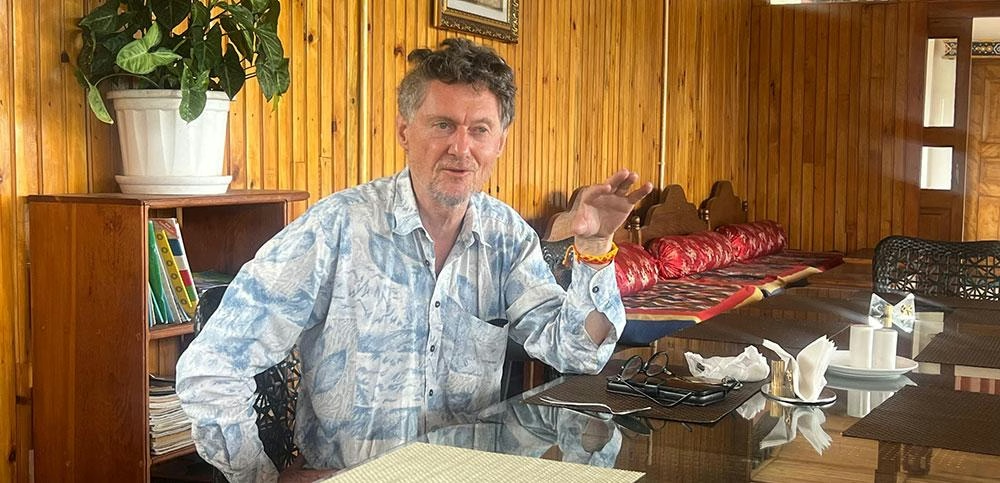
Reinhard Wolf, the society's current president, articulated this perspective clearly during a recent delegation visit to Bhutan. He emphasized that DBHG admires "the courage Bhutan is demonstrating" in pursuing such an unconventional development approach. This language reveals something important: international recognition of GMC isn't driven by skepticism or condescension, but by genuine appreciation for innovative thinking.
The society has already initiated promotional activities, hosting a well-attended webinar on GMC that generated significant interest among German audiences. The 2027 conference will substantially expand these efforts, targeting both the general German public and the country's substantial business community. This two-pronged approach recognizes that sustainable projects require both popular understanding and corporate engagement.
German Expertise and Sectoral Contributions 🔧
Wolf identified multiple sectors where German expertise and partnerships could meaningfully contribute to GMC's development trajectory:
- Education and skills development – Germany's renowned vocational training systems and higher education institutions offer transferable models
- Sustainability practices – German environmental technology and circular economy expertise could inform GMC's ecological framework
- Cultural preservation – European experience in managing cultural heritage within modern urban contexts provides relevant insights
- Healthcare innovation – German medical technology and public health approaches could enhance GMC's wellness-focused infrastructure
- Advanced technology integration – German expertise in digital systems, smart city technologies, and industrial innovation aligns with GMC's development vision
- Tourism management – Experience in sustainable tourism could help GMC balance visitor engagement with community protection
These identified areas demonstrate how international partnerships operate most effectively when they build on genuine complementarity rather than imposing external models.
The Spiritual Dimension: 108 Jangchub Choetens 🙏
A particularly significant milestone in GMC's development occurred on November 1, when Bhutan organized the simultaneous raising of 108 Jangchub Choetens—a spiritually resonant number in Buddhist tradition. This event coincided with the descending day of Lord Buddha and His Majesty The King's Coronation Anniversary, creating a convergence of spiritual and national significance.
The enthusiastic public response—with over 120,000 registered participants—revealed something crucial about GMC's reception within Bhutan itself. This wasn't a top-down government initiative met with indifference, but rather a project that captured popular imagination and inspired active participation. The scale of engagement suggests that Bhutanese citizens view GMC as genuinely aligned with national values and aspirations.
This spiritual foundation distinguishes GMC from conventional development projects. By anchoring urban development in Buddhist principles and cultural practices, the project acknowledges that meaningful communities require more than economic functionality—they require spiritual and cultural coherence.
Bhutan's Development Model in Global Context 🌏
Bhutan's approach to development has increasingly attracted international attention from scholars, policymakers, and thought leaders questioning conventional growth models. The nation's commitment to Gross National Happiness (GNH) rather than Gross Domestic Product (GDP) as a primary development metric represents a fundamental philosophical reorientation.
Gelephu Mindfulness City exemplifies this alternative development paradigm in practice. Rather than maximizing economic output regardless of social costs, GMC seeks to optimize human flourishing, environmental sustainability, and cultural preservation alongside economic development. This integrated approach addresses a growing recognition that traditional GDP-focused metrics inadequately capture what actually contributes to human wellbeing.
The international business community is increasingly acknowledging these insights. German corporations, in particular, have demonstrated growing interest in sustainability-focused development models that integrate environmental and social considerations into profit calculations. This convergence creates genuine opportunity for meaningful collaboration.
Building Bridges Through Civil Society 🌉
DBHG's role as a mediator and networker between Bhutan and Germany exemplifies how civil society organizations can complement formal diplomatic relationships. The society maintains connections across diverse sectors of Bhutanese society—government institutions, civil society organizations, businesses, and individual communities—creating a multifaceted network that facilitates understanding and cooperation.
The organization's engagement with the Royal Bhutanese Embassy in Brussels demonstrates how grassroots organizations can effectively coordinate with official diplomatic channels. These relationships, maintained on partnership rather than hierarchical bases, enable DBHG to support initiatives that serve both nations' interests.
The society's support for Bhutanese students in Germany addresses a practical challenge often overlooked in international relations discussions. By providing financial and social support to students navigating significant living expense challenges, DBHG invests in human capital and builds personal relationships that will shape bilateral relations for decades to come.
Looking Forward: Sustained Engagement and Expansion 🚀
As DBHG enters its fifth decade of engagement with Bhutan, the organization demonstrates no signs of diminishing commitment. Instead, the society is strategically expanding its advocacy role, positioning itself as a key voice promoting Bhutanese development initiatives to international audiences.
The 2027 conference represents more than a single event—it signals DBHG's intention to sustain and deepen engagement with Bhutan across multiple dimensions. Through its annual magazine, Thuenlam, and regular conferences, the society continues working to deepen German public understanding of Bhutan and strengthen bilateral ties.
This sustained engagement matters particularly for projects like Gelephu Mindfulness City, which require patient capital, long-term partnerships, and genuine cultural understanding. International support grounded in authentic relationship—rather than extractive investment seeking quick returns—creates conditions where innovative development can genuinely flourish.
Key Takeaways: A Model for International Cooperation 💡
The German-Bhutan Himalaya Society's commitment to promoting Gelephu Mindfulness City illustrates several important principles for international development cooperation:
Sustained engagement produces deeper understanding. Four decades of continuous relationship-building has created genuine comprehension of Bhutanese values and aspirations, enabling DBHG to authentically advocate for projects aligned with these principles.
Civil society complements formal diplomacy. Grassroots organizations like DBHG can accomplish relationship-building and advocacy work that government institutions alone cannot achieve, creating multifaceted connections across societies.
Alternative development models deserve serious consideration. GMC's integration of mindfulness, sustainability, and cultural preservation into urban development challenges conventional assumptions and offers valuable lessons for global audiences.
Long-term vision enables meaningful innovation. GMC's 40-year diamond strategy demonstrates that transformative development requires resistance to short-term pressures and commitment to sustained, deliberate planning.
As Bhutan continues developing Gelephu Mindfulness City and DBHG prepares to introduce this ambitious project to German audiences, an important international partnership enters a new and potentially transformative phase. This collaboration exemplifies how genuine cross-cultural understanding, sustained commitment, and shared values can create conditions where innovative approaches to development can genuinely flourish on the global stage.
You May Also Like
News
Gelephu Prepares for 40,300 Vehicles Ahead of Project 108
October 21, 2026
News
Third Child Plus Programme Disburses Nu 186M to 6,510 Children
October 21, 2026
News
Himalayan Yak Network Launches at Royal Highland Festival
October 21, 2026
News
Bhutan's Legislative Vision Faces Resource Constraints
October 19, 2026