Category:
PoliticsPDP Clarifies Speaker Change Decision: Not About Performance
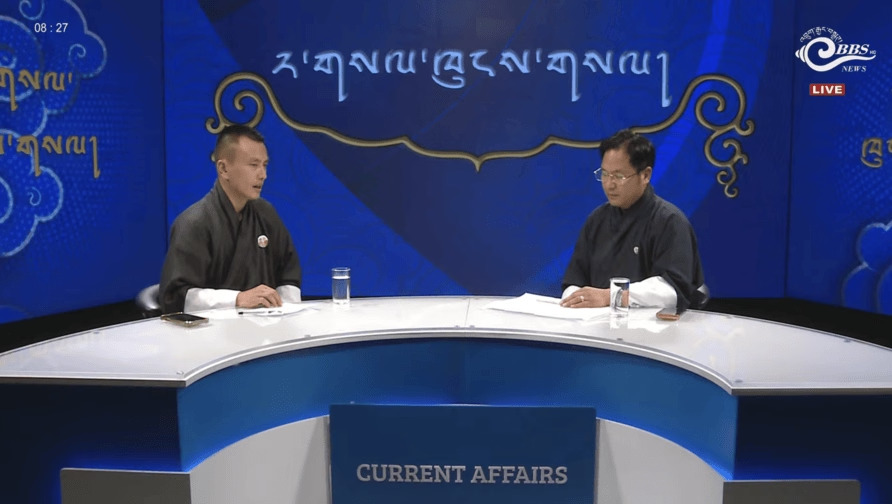
Understanding the Political Shift in Bhutan's Parliament 🏛️
Bhutan's political landscape witnessed a significant moment when the People's Democratic Party (PDP) made the strategic decision to nominate a new candidate for the Speaker position. However, the party has been emphatic in clarifying that this transition was not a reflection of poor performance by the outgoing leadership. Instead, it represented a calculated organizational choice aimed at strengthening parliamentary operations and enhancing the executive-legislative relationship.
The Speaker's role in any democratic institution carries immense responsibility. In Bhutan's National Assembly, this position demands exceptional communication skills, diplomatic acumen, and the ability to bridge diverse political perspectives. Understanding the nuances behind leadership transitions helps citizens appreciate the complexity of parliamentary governance.
The Real Reasons Behind the Leadership Transition 💼
When former Speaker Lungten Dorji stepped down from his position, many observers speculated about potential performance issues or internal conflicts. The PDP moved quickly to address these misconceptions, emphasizing that the resignation was entirely voluntary and strategic rather than forced or performance-based.
According to party leadership, the decision emerged from detailed discussions between the outgoing Speaker and the Prime Minister. These conversations revealed an organizational need rather than an institutional failure. The party's secretary general clarified that the former Speaker had performed his duties admirably throughout his tenure, maintaining the dignity and neutrality expected of the position.
What Changed in the Party's Thinking? 🤔
The PDP identified a specific gap in its parliamentary support structure. The party leadership recognized that the Prime Minister required enhanced collaboration and stronger communication channels within the legislative body. This wasn't about replacing someone who had failed—it was about positioning someone who could provide elevated levels of coordination and advocacy.
This distinction matters significantly in political analysis. Leadership transitions in democratic systems often stem from strategic repositioning rather than performance failures. Bhutan's political maturity is evident in how such transitions are managed transparently and explained to the public.
The Selection Process: Transparency and Deliberation 📋
Following Lungten Dorji's resignation, the PDP embarked on a methodical candidate selection process. Rather than rushing to fill the vacancy, the party conducted multiple rounds of internal discussions, demonstrating commitment to finding the most suitable candidate.
The party invited interested members to express their willingness to contest for the position. This inclusive approach ensured that capable individuals had the opportunity to step forward. Notably, the Deputy Speaker was also approached but chose not to pursue the nomination, respecting the party's deliberative process.
Why Health Minister Tandin Wangchuk? 🏥
The party eventually settled on Health Minister Tandin Wangchuk as its candidate for Speaker. This choice received unanimous backing from all 31 PDP members, indicating strong internal consensus. Several factors influenced this decision:
- Experience and Track Record: Tandin Wangchuk's ministerial experience provided demonstrated competence in managing complex institutional responsibilities
- Communication Excellence: The party emphasized his exceptional ability to articulate positions clearly and engage effectively with diverse stakeholders
- Second-Term Perspective: Serving his second term as minister, he possessed institutional knowledge and political maturity
- Collaborative Approach: His background suggested capability for the supportive role the Prime Minister required
The party secretary general, Kuenga Tashi, articulated the reasoning clearly: the organization needed someone who could speak effectively, communicate party positions persuasively, and work in closer alignment with executive leadership. These qualities, rather than any deficiency in the previous Speaker, drove the selection.
The Parliamentary Election and Its Outcome 🗳️
Despite the PDP's internal consensus and strategic nomination, the parliamentary election for Speaker took an unexpected turn. Opposition candidate Tempa Dorji secured the position, defeating the ruling party's nominee. This outcome reflected the complex dynamics of Bhutan's current National Assembly composition.
The loss represented a significant political moment. In parliamentary democracies, such defeats can indicate shifting power dynamics or coalition challenges. For the PDP, it underscored the importance of building broader consensus across party lines on institutional positions.
Accepting Democratic Outcomes with Grace 🤝
The PDP's response to the electoral loss demonstrated political maturity and commitment to democratic principles. Party leadership acknowledged the disappointment while reaffirming their respect for parliamentary processes. The party's secretary general noted that such electoral competitions are inherent to democratic governance.
Crucially, the PDP emphasized an important constitutional principle: the Speaker's position is fundamentally neutral and non-partisan. This individual, regardless of political affiliation, serves the entire National Assembly rather than representing any single party's interests. The Speaker's responsibility encompasses presiding over parliamentary sessions fairly and maintaining institutional integrity.
Maintaining Party Unity and Confidence 💪
Despite the electoral setback, the PDP has reaffirmed its internal cohesion and confidence in party leadership. Political organizations face numerous challenges beyond electoral victories, and maintaining organizational unity requires consistent communication and shared vision.
The party's commitment to continue functioning effectively, regardless of the Speaker outcome, reflects institutional resilience. In Bhutan's young democracy, such stability contributes to broader political maturation and public confidence in governance structures.
Broader Implications for Parliamentary Governance ✨
This episode illustrates several important aspects of Bhutan's political development:
Institutional Transparency: The PDP's willingness to publicly explain its decision-making process demonstrates commitment to democratic accountability. Citizens benefit from understanding the reasoning behind significant political moves rather than being left to speculation.
Separation of Powers: The election outcome reinforces the principle that parliamentary positions should reflect the broader legislative body's preferences rather than executive preferences. This separation strengthens democratic governance.
Coalition Dynamics: The result suggests that Bhutan's current political composition requires building consensus across party lines for institutional positions. This reality shapes how ruling and opposition parties must engage.
Democratic Maturity: Both the ruling party's strategic approach and their gracious acceptance of electoral defeat demonstrate that Bhutan's political culture continues evolving toward democratic norms.
Looking Forward: What This Means for Bhutan 🌟
The Speaker transition, while ultimately resulting in an opposition member assuming the role, has clarified several important governance principles. The PDP's clarification that the change wasn't performance-based protects the reputation of outgoing leadership while demonstrating the party's strategic thinking.
For Bhutan's political system, such transitions offer opportunities to strengthen institutional practices. The new Speaker, regardless of party affiliation, inherits a position that demands neutrality, fairness, and commitment to parliamentary excellence. The National Assembly's ability to function effectively depends on this institutional independence.
As Bhutan continues developing its democratic institutions, moments like these provide valuable lessons about leadership transitions, strategic decision-making, and the importance of maintaining public confidence in governance structures. The nation's political maturity will be measured not just by electoral outcomes, but by how gracefully all parties navigate such transitions while maintaining institutional integrity and public trust.
The parliamentary process continues, and both ruling and opposition parties have demonstrated their commitment to working within democratic frameworks. This foundation, built through transparent communication and respect for institutional norms, strengthens Bhutan's democracy for the long term.
You May Also Like
Politics
Bhutan and EU Parliamentarians Unite on Climate Action
September 26, 2026
Politics
Bhutan Launches Four Voter Participation Initiatives for LG Elections
September 16, 2026
Politics
Women in Politics: Breaking Through Barriers Before Election Day
September 15, 2026
Politics
Women Leaders Training: Preparing for 2027 Local Elections
August 31, 2026