Category:
EconomyLocal Fruit Farmers Battle Market Access Crisis
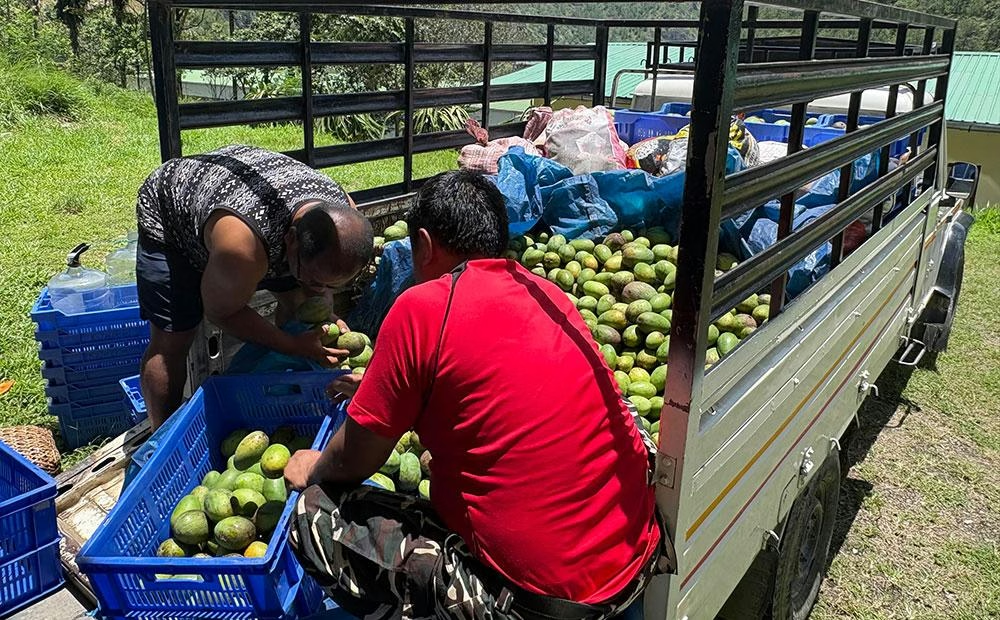
The Growing Harvest, Shrinking Profits Paradox 📊
Bhutan's agricultural sector is experiencing a curious contradiction. Production figures for locally grown fruits have surged dramatically over the past three years, yet farmers across remote regions continue to struggle financially. This disconnect between increased output and reduced income reveals a deeper structural problem within the nation's agricultural distribution network.
The numbers tell a compelling story. Mango production climbed from 4.3 metric tonnes in 2023 to 6.48 metric tonnes in 2025—a 50% increase in just two years. Mandarin output similarly jumped from 4.05 metric tonnes to 6.76 metric tonnes during the same period. Most striking, peach production nearly tripled, rising from 2.6 metric tonnes to 7.32 metric tonnes. Yet despite these encouraging production trends, many fruit growers report earning barely enough to sustain their livelihoods.
Geographic Isolation: The Hidden Cost of Rural Farming 🌄
Thanagrong Gewog, situated 75 kilometers from Mongar town, exemplifies the challenges facing fruit producers in Bhutan's remote agricultural communities. This distance, while not extreme by global standards, creates a logistical nightmare when combined with Bhutan's mountainous terrain and limited transportation infrastructure.
Farmers in this region face a trinity of interconnected obstacles: the absence of local markets, prohibitively expensive transportation, and degraded soil conditions that limit productive capacity. These challenges don't operate in isolation—they compound each other, creating a cycle that discourages agricultural investment.
Tshewang, a 51-year-old cultivator from Changshing Goenpa Chiwog, represents thousands of Bhutanese farmers caught in this predicament. Managing roughly one acre of diverse fruit crops including mandarins, apples, avocados, and grapes, Tshewang must travel to Mongar town, Chaskhar, and Yadi to find buyers. The annual transportation costs consume so much of his revenue that his net earnings barely reach Nu 20,000—approximately $250 USD annually for a year's worth of agricultural labor.
The Transportation Bottleneck 🚛
Transportation expenses represent the most immediate threat to profitability for locally grown fruits in remote areas. Vehicle rental costs of Nu 100 per kilogram fundamentally undermine the economic viability of fruit farming for smallholders.
Sonam Choden, a 32-year-old farmer from Atola Chiwog, cultivates mangoes, mandarins, and avocados on a 40-decimal plot. After accounting for vehicle hire and associated expenses, her annual income drops to approximately Nu 10,000—barely sufficient to justify the physical labor involved. During harvest seasons, finding available vehicles compounds the challenge, as demand from multiple farmers simultaneously exceeds supply.
In Bauchhoeling Panglen Chiwog, the situation becomes even more dire. Kezang Wangmo, a 42-year-old peach, pear, and kiwi producer, faces transportation costs of Nu 2,000 for a round trip to Mongar town. These expenses consume virtually all profit margins, forcing her to retain most harvests for household consumption or share them with family and neighbors rather than attempt market sales.
This transportation crisis isn't merely an inconvenience—it fundamentally prevents market participation for many rural producers. When transportation costs exceed potential revenue, rational economic actors withdraw from commercial agriculture entirely.
Soil Degradation and Agricultural Productivity 🌱
Beyond market access issues, Thangrong Gewog's fruit farmers contend with significant soil fertility challenges. Local farmland contains abundant small stones and pebbles that farmers believe contribute to poor soil quality. The region's sloping terrain exacerbates this problem through soil leaching, where essential nutrients wash away during rainfall.
These soil conditions directly limit production capacity, creating a secondary constraint on farmer income. Even with improved market access, degraded soil would restrict yield potential. Farmers have consistently advocated for comprehensive soil testing across the gewog to identify specific nutrient deficiencies and develop targeted remediation strategies.
The gewog's Agriculture Extension Office acknowledges these challenges and has initiated land development activities designed to improve soil fertility over time. However, these efforts require sustained investment and coordination. The pace of improvement remains slower than farmer expectations, particularly for producers facing immediate economic pressures.
Market Structure and Information Gaps 💼
The fundamental issue underlying these challenges stems from inadequate market infrastructure. Thangrong Gewog lacks established internal markets where producers can reliably sell their harvests. This absence forces farmers to either transport produce to distant towns or wait for occasional traders to visit their villages.
When traders do visit, they operate from positions of significant advantage. Farmers, lacking alternatives, must accept whatever prices traders offer. This information asymmetry and limited buyer competition systematically depress farm-gate prices, transferring value away from producers toward middlemen and traders.
Thangrong Gup Changa, the gewog administrator, explicitly identified limited market access and high transportation costs as primary impediments to agricultural expansion. Without guaranteed markets, farmers rationally avoid investing in increased production capacity, improved varieties, or enhanced cultivation techniques. Why expand output when existing production already struggles to find buyers?
The Broader Agricultural Policy Context 🏛️
These local struggles reflect broader structural issues within Bhutan's agricultural economy. The nation has invested substantially in increasing production capacity through improved seed varieties, extension services, and farming techniques. Yet the distribution and marketing infrastructure has not kept pace with production growth.
This supply-side focus, while important, creates bottlenecks when demand-side and logistics infrastructure remain underdeveloped. Farmers produce more fruit, but the system for getting that fruit to consumers efficiently hasn't evolved accordingly. The result: surplus production that doesn't reach markets, farmer frustration, and potential future underinvestment in agriculture.
Potential Solutions and Future Directions 🔮
Addressing this crisis requires multifaceted interventions operating simultaneously across several domains:
Market Development: Establishing cooperative marketing structures, farmer aggregation centers, or government-supported wholesale markets within or near remote gewogs could reduce individual transportation burdens and improve bargaining power.
Transportation Solutions: Subsidized or cooperative vehicle arrangements for harvest transport could dramatically reduce per-unit costs. Alternatively, cold chain infrastructure development would allow farmers to store produce longer, reducing time pressure and transportation urgency.
Soil Improvement Programs: Implementing comprehensive soil testing and targeted remediation programs would enhance long-term productivity, partially offsetting transportation cost disadvantages through higher yields.
Value Addition: Processing facilities for fruit preservation, juice production, or jam manufacturing could increase product shelf-life and value, justifying transportation costs through higher margins.
Digital Market Linkages: Modern supply chain technologies connecting producers directly with retailers or consumers could eliminate middlemen and improve price discovery.
Conclusion: Bridging Production and Prosperity 🌟
Bhutan's fruit farmers have successfully increased production, demonstrating agricultural capability and commitment to commercial farming. Yet this success remains hollow without corresponding improvements in market access and transportation infrastructure. The paradox of growing harvests and shrinking incomes cannot persist indefinitely—it will eventually discourage investment in agriculture precisely when the nation needs sustained rural development.
Resolving this challenge requires recognizing that production increases alone are insufficient. Farmers need equally robust investments in distribution, marketing, and logistics infrastructure. Only through integrated approaches addressing supply, demand, and logistics simultaneously can Bhutan's fruit farmers transform increased production into genuine prosperity. The window for action remains open, but closing these gaps demands urgent policy attention and coordinated implementation.
You May Also Like
Economy
Building a Thriving Business Ecosystem: Beyond Survival
October 21, 2026
Economy
Proving Commercial Viability: The Key to Attracting Investors
October 19, 2026
Economy
Seven Women-Led Businesses Transform Bhutan's Economy
October 19, 2026
Economy
Pork Market Crisis: Piggery Farmers Face Mounting Pressure
October 19, 2026