Category:
SportsGary Phillips: Building Bhutan's Football Future
A Fresh Vision for Bhutanese Football ⚽
Bhutanese football stands at a pivotal moment. With the appointment of Australian coach Gary Phillips as the head coach of Bhutan's U-20 national team, the nation's football federation has signaled a clear commitment to long-term development and structural improvement. This strategic decision reflects a broader vision to establish sustainable foundations for the sport across the Himalayan kingdom.
Phillips' appointment arrives during a transformative period for Bhutanese athletics, coinciding with increased international participation and a growing emphasis on youth development programs. His mandate extends far beyond immediate competitive success—it encompasses building a comprehensive system that will elevate the nation's standing in Asian football while nurturing homegrown talent.
Understanding the Opportunity 🌟
The Australian coach brings considerable experience in developing young players at the international level. When asked about his motivation for accepting the position, Phillips emphasized that the opportunity transcended typical coaching assignments. "What attracted me most was the chance to work at the highest level, but really a chance to grow as a nation," he explained during his initial engagement with the program.
This perspective reveals a crucial distinction between coaches who view their roles as temporary positions and those who see themselves as architects of systemic change. Phillips clearly falls into the latter category. His focus on nation-building rather than quick fixes aligns with how successful football programs in smaller nations have approached their development strategies.
Early Impressions and Player Potential 💪
During his initial weeks with the squad, Phillips observed encouraging signs among the young Dragon Boys. The players demonstrated genuine enthusiasm and a strong willingness to absorb coaching instruction—qualities that cannot be taught but form the cornerstone of effective player development.
"There is a great deal of enthusiasm and excitement," Phillips noted. "Enthusiasm goes a long way on the field." This observation, while seemingly straightforward, carries significant weight. In youth development programs, psychological factors often determine whether talented individuals translate their abilities into consistent performance.
However, Phillips maintained realistic expectations about the team's current capabilities. Having spent approximately one week with the squad at that point, he deliberately avoided premature judgments. This measured approach demonstrates sophisticated coaching maturity—recognizing that meaningful assessment requires extended observation and interaction.
Technical Development Areas 🎯
Phillips identified specific technical dimensions requiring attention. The team needed to develop greater patience and constructive decision-making while maintaining possession. These refinements represent foundational skills that distinguish developing teams from established football nations.
The coach emphasized that improving these technical aspects requires systematic instruction, repetition, and environmental reinforcement. Players must understand not just what to do, but why particular approaches prove more effective under various match conditions.
Building a Bhutanese Football Identity
A particularly insightful aspect of Phillips' philosophy involves allowing Bhutanese football to develop its own identity rather than imposing an external template. "This is not about me," he stated emphatically. "This is about Bhutan expressing how they want to express themselves, how they want the world to see them."
This philosophy reflects contemporary understanding about sustainable sporting development. Successful national programs typically blend international best practices with local characteristics, player strengths, and cultural values. Countries like Iceland, Portugal, and Croatia have demonstrated that smaller nations can achieve remarkable international success by developing distinctive playing styles aligned with their player pool's inherent qualities.
Phillips described the Bhutanese players as naturally expressive athletes. The challenge involves channeling this expressiveness through improved discipline and structural organization. Greater tactical coherence and positional understanding would allow individual creativity to flourish within a cohesive team framework.
Organizational Excellence as Foundation 📋
Phillips emphasized that organizational clarity forms the bedrock of effective football development. Players require comprehensive understanding of their specific responsibilities both when their team possesses the ball and during defensive phases. This encompasses:
- Positional awareness: Understanding optimal positioning relative to teammates and opponents
- Tactical synchronization: Coordinated movement patterns that create numerical advantages in key areas
- Role comprehension: Clear definition of individual responsibilities within the team's overall system
- Mechanical precision: Consistent execution of fundamental techniques under match pressure
These organizational elements might seem elementary, yet they distinguish professional programs from amateur arrangements. Many developing football nations overlook these foundational components, prioritizing flashy attacking play while neglecting structural coherence.
Learning from Global Examples 🌍
Phillips drew inspiration from smaller European nations that have achieved disproportionate international success. Countries including Iceland, Wales, and Serbia have proven that limited population size and resources need not constrain competitive achievement. These nations compensated for numerical disadvantages through systematic player development, tactical sophistication, and organizational excellence.
"We are a small nation, but we have seen small European nations do very well on the world stage," Phillips observed. "We are really very young in world football terms. However, the game is growing fast."
This perspective acknowledges Bhutan's relative inexperience in organized international football while recognizing the sport's accelerating development trajectory across Asia. The window of opportunity for establishing competitive foundations remains open, but requires immediate, sustained effort.
The AFC Group Stage Challenge 🏆
Bhutan's participation in the AFC group stage represents a significant milestone. These competitions provide invaluable exposure to higher-level opponents, enabling meaningful assessment of player development and identifying specific improvement areas. International matches offer learning opportunities that domestic competition cannot replicate.
Phillips' preparation strategy for these competitions involves establishing fundamental principles that extend beyond the immediate tournament context. Success in the AFC group stage matters less than the systematic development occurring throughout the preparation process.
Strategic Priorities Moving Forward ✨
Phillips outlined clear priorities for his tenure:
- Foundation establishment: Creating sustainable systems for youth player development
- Technical improvement: Enhancing possession-based football and tactical understanding
- Organizational development: Implementing clear structural frameworks
- Player confidence: Building psychological resilience and match-day composure
- National expression: Developing a distinctive Bhutanese football philosophy
These priorities reflect a comprehensive approach extending beyond immediate competitive results. Phillips understands that transforming national football programs requires patience, consistency, and unwavering commitment to long-term objectives.
Translating Enthusiasm into Consistency 🔥
The most significant challenge ahead involves converting the players' evident enthusiasm into consistent, high-level performances. Enthusiasm provides the psychological foundation, but sustained excellence demands technical proficiency, tactical discipline, and match-day composure.
Phillips must implement training methodologies that reinforce desired behaviors under increasingly demanding conditions. This progression from controlled practice environments to competitive match situations represents a critical coaching responsibility.
Conclusion: Building Tomorrow's Champions
Gary Phillips' appointment signals Bhutanese football's commitment to systematic development and sustainable growth. Rather than pursuing short-term competitive gains, the federation has invested in comprehensive program transformation. Phillips brings the expertise, perspective, and philosophical approach necessary for this ambitious undertaking.
The coming months and years will reveal whether Bhutan can translate its natural enthusiasm and growing infrastructure into competitive international success. Under Phillips' guidance, the foundation for sustained progress is being carefully constructed. The Dragon Boys' football future appears brighter than ever, with a coach who genuinely understands that true success emerges from patient, systematic development rather than overnight transformation. 🇧🇹
You May Also Like
Sports
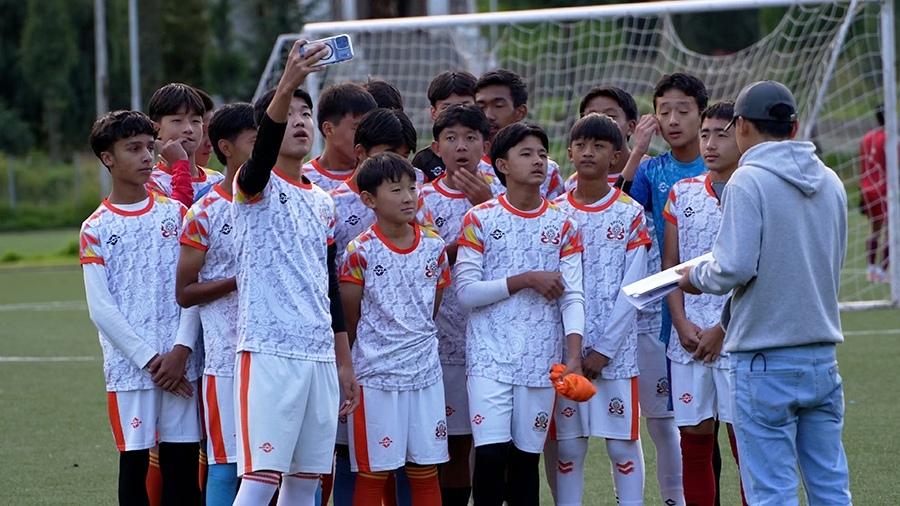
Bhutan U-15 Team Pursues International Exposure at FIFA Festival
October 7, 2026
Sports
Cricket Coaching Programme Expands to Monastic Institutions
October 6, 2026
Sports
Trashigang Archery Tournament Funds Community Growth
October 4, 2026
Sports
BPL Final Stretch: Title Race & Relegation Drama
September 30, 2026